He founded Westerly Marine Construction and launched a thousand dreams
Issue 96 : May/Jun 2014
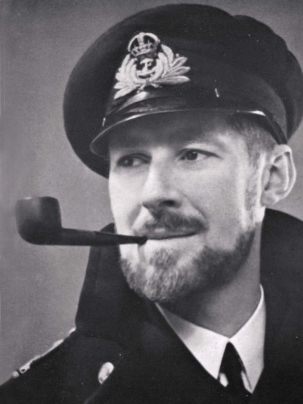
Denys Rayner was born in the outskirts of London, England, in 1908. As a boy, he was smitten with boats, often drawing navy destroyers in the margins of his schoolbooks. In 1925, he joined the Royal Naval Volunteer Reserve (because he had flat feet, he could not join the regular Royal Navy). He took training in navigation, which turned out to be a great choice. When World War II commenced in 1939, he was given command of a unit of five armed trawlers. As the war progressed, so did his commands: corvettes, destroyers, and eventually a group of escorts — all on anti-submarine and anti-mine missions around the world. A decorated officer, Denys retired from the RNVR in 1949 after 24 years of service.
Upon retirement, he took up farming in the “home counties” outside London, as well as writing and, eventually, boatbuilding. His first novel, The Enemy Below, published in 1957, recounts his wartime experiences. A movie of the same name starring Robert Mitchum and Curt Jürgens was adapted from the book. Several other books followed, including The Great Yacht Race in 1966, about a transatlantic race in 1866. Denys authored other books on sailing, motorboating, and safety at sea.
His journey into boatbuilding began with several small boats he owned, sailed, and maintained in Scottish waters. His father had been involved in sailboat racing, but Denys developed a passion for small-boat cruising. In 1937, he designed, and had constructed, a 4 1⁄2-ton, 22-foot 5-inch clinker-built auxiliary gaff cutter he called Robinetta.
His goal with Robinetta was to build a boat that was sufficiently comfortable to please his wife. It had features later found on many Westerly boats: the cabin trunk extended outboard to merge with the topsides at the
sheer and it had 6 feet of standing headroom. Denys hauled Robinetta when he began his wartime service and sold her in 1946. This stout boat is still sailing today.
Drawn back to small boats
While engaged in farming during the 1950s, Denys was asked to build plywood dinghies to accompany plywood camping trailers that were being produced nearby. Once back in the boating scene, he began building small sailboats as well, and formed Beacon Boat Company to sell his boats. He soon returned to his small-boat cruising roots and designed a 20-foot plywood pocket cruiser, the Westcoaster 20, of which approximately 60 were built.
In 1961, Denys designed the one-off plywood, 5-ton Corvette. Although this was a satisfying boat for the owner — who named it Danica — its compound-curve shape was expensive to build, and Denys turned his attention to the new medium of fiberglass. After experimenting with some small fiberglass boats, he and his partners decided a brand-new temperature-controlled boatbuilding facility was the only way to go.
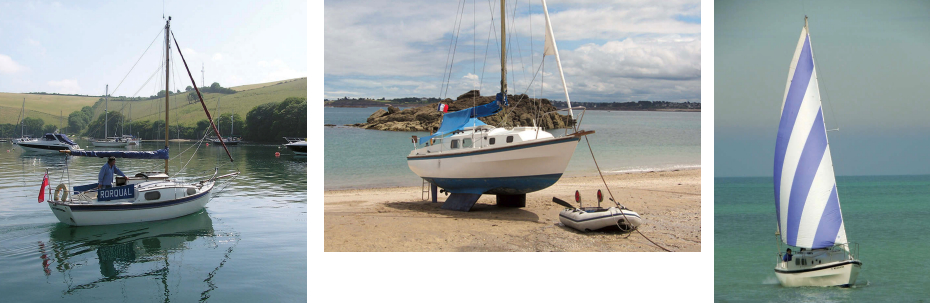
In 1963, his Westerly Marine Construction Company Ltd. began building comfortable trailerable 22- and 25-foot cruising boats near the Solent, a popular sailing area on England’s south coast. These boats would also have shallow-draft twin or “bilge” keels that gave them the ability to dry out upright at low tide and still be very seaworthy. His friend Simon Baddeley said the “aerofoil molded bilge ballast keels” are “far more sophisticated than twin fin keels.” (See “Westerly Centaur” in the July 2013 issue.) Their market niche was the customer who cared about comfort as much as about sailing ability. From the beginning, Denys sought not only to obtain Lloyd’s certification but to exceed the standard. He had some qualms about the as-yet-unproven properties of fiberglass and was not sure the Lloyd’s criteria were sufficient to ensure a sturdily built boat. Because of this attitude, many Westerly boats are still sailing.
Success story
Soon, Westerly had orders. In fact, customer demand far exceeded production capacity, and the company expanded its facilities and staff rapidly to meet it. During the 1970s, Westerly was Great Britain’s largest and most popular producer of yachts. The Westerly 30 was the last to be designed by Denys Rayner. His life was cut short by cancer in 1967. He did, however, live long enough to see two small Westerlys, a 22- and a 25-footer, cross the Atlantic with relatively inexperienced crew, fulfilling his dream and passion of introducing others to small-boat cruising.
Indeed, Denys authored several instructional guidebooks for such adventures: Safety in Small Craft, published in 1961, and Small Boat Sailing, in 1962. In Safety in Small Craft, Denys wrote, “In any reasonable weather, it is the diminutive size of the yacht which makes long passages under sail such thrilling affairs and one of the reasons which I, for one, find the smallest possible craft the most rewarding.” He commented furthermore that lower cost is also a good reason to cruise a smaller boat.
Not to be confused with Westerly Marine Custom Boatbuilders in California, Westerly Marine Construction Ltd. produced 60 different models of boats, ranging from 18 to 49 feet, all of them designed by top naval architects and built to high-quality standards. Many of the models were reworked variations of existing hulls.
Despite its being a profitable company, some bad business decisions and tough economic times brought Westerly Marine Construction down in 1981. The ensuing years brought several buyers, variations in the name of the company, and changes in the product line, or lack thereof, but nearly all the boats were referred to simply as Westerlys.
The true end came in 2000 when no buyer could be found. By this time, most of the molds had been dispersed and/or destroyed. However, many of the stout Westerly line of boats still ply the waters of the world. And for this we can be grateful to Denys Rayner and those who successfully followed his lead.
Allen Penticoff, a Good Old Boat contributing editor, is a freelance writer, sailor, and longtime aviator. He has trailer-sailed on every Great Lake and on many inland waters and has had keelboat adventures on fresh and salt water. He presently owns an American 14.5, a MacGregor 26D, and a 1955 Beister 42-foot steel cutter that he’s restoring.
Thank you to Sailrite Enterprises, Inc., for providing free access to back issues of Good Old Boat through intellectual property rights. Sailrite.com