A micro-cruiser with four decades of fans
Issue 101 : Mar/Apr 2015
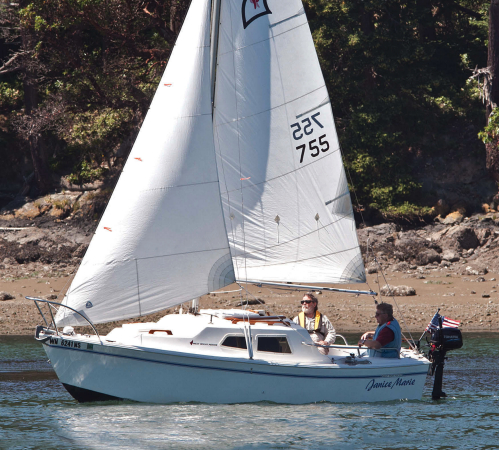
Wayne Egleston is a lifelong resident of Island County, Washington, and was a power-boater until 2008, when he spotted a sad-looking 1996 West Wight Potter 19 on the way to his favorite launch ramp. The little boat was so black with mildew and dirt that Wayne walked away at first, but he couldn’t get it out of his mind, so he bought it. The interior, sails, and cushions turned out to be in excellent condition, and the rest cleaned up perfectly with soap and elbow grease. Wayne renamed her Janice Marie for his wife (who nevertheless did not take to sailing) and has honed his sailing skills over the ensuing years.
Background and history
The story of the Potter 19 really begins with the Potter 14, designed and built in plywood in 1960 by Stanley Smith on the Isle of Wight in England. The tiny boat had a V-berth in a snug cabin, a gunter rig, and a heavy galvanized-steel centerboard that contributed greatly to its stability. In 1966, Herbert M. Stewart of Ingleside, California, bought a boat and the rights to U.S. production of the Potter 14, founded HMS (his initials) Marine, and began production in fiberglass. Almost immediately, the diminutive boat became a cult classic — owners seem to universally extol the simplicity, safety, and sailing virtues of this micro-cruiser.
The Potter 14 evolved into its current form over the first decade of production and, in 1971, Herbert M. Stewart designed the HMS 18 for family cruising, with four berths, minimal galley and head facilities, a deeper cockpit, and a hot-dip-galvanized lifting keel rather than a centerboard. He halted production of the HMS 18 in 1975, eventually selling the company and the Potter name to Joe Edwards in 1978.
Joe continued to build the smaller boat, renamed the Potter 15 (by adding the rudder and outboard bracket to its length), and resurrected the HMS 18 as the Potter 19 in the 1980s, using the same “measurement stretch” method. Some say quality of fit and finish deteriorated somewhat during Joe Edwards’ ownership. He sold the company in 1992 It became International Marine and, after changing hands several times, was acquired by Ken Lange, the current owner. The company still produces both the Potter 15 and the Potter 19 and Jerry Barrilleaux, a legendary figure in Potter Yachter circles, states that the quality of the current boats is as good as it has ever been. New molds have been tooled, keel-raising systems improved, interior modifications made, and additions made to the list of options offered.
Design and construction
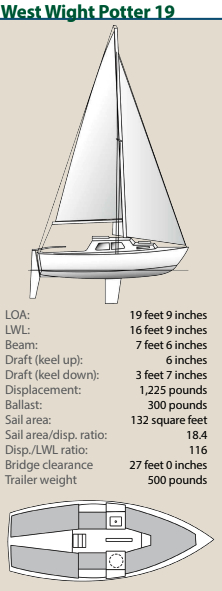
The HMS 18, like her smaller sibling, was created from a sheet-plywood plug with a hard chine and low-deadrise V-bottom. Since she was designed with much more freeboard, a straighter sheer, and a doghouse cabin trunk to maximize interior volume, she has a chunkier appearance than her more curvaceous little sister. The Potter 19 hull and superstructure are identical to the earlier HMS 18, but the deck, cockpit sole, coachroof, and other flat horizontal surfaces are cored with balsa rather than plywood. As with all wood cores, care must be taken to properly bed fittings to avoid rot. No instances of core failure were reported by owners who responded to our request for comments.
Until 1997, the steel keel was not galvanized and was less shapely than the original HMS version. A galvanized version of the original keel shape appeared in later boats and an extra layer of glass fabric in the hull and cabintop, called “Blue Water Layup,” was offered.
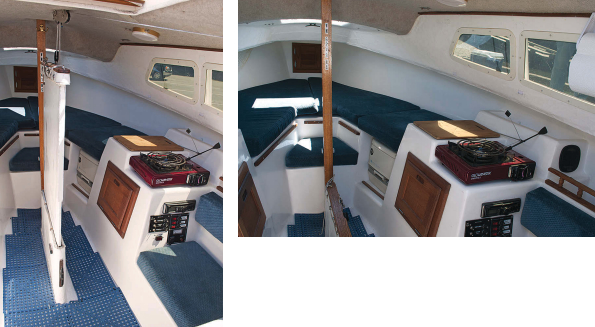
A fiberglass molding glassed to the hull forms the cabin furniture, which has minimal screwed-on wood trim, and marine fabric is bonded to the overhead. Closed-cell foam installed under the berth flats forward and aft is said to provide positive flotation.
A backstay, essential for maintaining good sail shape, was optional on older Potter 19s but is currently standard. The spreader-less fractional rig with upper shrouds and single lowers is rudimentary, but adequate and foolproof, and the mast and boom extrusions are relatively light.
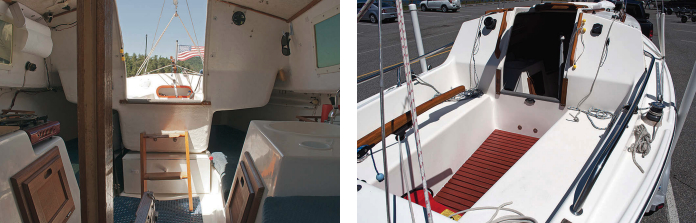
Nylon mooring cleats are provided and the anchor rode is led through a cowl ventilator forward, but the design does not include an anchor well or a seat locker in the cockpit.
The factory has always offered many options, such as an anchor roller, boarding ladder, bow pulpit, opening portlights, electrical systems, extra handrails, stainless-steel cockpit rails, and running lights, and option “packages” have been popular. Most owners who responded to our survey stated that low storage and initial maintenance costs were a major factor in their decision to choose the Potter 19.
The Potter 19’s dagger keel weighs more than 300 pounds and is raised by a wire cable that runs through a complex arrangement of blocks up to the cabin overhead and then aft under the cockpit coaming to a winch mounted directly under the tiller inside the transom. The winch handle is in the cockpit, convenient to the helmsman, and the combination of blocks and winch gearing makes raising the heavy keel relatively easy. Many owners have replaced the cable with low-stretch high-tensile synthetic line, and several (including Wayne) have modified the lifting assembly so it can be detached and moved out of the way after the keel has been lowered. The fully retracting keel, along with the low-deadrise hull form, makes the boat exceptionally easy to launch and recover, and in spite of the substantial impact this keel design has on the cabin layout, few owners seem to consider it a problem.
Some owners with standard layup hulls mentioned slight pumping of the cabin sole when the boat is sailed hard in heavy weather, and some oil-canning and flex occurs in the flatter portions of the topsides and cabin sides, but no one has reported failures of these components. Many owners related stories of hard groundings with minor or no damage to the heavily constructed keel trunk. One had added glass to reinforce the joint where the keel trunk meets the sole and several mentioned typical gelcoat crazing at stress points and sharp angles, but all felt the boats were solidly constructed for their intended use and would take far more punishment than their owners.
Accommodations
On the trailer, or to reduce “clunk in the trunk” at anchor, the raised keel decisively bisects the compact cabin between the port and starboard galley counters, but becomes less obtrusive when lowered into the 15-inch-high by 24-inch-long centerline trunk. The 22-inch (fore-and-aft) galley counters include a molded-in sink to port and a stove flat to starboard, plus stowage bins outboard. Below the counters are stowage cabinets, with the battery box to starboard in current boats. In the 1990s, the portable head was moved from the starboard cabinet to a molded recess under the starboard V-berth cushion where headroom over the toilet seat is a full 33 inches. Personal experience confirms the head is far more comfortable to use than when it was located in the cabinet.
The V-berth measures 6 feet 6 inches diagonally. Each after-section of the V is 23 inches wide and has 28 inches of headroom above the berth cushion. A small hatch overhead is suitable for sail stuffing and ventilation. There is a small filler, but the mahogany mast-compression post prevents it from extending all the way to the head of the berth.
A storage bin/backrest molded into the liner creates an 18-inch-wide seat aft of the galley counter on each side and 26-inch-wide quarter berth flats extend another 6 feet under the cockpit seats. These have comfortable knee room and width but are not for the claustrophobic and are difficult to slide into, as they extend only 12 inches into the cabin. Overall headroom, measured to the cabin overhead under the raised doghouse, is 54 inches, and standing space under the open companionway hatch extends nearly 2 feet forward of the cabin bulkhead.
A short ladder leads up through a snug 21-inch-wide companionway to the compact cockpit. There is no bridge deck, but the sill is as high as the cockpit seats, which are a comfortable 15 inches wide and 15 inches above the footwell sole. Their 8-inch coaming seatbacks are supplemented by the optional stainless-steel guardrails that extend up another 6 inches. The cockpit seats are 5 feet 7 1⁄2 inches long and the footwell tapers from 27 inches to 21 inches wide at the transom. The upper part of the companionway hatchboard hinges down to form a small cockpit table forward. Janice Marie was originally fitted with a tiny aftermarket access hatch, and similar small access hatches were offered as options on later boats. All the sail controls and the keel winch handle are within easy reach of the helmsman for singlehanding. The cockpit feels very secure and is quite comfortable for two large adults when sailing.
Most owners, like Wayne, use their boats for daysails and short cruises. Once adapted to the centerline keel trunk, which can make going forward a bit of a struggle, they are well pleased with the accommodations and layout. The commodious cabin comes at the expense of cockpit space, and while some might prefer a more flexible and open interior with less built-in “furniture” (the very newest boats do eliminate the port galley cabinet in favor of an extended settee berth), the cabin layout and volume seem strong selling points for the boat.
Under way
Once away from the launch ramp, Wayne shut down the 6-horsepower long-shaft outboard and raised the sails from the cockpit. We slipped out into Cornet Bay with about 8 knots of wind and the usual swirling currents funneling through Deception Pass.
The boat handled well under full mainsail and lapper jib, but would have been happier with a genoa in the moderate air. She was extremely stiff, so at one point both of us moved to the leeward side of the cockpit to heel her to 15 degrees, which, with only half of the bottom immersed, would have been optimum with a bit more wind. I sailed a Potter 19 in the Chesapeake some years ago, and by maintaining a 15-degree angle of heel while flying a genoa in a stiff breeze experienced a two-hour sustained 6-knot broad reach. But even with the smaller headsail and lighter air of our test day, Janice Marie behaved very well, ghosting slowly but surely out of dead-air spots in the lee of Ben Ure Island and accelerating under complete control. The helm was responsive and predictable, the boat pivoted crisply, tacking and jibing decisively.
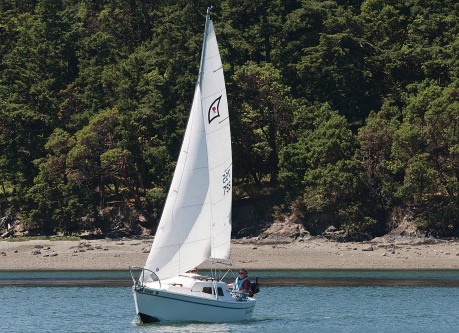
The wide beam and bottom configuration keep her level and the hard chine is said to aid in going to windward. Although definitely a cruiser rather than a weatherly racehorse, she was anything but sluggish.
Several owners use the popular light-weight 4- to 6-horsepower four-stroke outboard motors, which provide plenty of power for the boat. No one reported any difficulty maneuvering under power with the keel and rudder in the down position, but some mentioned using both the rudder and the outboard to steer in tight reversing situations.
An aftermarket rudder foil by Ruddercraft is a popular modification that is said to improve windward performance, and many owners have led halyards to the cockpit and fitted jib downhauls or roller furling. A few owners have installed Biminis and some have added boom vangs, Barber haulers, improved outhauls, and Cunninghams to improve sailing performance.
Trailering and launching
The smallest tow vehicle in our survey was a 6-cylinder Honda Odyssey. Several who towed with an SUV or pickup said it was easy to forget the boat was back there. Some said fuel economy dropped about 20 percent when towing.
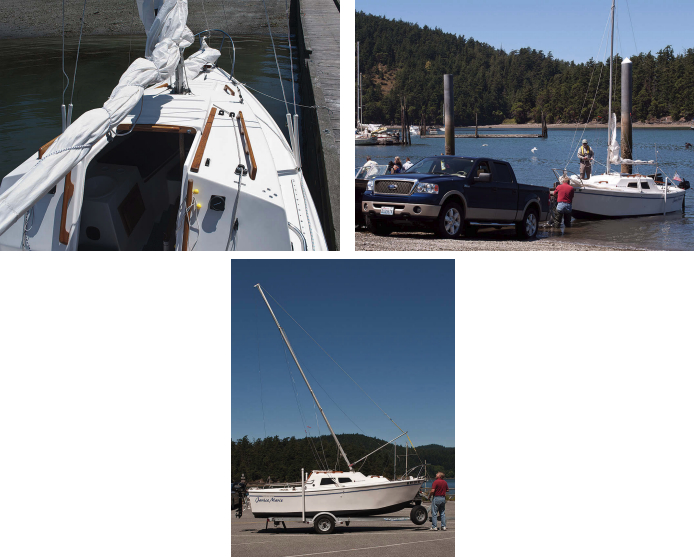
Rigging and launching takes about 40 minutes and, with her nearly flat bottom and low-rider trailer, the boat slips easily into the shallow water without wetting the truck tires. For the test sail, Wayne lowered the keel, dropped the kick-up rudder, started the engine, and backed out smartly. The near-flat-bottom design makes the boat difficult to control unless the rudder and keel can be dropped, especially in any wind or current.
On our return to the ramp, Wayne started the outboard and deftly furled the sails without leaving the cockpit, using a jib downhaul and a neat rig for furling the mainsail. At the launch ramp float, he raised the rudder and outboard, cranked up and locked the keel, and went to get the truck. Tall aftermarket “goal posts” guided the boat onto the trailer once her foils were retracted, and she slid easily onto the trailer bunks.
The Potter 19 was designed to be stored in a standard garage, but the low-slung trailers that aid in launching and garage storage use small-diameter wheels that can be prone to overheated tires and bearings. As a result, in spite of the ease of towing and light rig weight, the running gear must be watched closely, especially when towing for long distances at speed.
Conclusion
The Potter 19 has intrigued and seduced a wide variety of sailors for over four decades. It has provided an affordable introduction to sailing and cruising for many. A loyal following of very experienced sailors has continued to race and cruise these rugged little boats.
Unusual looking, with a solid, functional charm all their own, these beamy, hard-chine boats can be made to perform better than specifications and appearances might suggest. But the real appeal for most owners is the ability to cruise safely in a trailerable, seaworthy, solidly built, affordable sailboat with a long pedigree.
In spite of accounts of bluewater exploits (usually in heavily modified boats), the Potter 19 should really be considered a moderate-weather coastal cruiser. The initial stability and lack of heel resulting from the hull form may be reassuring to an inexperienced sailor, but the boat, like most hard-chine shoal-draft designs, has a limited range of ultimate stability.
Used-boat prices range from nearly $16,000 for a 2008 model to less than $3,000 for a mid-1980s version, so an older boat can provide a lot of economical sailing adventure. Owners’ associations are active throughout the country, and the boat is still in production, so sails and many parts are available from the factory.
Ferd Johns and his wife, Beth, are retired architects now living on Whidbey Island, Washington. Ferd’s once formidable fleet has been reduced to two trailerable sailboats and a mini-trawler (not counting assorted kayaks and dinghies), which they use to cruise the Pacific Northwest, Chesapeake Bay, and the Florida Keys
Thank you to Sailrite Enterprises, Inc., for providing free access to back issues of Good Old Boat through intellectual property rights. Sailrite.com