. . . meets two canoe-stern cousins
Issue 100: Jan/Feb 2015
The Tom Hale-designed Vineyard Vixen 34 is a pretty little canoe-stern yacht much in the style of Bill Crealocks’ Pacific Seacraft 34 and Thomas Gillmer’s Southern Cross 35, but it predates those designs by ten and three years respectively. I discussed the origins of the canoe-stern yacht in “Double-enders and Canoe Sterns” in the September 2012 issue.
Bill Crealock once famously said that, in a heavy following sea, it’s much better to have a bow at both ends of the boat. Heaven only knows what he would make of the current trend of carrying maximum beam right aft that results in vastly larger cockpits and aft cabins and transoms that resemble terraced patios. With regard to “above the water” aesthetics, these three boats owe much to Albert Strange’s original canoe yawls of the 1890s and L. Francis Herreshoff’s reinterpretations of the concept in the mid-20th century. However, their designers all opted for the more “modern” underwater profile of separate keel and rudder, with the rudder on all three mounted on a full-length skeg. Both the Albert Strange and L. Francis Herreshoff underbodies had a full-length keel with the rudder forming the trailing edge, a hull form that has substantially greater wetted surface.
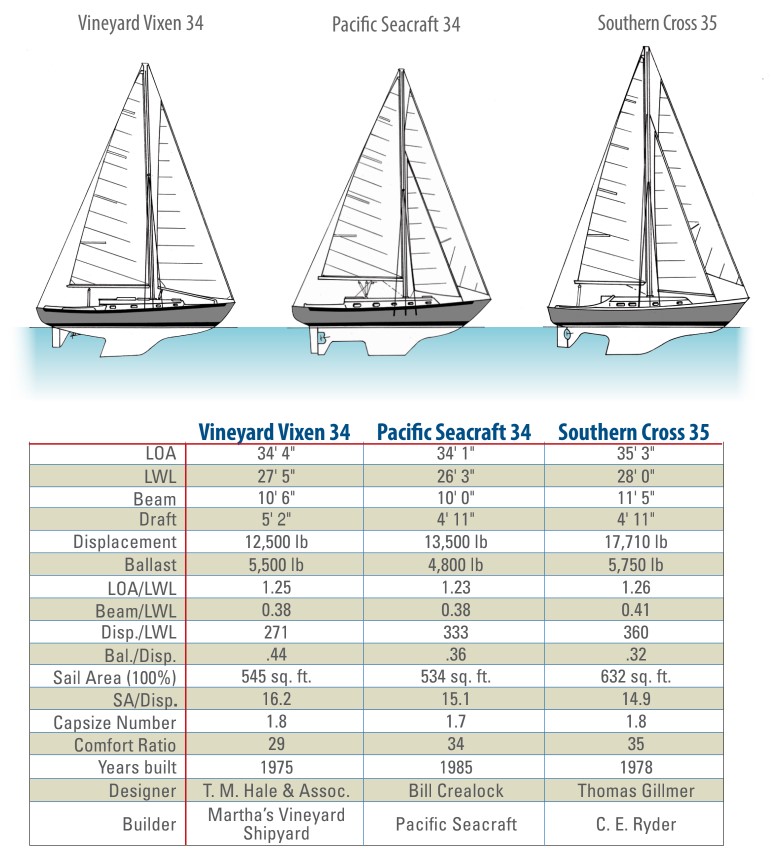
On the Pacific Seacraft, the skeg transitions into an extension that joins the keel. While this would improve directional stability, it would impede maneuverability and add to wetted surface area. Note that on the Pacific Seacraft 34 and the Southern Cross 35 the propeller is in an aperture in the skeg, which in this respect resembles a vestigial keel, while the Vixen’s propeller is supported by a strut forward of the skeg. None of these boats carries the yawl rig preferred by Strange or the ketch rig favored by Herreshoff. Instead, the Vixen has the higher-aspect-ratio sloop rig of its contemporaries while the Pacific Seacraft and Southern Cross have the modern version of a cutter rig with an inboard staysail.
With regard to the relative potential performance of these three boats, it’s hard to overlook the 5,000-pound difference in displacement between the Vineyard Vixen and the Southern Cross. The much greater displacement of the Southern Cross on an LWL that’s just 7 inches longer leads to equally divergent displacement/length (D/L) ratios: a respectable 271 for the Vixen and a heavy 360 for the Southern Cross. The Pacific Seacraft, being only 1,000 pounds heavier than the Vixen, falls in between, but toward the heavier side at 333. Note also that, while the displacements and D/L ratios vary considerably, the ballast weights are more consistent, ranging from 4,800 pounds for the Pacific Seacraft to 5,750 for the heavier Southern Cross. The resulting ballast/displacement (B/D) ratios are 44 percent for the Vixen, 36 percent for the Pacific Seacraft, and 32 percent for the Southern Cross. Even though the Southern Cross has substantially greater sail area than the other two boats, her heavier displacement gives her the lowest sail area/displacement (SA/D) ratio of 14.9, against 15.1 for the Pacific Seacraft and a more performance-oriented 16.2 for the Vixen.
So what would this all mean if these boats were to find themselves sailing together around a hypothetical racecourse? If the numbers are to be believed, the older Vineyard Vixen would appear to have the edge in light to moderate conditions with both a lower D/L ratio and a higher SA/D ratio, as well as a higher B/D ratio. This performance edge would prevail both upwind and down. However, as the wind builds, the Southern Cross could come into her own when, at higher heel angles, her heavier displacement should overcome a higher center of gravity, giving her the stability to carry more sail on her slightly longer waterline.
Looking at the comfort ratios, the Southern Cross at 35 fares best, due to her high displacement, with the Pacific Seacraft a close second at 34, due to her shorter LWL and narrower beam. But at 29, the Vixen’s is certainly quite acceptable. The capsize numbers of all three boats are substantially below 2, well within the conservative range, and would make them good sea boats for long passages, which I’m sure all three have accomplished.
It is not often that the older boat comes out on top in performance, but in this case the Vineyard Vixen certainly looks like the more nimble performer. Nevertheless, all three boats are exceptionally attractive and excellent representatives of the modern interpretation of the canoe yawl.
Rob Mazza is a Good Old Boat contributing editor who, in his long career with C&C and in other design offices, has contributed enormously to the enjoyment of those who sail and own good old boats.
Thank you to Sailrite Enterprises, Inc., for providing free access to back issues of Good Old Boat through intellectual property rights. Sailrite.com