. . . has acquired heirloom status
Issue 101 : Mar/Apr 2015
Rare is the man or woman who buys a boat and keeps it for a lifetime, handing the revered craft down to children like a family heirloom. Some people just have simple needs and small dreams, and the relationship with their boat is symbiotic. – Dan Spurr, Yacht Style
The early 1970s were watershed years for the U.S. boating industry, and nowhere was that more evident than on Florida’s west coast. In spite of a difficult national economy at that time, Florida, with its growing population drawn to plentiful water, sun, and coastline plus the impact of the Southern Ocean Racing Conference, gave rise to the likes of Charlie Morgan, Ted Irwin, and Bob Johnson who established a Mecca for production boatbuilders.
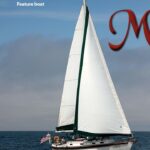
In 1963, Ted Irwin designed and built the 31-foot wooden sloop, Voodoo, in a shed in St. Petersburg Beach. From 1964 to 1966, she won 24 out of the 28 races of the Florida Ocean Racing Association. In 1966, Ted started Irwin Yacht and Marine Corporation. Its initial building contained only 12,500 square feet, but over the next decade grew to 75,000 square feet and employed more than 200 people. By the early 1980s, Irwin Yachts was the largest privately owned builder of production sailboats in the U.S. During that time, Irwin designed and produced more than 50 different models. Among them was the 1970-designed Irwin 32.
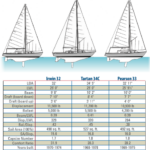
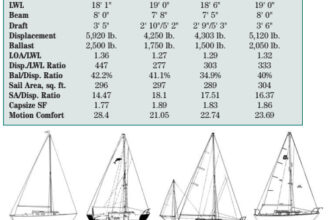
Between 1970 and 1975, more than 20 North American boatbuilders offered close to 50 production boats in that size range. There’s nothing groundbreaking in the design of the Irwin 32. She was offered in full-keel and centerboard versions. Her six-page original brochure, which includes hull construction details, complete specifications, and lists of standard equipment supplied with the boat, can still be viewed on the excellent website www.irwinyachts.com.
How could a prospective buyer choose a new boat and all its equipment from such an extensive list of choices without access to Internet sites like Yachtworld? I asked Merle and Pat Graser, the original owners of Quest, an Irwin 32.
A family of sailors
Merle and Pat both grew up “on the water,” but in totally different parts of the sailing world. Merle began his sailing life in Ohio, where he learned to sail at the age of 14 on a 12-foot Nipper dinghy designed by Ray Greene. He daysailed it on Lake Erie and got his first taste of cruising while “camp cruising” overnight with the Nipper on the Maumee River. After moving to Miami, he owned a succession of one-design boats that he raced with his brother.
Pat was born in Trinidad, where her father was stationed as an airline pilot. He owned a bluewater sloop named Tawana. Pat began sailing on that boat at age 3. Coincidentally, both Pat and Merle moved to Miami in 1947. They were employed in the banking business and married soon after they met. In 1963, they moved to the town of Venice on Florida’s west coast. Merle became one of the founders of the First National Bank of Venice and ultimately its president.
The Grasers’ first boat in Venice was a 20-foot V4, a locally built fiberglass sailboat with minimal cruising accommodations. By the time he was 3, their son, Shaun, was accompanying them on overnight cruises on this small boat. His younger sister, Cathy, soon became part of the crew. By 1971, the family had outgrown the small cabin of the V4. “The kids couldn’t turn over in the quarter berth,” Pat says.
Merle and Pat began a search for a new boat. They wanted a boat large enough for the four of them to cruise in comfort, but with shallow enough draft for Florida’s west coast. They also wanted it to be safe in open water for cruising and to require minimal cosmetic maintenance. If it was built locally, all the better. They attended several Florida boat shows where they saw the Irwin 32 along with Pearsons, Morgans, and others.
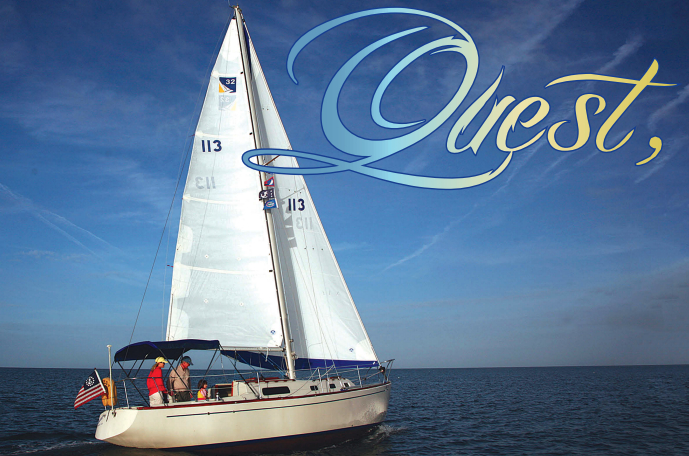
Merle was familiar with Ted Irwin’s reputation. He and Pat went to the Irwin yard in St. Petersburg. “It was spotless,” Pat remembers. “You could eat off the shop floor.” In spite of the fact that they never had an opportunity to take a sister ship for a test sail, they placed their order for hull #113 in November of 1972. Their faith in the Irwin 32 was based on the appeal of her traditional lines, her keel/centerboard configuration, the winning reputation of Ted Irwin, and the fact that she would be built nearby.
Eager owners
Each week through the winter of 1972 and ’73 they drove to St. Pete to watch their boat being built. In May of 1973, their boat was delivered to a boatyard in Sarasota for commissioning. Inspired by the song “The Impossible Dream” from The Man of La Mancha, they christened her Quest. Just before she was to be lowered into the water, the yard discovered Quest’s headstay was too short and asked to delay the launch until the following week.
“You need to make it work today as the Grasers will take delivery today,” their broker responded. The yard installed a pair of extender plates and Quest sailed for her home in Venice, about 20 miles south. A week later, Irwin replaced the headstay.
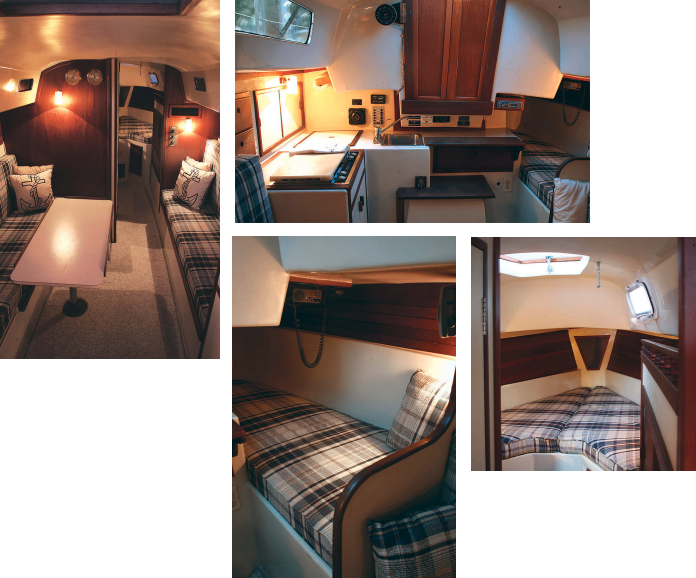
Merle and Pat were impressed by the overall quality and simplicity of the Irwin: minimal exterior trim to be varnished, a simple sail plan that was easily controlled, a centerboard for sailing the shallows of Florida, sufficient accommodations for the family while cruising and, most important, everything worked. The original sails were part of the package ordered from Irwin. “It’s a dream boat and handles beautifully,” Merle says.
They spent their first season doing some local cruising, occasional club races, moonlight sails, and daysailing. Later that year, they began a family tradition that lasted for 20 years aboard Quest: a Christmas cruise to Useppa Island in Pine Island Sound about 40 miles south of Venice. Now that the boat was “broken in,” they extended their cruising range to include frequent weekends anchored in Cayo Costa or docked at Useppa Island. Each summer, the family took longer trips to the Dry Tortugas, the Florida Keys, Miami, and the Bahamas.
Wider horizons
Their first offshore cruise was a crossing to the Dry Tortugas. Son Shaun navigated using a Bendix RDF. After several hours of sailing, Merle asked him for their position. “Well”, Shaun replied, “If this thing is right, we are in Ft. Meyers on Route 41 near McDonalds.” They arrived in the Dry Tortugas without incident. On their return, they ran into heavy weather that continued to build. They reduced sail until they were sailing under the storm jib only while running before 15-foot seas. Quest handled it well. The only problem they experienced was a leak around the port running light, which was under water much of the time.
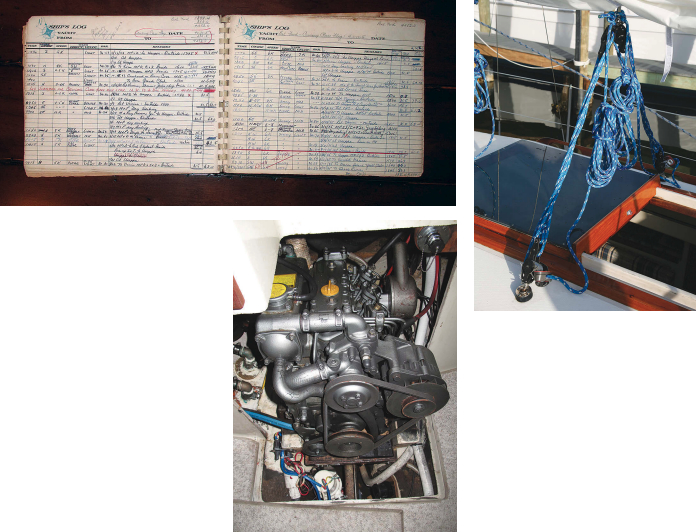
After the children were grown, Merle and Pat continued cruising by themselves. Over the years, Pat kept a handwritten cruising log describing each voyage, something rarely seen in today’s electronic world. She dutifully recorded every mile, earning a star on a flag from the Cruising Class of the Sarasota Sailing Squadron for each 1,000 miles of cruising. Their flag carries five stars.
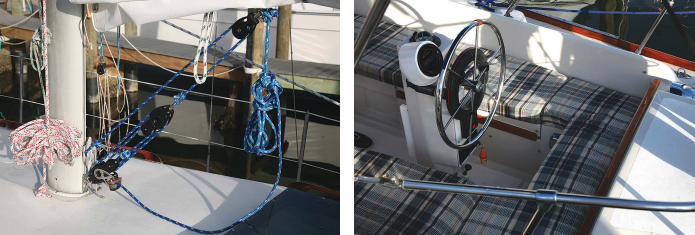
They eventually replaced the hanked-on jib with a roller-furling jib, much to Pat’s delight, as she did the foredeck work. They shortened the boom to accommodate a Bimini and installed air conditioning. Instead of trading boats, they stuck with their trusty Irwin 32, modernizing her with new equipment over the years.
Passed down a generation
In 1992, Merle and Pat moved on to trawlers and they turned Quest over to Shaun. He introduced sailing to his new wife, Paula, who quickly became as enthusiastic as he is.
In 1997, Shaun and Paula replaced the Atomic 4 with a 27-horsepower Yanmar diesel as the gas engine was becoming unreliable. The work was done by a local boatyard that also had to replace the engine mounts, shaft, and prop. Shaun and Paula rerigged the mainsheet with a bridle, added a vang and Cunningham, and replaced the chainplates and standing rigging. They also installed an autopilot and GPS. In 2013, they added a new North full-battened mainsail on a Harken Battcar System. They replaced the cushions inside and out and covered the new ones with a plaid fabric to retain the original looks of the boat.
One item that requires replacement on occasion is the centerboard pendant. The inboard and underwater ends of the pendant are connected by a Delrin rod that slides in a tube that’s sealed with a stuffing box. The underwater portion of the cable sometimes fails, necessitating quick action to plug the tube. “It usually happens in January, when the water is cold,” Paula says. They recently replaced that portion of the pendant with Spectra line.
They have also fitted a second high-water alarm and an additional high-velocity bilge pump. The original electric and alcohol combination stove is still on board. The electric top is used when connected to shorepower, and hinges up to allow access to the alcohol burners when the boat is not at a dock. The Grasers never added refrigeration and still use the trusty old icebox.
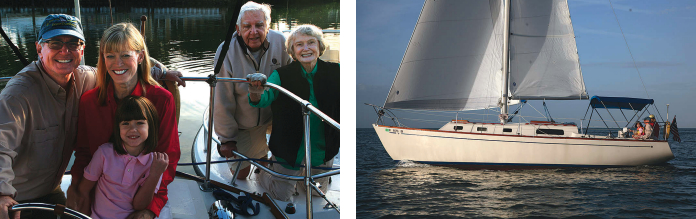
More generations to come
Shaun and Paula continue to use Quest primarily for daysailing. “We sail out into the Gulf of Mexico for two hours and return,” Shaun says. “We also do an occasional race now and then,” Paula adds. Because Shaun has a successful dental practice in Venice, long-distance cruising is not practical for them.
Shaun and Paula’s two older sons grew up sailing on the boat and have become sailors. Although they live in other parts of the country, they often race with Merle and Shaun when they visit their parents in Florida, making it a three-generation family affair.
Because, like Merle and Pat before them, Shaun and Paula have now owned Quest for about 20 years, I was prompted to ask Shaun what their plans might be for the boat. “Keep it,” he says without hesitation.
With more sailors growing up in the family, it’s likely that Quest will be passed on to yet another generation. “I don’t think anything will be happening soon,” Paula says.
“It is absolutely the perfect boat for us,” Shaun agrees. How much more can one boat be loved?
Bill Jacobs has spent nearly 50 years in sailboats and powerboats. His marine photography is displayed in galleries, private collections, and museums, and has been printed in boating publications. His articles have been published in boating publications since 2004. Bill winters in Sarasota, Florida, and cruises on a Mainship 34. In the summer he can be found sailing his Cape Dory Typhoon on Lake Michigan off the shores of Door County, Wisconsin.
Thank you to Sailrite Enterprises, Inc., for providing free access to back issues of Good Old Boat through intellectual property rights. Sailrite.com