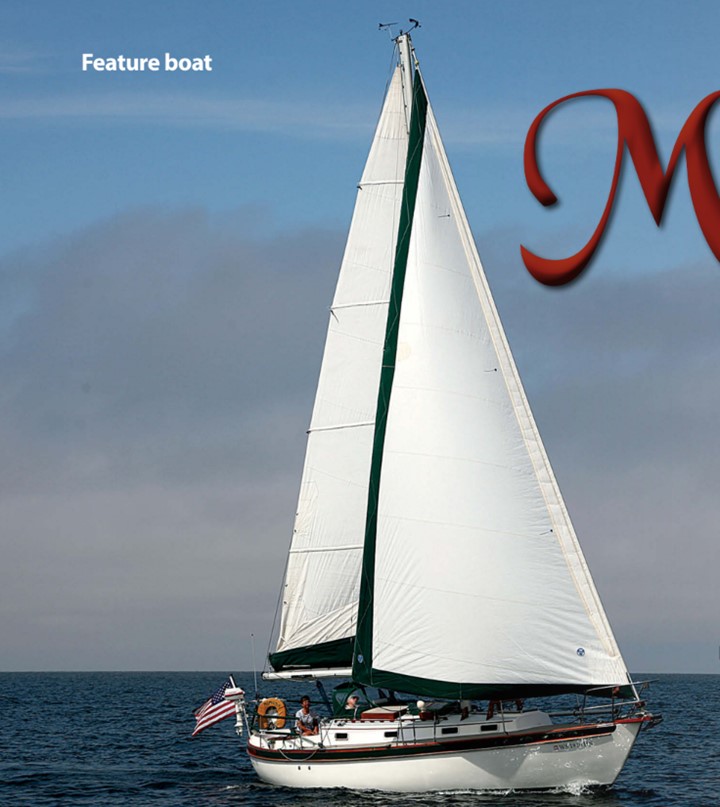
A double-ender that looks and handles like a classic
Issue 100: Jan/Feb 2015
Steve Capp had never seen, nor heard of, a Vineyard Vixen. And why would he? He and his wife, Carol, started sailing in 1982 on a 16-foot Hobie Cat. It was perfect for sailing on a small lake right off the beach in front of their vacation cabin and on the waters of Green Bay when they towed it to their new summer residence. As they spent more time in Ellison Bay during the summer months, they agreed to buy a slightly larger boat. “We thought it would be nice not to get wet every time we went sailing,” Steve says.
They began by looking for a 25- to 29-footer, thinking they’d first gain experience daysailing and later purchase something larger. Steve took many Power Squadrons courses, and their Internet search began in 2007. A friend of his, whose father had recently passed away, was aware of Steve’s search. The family wished to sell his boat, and Steve went to northern Illinois to see it. Although he wasn’t familiar with the 34-foot Vineyard Vixen, Steve says, “After looking at her classic lines and sailing her, I fell in love with her.” She had carried the name Mimosa proudly in the hands of two attentive owners. Steve and Carol would continue the tradition.
Prior to finalizing the purchase, Steve hired a surveyor who confirmed that the boat was well built and in great condition. He found a few other Vixens for sale on the Internet and felt the price was fair. He and Carol completed the purchase in the fall of 2008. After further research, Steve was impressed with the boat’s unique design and the limited number that had been built. Although she was a larger boat than he and Carol had anticipated buying, the ease of sailing her on test sails gave them confidence. “I figured the real difference would be in docking, but with caution and practice, Carol and I could master that,” he says.
After storing her for the winter, Steve, his son Keith, and a professional captain sailed her 250 nautical miles to her new home in Door County. Steve had not had the experience of a long passage and feels the investment in a captain was valuable for safety reasons. It also presented a great opportunity for learning large-boat handling skills while under way.
A yard with a history
Mimosa was built in 1986 by Martha’s Vineyard Shipyard. If that name conjures up images of a field of moorings, tall tidal docks, clapboard sheds, marine railways, and ghosts of large commercial sailing vessels, it’s hardly surprising. The yard has been in continuous operation for more than 150 years, so the Vineyard Vixen 34 comes from a strong New England heritage.
Yard owner Tom Hale had a dream he wanted to fulfill of building a cruising sailboat, so he attended the 1972 Newport Boat Show to look at production sailboats. He settled on a 29-foot sloop with a double-ended hull, a decision driven primarily by aesthetics, as he was a fan of L. Francis Herreshoff’s Rozinante design. The yard received several orders for the Vixen 29 and started to build sailboats.
In 1975, desiring to build a larger boat, he enlisted the aid of his son Tom Jr., who had recently graduated with a minor degree in yacht design. They settled on a 34-foot version. The first boat was a demo for upcoming shows and, with orders in hand for three more boats, they completed the final production tooling in 1977. Younger son Phil took over production. From 1976 to 1986, the yard built 33 Vixen 29s and 30 Vixen 34s.
The construction details for both boats are similar, with an emphasis on simplicity of design and accessibility of components. The hull was constructed of solid fiberglass, with three layers of mat and woven roving in the topsides, four layers below the waterline, and five layers in the keel, in which the lead ballast was encapsulated. Owners had a choice of white, flag blue, black, or green gelcoat.
In the earliest models, the deck was cored with plywood, which gave way to foam core in later years. The deck met the hull on a 4-inch inward-turning hull flange, where it was bonded with polyester putty and mechanically attached with stainless-steel fasteners every 8 inches to make a very secure hull-to-deck joint. The mast, built by Metalmast Marine, was stepped on deck above a concealed solid-teak timber that extends to the keel. Around 1980, the original self-tending jib was replaced with a roller-furling genoa.
Keeping up Mimosa
Prior to her purchase by the Capps, Mimosa’s original Atomic 4 gas engine was replaced with a 27-horsepower Yanmar 3JH2E diesel, her icebox was converted to 12-volt refrigeration, and she received a new suit of sails.
Since Steve and Carol have owned the boat, they have had her topsides repainted with Awlgrip, replaced the batteries, and upgraded the electrical and battery-charging system. All the portlights have been replaced with new opening ports by New Found Metals. Steve’s next big project will be to replace the Treadmaster deck surface, which still provides good traction but is showing the effects of many years of exposure to the sun.
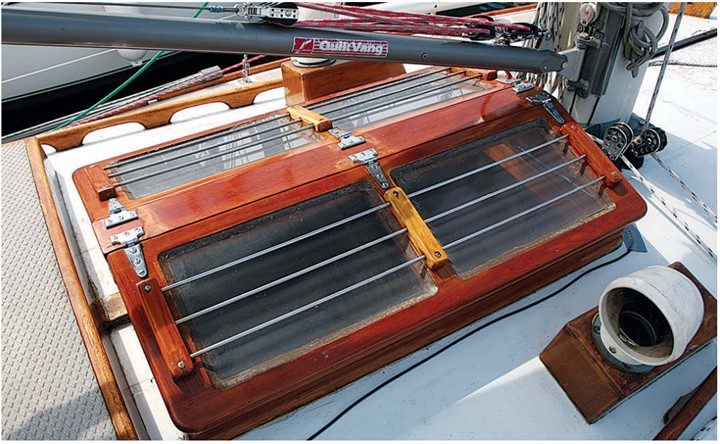
Typical of New England boats of its era, the Vixen has plenty of brightwork to lend a nautical flair, including a varnished butterfly hatch that is truly beautiful to behold and fills the interior with vast amounts of natural light. Since Mimosa has been well cared for, Steve thinks it’s worth the time and effort to continue the tradition. Although she is of relatively narrow beam by today’s standards, Mimosa’s sidedecks are more than adequate for moving around the deck, as the cabin trunk is suitably proportioned. Because of her modern sail-handling system, with a StackPack for the main and a roller-furling jib, all the sail controls lead to the cockpit.
Seagoing features
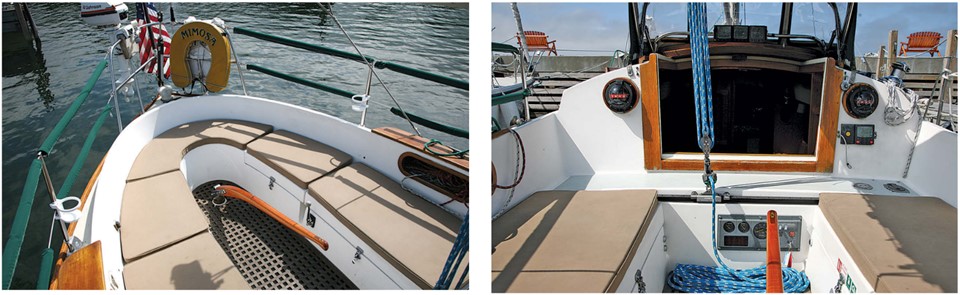
Befitting a vessel fully capable of offshore work, the cockpit is deep and secure, providing good back support and plenty of legroom. A substantial bridge deck — a safety feature often found in older boats — minimizes the chance of a rogue wave washing below. A full-width traveler provides excellent mainsail control and a sturdy Whale Gusher pump is close at hand in the event of an emergency.
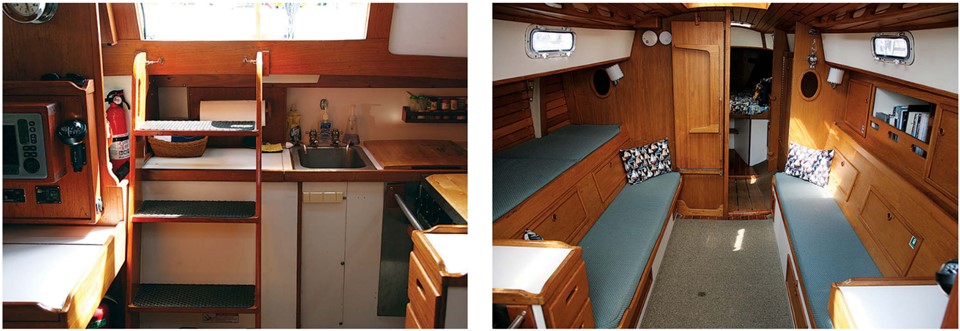
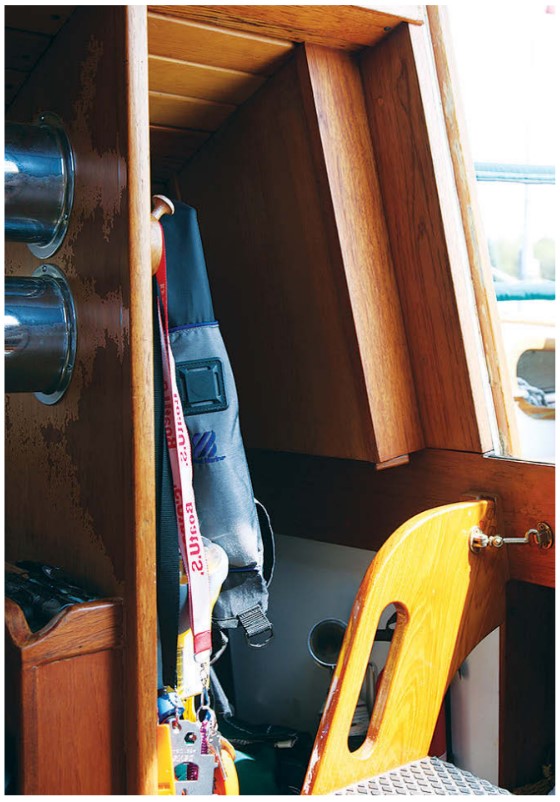
Descending the companionway ladder into the interior is like stepping into a world of elegant simplicity. There are no fancy finishes or lounge chairs, nor any wall-mounted flat-screen entertainment-center equipment. Next to the companionway to starboard is something rarely found on any sailboat of any size: a dedicated hanging locker large enough to hold a couple of foul weather jackets, along with life jackets, and safety harnesses.
The saloon is brightly illuminated by the butterfly hatch and tastefully finished throughout in Herreshoff style with off-white laminate and wood trim. Another feature traditionalists will find satisfying is a proper pilot berth to port. It’s a great place for a nap or to snuggle into while under way on starboard tack. Teak planks cover the entire overhead, adding warmth and style to the interior. It would not be hard to imagine sitting in the saloon with L. Francis himself. Many of the simply detailed panels, including the wood trim and laminate surfaces, are removable to allow access to the engine, wiring, plumbing, and other systems.
A pleasure to sail
Steve and Carol are now in their fifth sailing season on Mimosa. Steve says he loves the looks of the boat and appreciates how well she’s built. “I take great comfort in the safety of high cockpit coamings and a proper bridge deck, but there are tradeoffs relating to the ease of going below and exiting the cockpit,” he says. He notes that the tiller provides a great feel for the boat, but is glad he has an autopilot when they make long passages.
He and Carol have taken the opportunity to sail Mimosa each summer on cruises up to a week long and have crossed Lake Michigan several times. “Although I have learned a great deal in the past five years, I still consider myself a novice,” Steve says. “I maintain a keen eye on the weather forecasts to prevent problems.”
Carol has become an expert crewmember when docking and takes her turn at the helm, although she prefers to do so in lighter winds. No doubt she appreciates the wide sidedecks when handling docklines. She likes having electric refrigeration on the boat and finds the galley sufficient for onboard cooking. The Capps have frequently looked at newer designs at boat shows and are amazed at the amount of space in today’s 34-footers. Due to its relatively narrow beam compared to current designs, the Vineyard Vixen has less room for storage, dining, and guests, but in spite of those issues Steve and Carol are both very satisfied with Mimosa.

Bill Jacobs has spent nearly 50 years in sailboats and powerboats. His marine photography is displayed in galleries, private collections, and museums, and has been printed in boating publications. His articles have been published in boating publications since 2004. Bill winters in Sarasota, Florida, and cruises on a Mainship 34. In the summer he can be found sailing his Cape Dory Typhoon on Lake Michigan off the shores of Door County, Wisconsin.
Thank you to Sailrite Enterprises, Inc., for providing free access to back issues of Good Old Boat through intellectual property rights. Sailrite.com