A robust trailerable with innovative features
Issue 102 : May/Jun 2015
Rex Henthorn got the sailing bug in 1980 when he bought a summer home on Lake Freeman, just north of Lafayette, Indiana. The home came with a 14-foot Chrysler scow and it wasn’t long before Rex was hooked. In 1988, he bought a new Capri 14 and gained a reputation in Lake Freeman’s Lafayette Sailing Club as a skilled racer. However, his wife, Sandy, usually watched Rex from ashore, since she didn’t share her husband’s enthusiasm for messing about in small tender boats.
By 2007, the Henthorns were investigating boats that would still allow Rex to enjoy the feel and responsiveness of a smaller tiller-steered sailboat yet give Sandy a better sense of security and comfort on the water. When they took a Rhodes 22 on North Carolina’s Albemarle Sound for a test sail, they knew they had found the answer. They bought a “recycled” boat, a 1988 model that had been completely refurbished and upgraded in 2006 by the original builder, General Boats. It was essentially a new boat and included in-mast furling, stainless-steel trim instead of brightwork, and many more improvements.
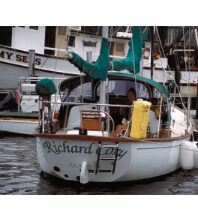
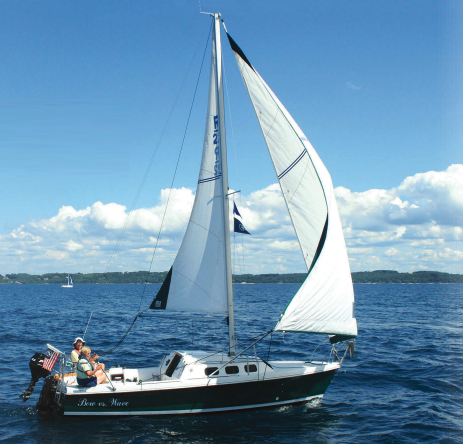
They brought Bow vs. Wave home to Lake Freeman and have enjoyed sailing her there and on the Great Lakes ever since. (Rex, an attorney, liked to leave the office early on Fridays to sail and, rather than write “Gone sailing” on the company calendar, he entered the fictitious case name “Bow vs. Wave.”)
In October 2014, on our way to the Annapolis boat show, my wife, Sandy, and I spent a day at Lake Freeman with the Henthorns and got to know Bow vs. Wave inside and out.
History
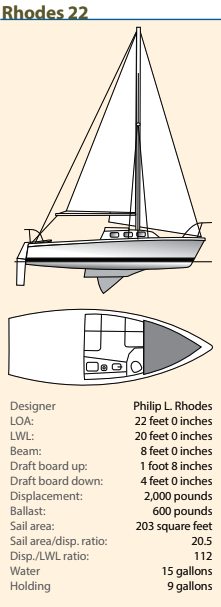
In 1959, Stan Spitzer’s General Boats Company began marketing the Nils Lucander-designed Picnic 17 sailboat. The boats were built in various places, from Wichita, Kansas, to Nova Scotia. The Picnic 17 design had a wide flare in the topsides, providing hiking room. When Stan approached yacht designer Philip Rhodes in the 1960s for the design of a new 22-foot boat, his concept included the same flared topsides. The deckhouse and interior were drawn by a Kansas aircraft design firm. The result of this collaboration was the Rhodes 22 Continental, although the “Continental” model designation was later dropped.
The first boats were built around 1968 Stan and his brother Elton marketed the Rhodes 22 through their General Boats Company in New York. At first, the boats were built in a variety of locations, but General Boats soon began to build them at their own facilities to standardize and control construction methods and quality. They later moved the company to Edenton, North Carolina, where it continues today as General Boats International Corporation. The company still builds new models of the Rhodes 22, but it also offers a unique buy-back program to Rhodes 22 owners, and a high percentage of the company’s business involves used and “recycled” boats. When a repurchased model goes through the recycle process, it is in essence a new boat, with many improvements and innovations that Stan and his company have developed over the years.
Construction
The Rhodes 22 is constructed using 25 separate molds, allowing accurate duplication and a good finish for all parts. The first boats were built by outside contractors using chopper guns. The result was a light hull, but it had a tendency to flex a lot, so the contractors began to use hand-laid roving and chopped mat. That led to unattractive roving print-through on the gelcoat. The brothers experimented to find the ideal method and settled on a thick solid-mat layup that provides good flexure resistance and eliminates the gelcoat print-through. Its thickness is reduced up the topsides, where the flare gives the hull added strength. The transom is a very heavy solid layup to support the rudder and motor mount without the need for backing plates. The Rhodes 22 hull is very beefy.
The deck is made in much the same manner but with a rigid plastic core. The result is a very stiff, inch-thick sandwich that is not prone to softening or delamination. Backing plates are not used under deck hardware, since the strength of the whole assembly easily resists pullout loads. An interior liner adds to the overall stiffness of the boat.
The hull-to-deck joint is of the shoebox type with a downturned deck flange overlapping the vertical hull flange. Sealant is applied between the flanges and the two are joined with stainless-steel fasteners. A rubrail assembly on the exterior covers the joint. On the interior, the overhead liner also has a downturned flange to hide the inner side of the strong hull-to-deck joint. Glassed-in foam flotation under the V-berth and cockpit renders the boat unsinkable.
The integral fin keel forms a T-shape within the hull that adds stiffness. The T-section is filled with what General Boats calls a “proprietary ballast mix.” A slot in the keel houses General’s “Diamondboard” fiberglass centerboard that pivots on a forward pin and provides good lateral resistance. Its lightness allows easy single-line control. With the pivot inside the boat, leakage is not an issue.
The rudder foil includes a clutch system that keeps it down in the sailing position yet allows it to rotate upward if an obstruction is encountered. The rudder-head assembly mounts on stainless steel pintles and gudgeons. General Boats offers a link arm, mounted on the rudder head, that can be connected to the motor cowl so the motor and rudder turn together. An option offered in both new and recycled boats is a tiller-mounted motor control.
The rig
The Rhodes 22 has a deck-stepped aluminum mast with single spreaders and supported by single upper shrouds, forward and aft lowers, the forestay, and dual backstays. The upper shrouds connect to chainplates at the outer edge of the deck and the lowers connect to the edge of the cabintop. This leaves decent space between them on the limited sidedecks.
The mast tabernacle is a much safer captive-bolt unit instead of a pin-in-slot type, and the mast can be raised from forward or aft. General Boats offers a mast-raising system that makes for easy setup. Bow vs. Wave has what the company calls IMF (InnerMast Furling.) It’s a convenient addition, and while some buyers might prefer a lighter mast and standard mainsail, most cruisers like the ease of furling and reefing. With the 175 percent roller-furling genoa, sail handling is easy, even with limited crew. Lead tracks are mounted outboard and aft for use with the genoa fully deployed. Inner tracks along the cabin trunk allow close-hauled sheeting inside the upper shrouds when the genoa is reefed.
The aluminum boom is sheeted at the end to an innovative traveler: a bar with its ends mounted to the dual backstays. The control system uses a continuous line and cleats and can be easily adjusted under sail to position the block at any point along the bar. It is conveniently out of the way of the tiller.
Sheet winches are mounted on raised coaming sections. New boats are furnished with Lewmar winches; Bow vs. Wave still has her original Barient winches.
On deck
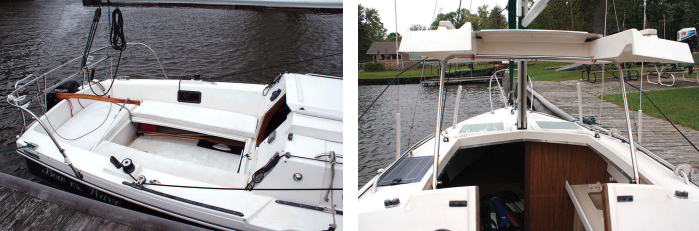
The foredeck is uncluttered. A stainless-steel pulpit is fitted at the bow, and chocks on the toerail on both sides lead docklines to a single mooring cleat on the centerline. The boat has no lifelines. The General Boats website notes that they aren’t recommended because they interfere with sail handling and are just the right height to trip over.
The cabin trunk has two large forward-facing opening ports and three portlights on each side. At the front of the coachroof are two large hatches for light and ventilation. Aft of the mast step, the coachroof has a pop-top that incorporates the companionway sliding hatch assembly but obviates a sea hood. The hatch slides easily and, in the down position, the whole pop-top assembly rests over a raised deck fiddle to prevent leakage. Stainless-steel grabrails on the outer edges of the coachroof also serve as toerails for anyone working at the mast.
The aft end of the cabin trunk has stainless-steel grabrails on each side to assist crew boarding or leaving the boat, and the cabin serves as a decent backrest. The cockpit is enormous for a 22-foot boat. The seats are 7 feet 4 inches long and have open space beneath them. Feet can be tucked back under the seats or stretched across and loose items can be stowed beneath them. The coamings provide comfortable backrests and have stowage cubbies in them near the winches. A filler board stowed on the cockpit sole can be placed between the seats over the cockpit well to provide a full-width sleeping space. General Boats offers a boom tent that forms a starter for a full enclosure or “boom room.” Bow vs. Wave has such an enclosure. When it is up, the cockpit becomes a large guest room or a refuge from the weather at anchor.
The aft seat has a hatch to access stowage below. The fuel tank for the outboard is placed under the portside cockpit seat, out of the way but accessible. Stern cleats, the stainless-steel stern pulpit, and a fold-up stern ladder complete the on-deck features.
Accomodations
Standing headroom under the raised pop-top is around 6 feet 4 inches. The top goes up and down easily. The aft end is raised using a U-shaped rear support with telescoping legs that lock into place, then a sliding support on the mast is raised to complete the operation. The pop-top can be left up while sailing. This may not be the best practice when conditions are rough, but it’s enjoyable on more gentle sailing days. With the pop-top down, sitting headroom in the small saloon is about 50 inches.
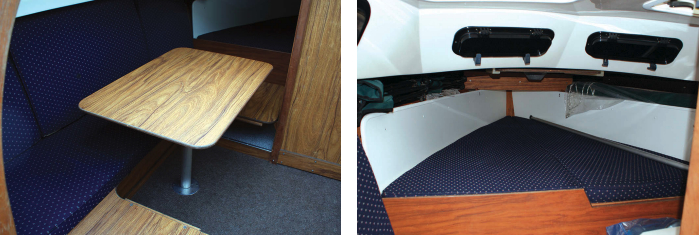
The V-berth is adequate at 6 feet long and can reasonably accommodate two people so long as they are not too tall and don’t mind a little competition for foot room. Aft of the V-berth and to port is a combination settee/U-shaped dinette seat with tool storage underneath. A removable top can be set on a post for use as a table, or dropped to fill the gap in the U-shaped seat, creating a 6-foot 6-inch double berth. When the removable section is not being used, it is stowed in slides above the V-berth.
Sanitation options include a standard marine toilet with a 9-gallon holding tank, a composting toilet, or a Porta Potti. Rex and Sandy selected the Porta Potti for Bow vs. Wave because Lake Freeman has no pump-out facilities and it also makes more cabin space available for storage.
The head compartment on boats with a marine toilet is between the V-berth and galley. The compartment door is an ingenious three-piece adjustable arrangement that extends outward to allow more room inside when the compartment is occupied.
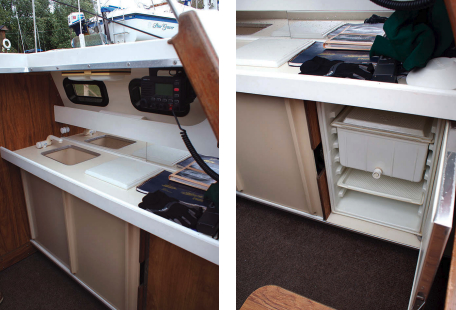
The galley is located to starboard, aft of the head. It has a single sink served by a 15-gallon water tank, with ample storage underneath accessed by sliding panels. Aft of the sink is a good-sized counter space with room for a butane stove. A large icebox is under the aft end of the counter. It has an internal ice chest with a spigot to provide fresh cold water as the ice melts. The breaker panel, radio, and electronics are to starboard over the galley counter.
A hinge in the smoked-Plexiglas companionway dropboard allows the top portion to be folded back into the cockpit. Supported by an aluminum post, it serves as extra galley counter space or as a convenient cockpit table.
Under way
Most trailerable cruisers rely on outboard power, and the 9-horsepower Mercury four-stroke on Bow vs. Wave moved her smartly through the water as we headed into the wind to set sail. A drawback aboard small cruisers is the need to wrestle with the outboard to raise and lower it. The design of the Rhodes 22 motor mount is top-notch: with its 6:1 purchase, the motor can be raised and lowered with ease.
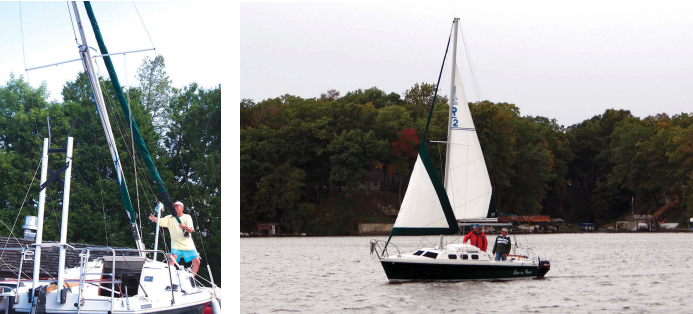
We had plenty of wind for our test sail. Rex set the reefed genoa and unfurled enough of the in-mast mainsail to balance the boat. The centerboard control is a single line and there was no great effort involved in setting sail and adjusting the board, even in the strong winds. With the motor off and in the raised position, we put the bow down, trimmed for a reach, and the boat surged ahead up the lake. There is some initial tenderness, but when the boat is heeled she quickly stabilizes. Higher gusts and a little more heel brought the flared topsides into play and the boat felt very solid.
Rex uses the extra width on the flared topsides to help balance the boat. He brings his genoa sheet around the leeward winch and up to the windward winch so he can still control the sail while he is hiked out on the high side. In the gusts, even with reduced sail area, Bow vs. Wave accelerated quickly and was never out of control.
We sailed to windward with the reefed configuration and pointing angles were not optimum. We were able to achieve perhaps 55 degrees off the wind. We eased the sails and headed downwind. Things quieted down a bit and the boat performed well, even with reduced sail. We did not try to sail too deep and there was very little roll tendency. The tiller and rudder combination provided fingertip control on all points of sail. The boat sails much like a responsive smaller dinghy, but with a lot more stability and comfort. The traveler system is very easy to use. I found that even in blustery conditions, Bow vs. Wave is a safe and dependable sailboat.
Rhodes 22 owners didn’t buy their boats to race them, but with a PHRF rating of 258 (275 with the IMF system) it compares favorably with the Catalina 22 at 276 and an older Hunter 22 at 252. You won’t keep up with designs like the Capri 22 at 213 or especially a J/22 at 180, but you’ll have fun trying.
Price and availability
General Boats buys back many of the used Rhodes 22 fleet, leaving relatively few on the open market. However, some were listed in early 2015 at prices ranging from $25,000 down to a bargain-basement $4,900 for an early 1970s model.
Buying a used and/or recycled boat through General Boats can generally be done within a range of $15,000 to $35,000, depending on the age of the boat and whether it has been through the recycling program. The company offers a new-boat warranty for its recycled boats. For comparison, an entirely new Rhodes 22 can be had for around $50,000.
Tom Wells is a contributing editor with Good Old Boat (and he has also earned the honorary title of Troubadour through his musical contributions at boat shows). He and his wife, Sandy, have been sailing together since the 1970s and own and sail a 1979 Tartan 37, Higher Porpoise.
Thank you to Sailrite Enterprises, Inc., for providing free access to back issues of Good Old Boat through intellectual property rights. Sailrite.com