Nature and lack of nurture take their toll
Issue 103 : Jul/Aug 2015
We had just crossed the equator northbound on passage from the Solomon Islands to Micronesia when we saw a squall approaching from the east. We studied the squall’s profile on radar and decided it was typical of what we had already endured a dozen times over the last few days and also that it would likely pass behind us. Our mainsail was already deeply reefed, so we rolled in about half of the genoa, closed the companionway, and waited.
In an instant, the wind direction shifted dramatically and the squall was upon us, bringing deafening wind, blinding rain, and sea spray. Carina heeled over, came up, and rocketed into the darkness with her port side deck immersed to the portlights as waves rushed aboard. When Leslie released the sheets, the mainsail and boom fell violently against the leeward running backstay. Carina still heeled dangerously while Leslie cranked furiously on the furling line as sails and lines flogged violently in the gale. By the time things were under control, the squall had moved on and we were flopping around in steep square waves, soaked and exhausted. Trade winds filled in behind the squall as if in slow motion and, as we prepared to get under way once again, we noticed Carina’s mainsail had lost a batten and its aging leech was rapidly unraveling. Suddenly we were facing a journey of hundreds of ocean miles sailing to windward without a mainsail.
This was just one more lesson for us in how the very nature of sailing is hard on boats and their gear, and especially on sails.
The materials used to make modern cruising sails are all plastics, and plastics are polymers, meaning they are composed of small organic molecules (monomers) chemically bonded together to form very large, very strong molecules. If the bonds are broken, the polymers break down and the materials fall apart. (The monomers, and hence their polymers, are called organic chemicals because they contain carbon.)
Dacron, used to make sailcloth, thread, and webbing is a polyester. Nylon, used for webbing and light-air sails, is a polyamide. Spectra is an ultra- high-molecular-weight polyethylene. Sunbrella, a solution-dyed acrylic fabric, is a polyacrylate. Damage to these organic polymers can occur from physical, chemical, radiation, and biological sources.
Physical damage
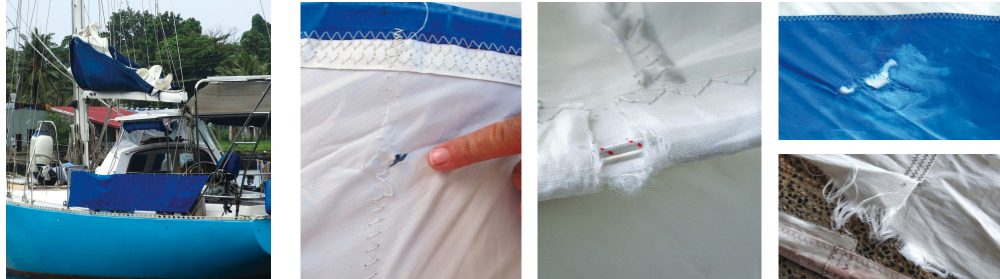
Physical damage occurs when sails slat against wire rope rigging in light wind or are tacked across standing rigging. They can chafe against lifelines and bow pulpits. They can collapse and then suddenly fill with a gust of wind. Sails may be allowed to flog or flutter along their edges.
In heavy winds, leech flutter, however minor, will rapidly turn a sail’s edge into confetti. Once a leech tape is compromised, the leech line is exposed and can become snagged on rigging. When this happens, the leech tape will rip open end-to-end.
Chafe or the abrading of the sailcloth, stitching, or webbing can occur wherever a headsail contacts a part of the boat such as spreaders, pulpit, or shrouds. Lazy-jacks, with or without a stackpack-type sailcover, cause mainsail chafe. A better alternative are lazy-jacks that stow away alongside the mast and boom, such as EZ-Jax. Chafe also occurs where a sail is attached to the vessel — at the hoist and tack shackles — and at the clew where constant movement of sheets can chafe the sailcloth and unprotected webbing.
Chemical damage
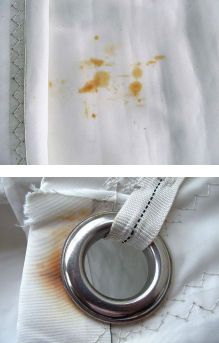
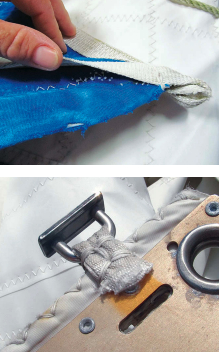
Chemical damage can occur when degrading hardware leaves a residue that stains and attacks fabric by breaking down the polymer molecules. Hanks and pressed-in rings are common culprits.
Despite the aesthetics, we prefer to not attempt to remove stains if the method necessary to do so is harsh and might further damage the cloth. We prefer to remove the contaminating element, wash the area with warm soapy water, rinse it thoroughly, and let it dry. If the sailcloth has actually been breached by the chemicals in the stain, we repair it by applying a patch.
Radiation damage
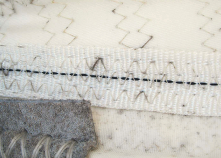
Exposure to ultraviolet radiation is the cause of the greatest damage we have seen while repairing cruising sails. Sails are exposed to UV while in use, but many headsails also are vulnerable to UV damage when furled. The same is true for mainsails. Stackpack covers have become popular and it’s common to see a mainsail sitting for days in a sailcover of this type that has not been properly closed and secured. In short, if you want your sail to last, no key load-bearing webbing, stitching, or any amount of Dacron sailcloth of a sail should see the light of day when the sail is not in use.
Most sails are protected from UV radiation using shade cloth. Sunbrella is the most widely used, though there are others, such as Solacryl. Darker colors provide better UV protection than light colors because the dyes used to make them absorb light. Darker-colored shade cloth lasts longer too.
Sunbrella has two disadvantages as a shade material: weight and poor abrasion resistance. For working jibs and genoas on a cruising sailboat, the weight is generally not a problem, though many opt for UV-coated Dacron which, in our experience, does not last as long or protect the sail as well as dark shade cloth. The bottom line: dark-colored shade cloth such as Sunbrella provides the best protection from UV for cruising sails.
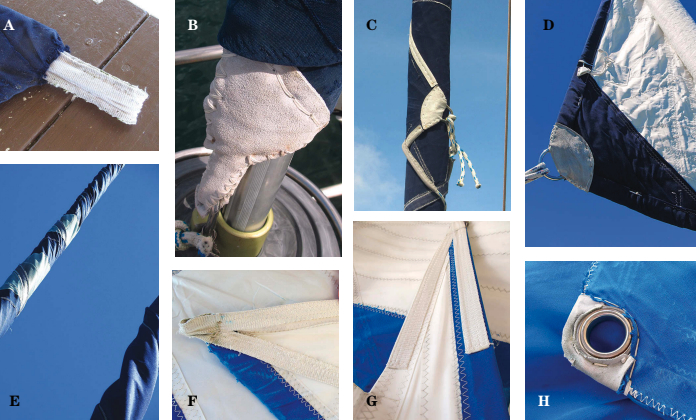
Along the exposed foot and leech edges of a furling genoa or staysail, light can sneak in while a sail is furled, so whatever UV-protective material is used should wrap around the inside of the foot and leech to the full width of the sail tape (approximately 1 1⁄2 to 2 inches for sails on the average cruising yacht).
At headsail corners, there are two issues: light leakage (as with edges) and webbing damage. Light leakage can be mitigated by incorporating a patch of UV-protective material in the inside of a roller-furling sail at all three corners.
Protecting webbing attachment points is even more important. Webbing connections on all corners of a headsail should be protected from exposure to UV radiation. Better sailmakers use tubular polyester webbing inside of tubular Spectra webbing for head and tack corners and then go on to sew a leather cover over this webbing assembly. The clew-corner webbing should also be protected from UV (and chafe) by leather. Thus, all sail corner connections are both UV- and chafe-protected on these better-made sails. This type of protection lasts a long time, years in fact, before the leather degrades and must be replaced. In the interim, the load-bearing webbing is protected, retains its strength, and lasts indefinitely.
Biological damage
Creatures such as birds, bats, geckos, cockroaches, mud wasps, and the more insidious microbes can leave biochemical residue that damages sails. Salt crystals and mildew abrade sails, but the growth of mildew also rots sailcloth by breaking down the fabric’s polymeric organic molecules. This is, after all, the role of fungus in nature.
Clean, dry sails will not mildew, whereas sails that are wet or salty (and therefore continuously wet) provide a comfy place for fungus to reproduce. Mildewed sails plague sailors in temperate and tropical climates alike.
New Sunbrella shade cloth sheds water, but this property decreases with age and UV exposure. As Sunbrella ages, it begins to absorb moisture and stay wet longer, promoting the growth of mildew on the sail it is meant to protect. In rainy climates, stack-pack-type mainsail covers left open can trap water and promote the growth of fungus on the wet mainsail.
For killing established mildew, there are many recommended cocktails of water, bleach, vinegar, or baking soda followed by sunlight. Proceed with caution when applying any harsh chemical agents to your sailcloth.
Modern sails are made of high-performance plastic materials that are damaged by physical, chemical, radiation, or biological sources. By specifying sail design features when purchasing and by learning how to care for your sails, you can mitigate such damage and keep your sails pulling longer. This is especially important if you plan to cruise to distant shores where there is no sailmaker.
Leslie Linkkila and Philip DiNuovo came to cruising and boat ownership as adults and quickly developed a passion for small-boat travel. In 2003, they quit their professional jobs and left the Pacific Northwest behind to cruise the South Pacific in their Mason 33, Carina. In April of this year, Carina was in the midst of a refit in the Philippines. Catch up with them at http://sv-carina.org.
Thank you to Sailrite Enterprises, Inc., for providing free access to back issues of Good Old Boat through intellectual property rights. Sailrite.com