A cat-rigged unballasted sharpie for gunkholing
Issue 106 : Jan/Feb 2016
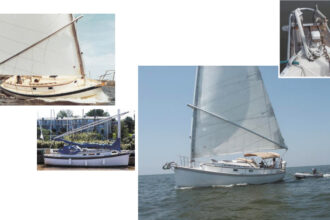
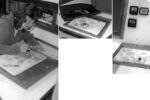
John and Julie Mohr of Seymour, Indiana, own a 1992 Bay Hen 21 named Orca. John, a cartographer, was looking for a simple boat to sail on nearby Lake Monroe when he found this boat listed on an eBay charity consignment sale. He went to have a look at it and found that, although the black hull was oxidized from 15 years of sitting outside, the sail, cushions, and canvas were in like-new condition stored inside the cabin. His was the winning bid, so he trailered it home and began to polish the hull.
As John and Julie eventually expect to sail her in the Pacific Northwest, they wanted an appropriate name for the boat, so they christened her Orca. After sailing her for a season without an outboard motor and doing little to her, John began replacing lines, cleaning teak, and otherwise spiffing her up.
John began sailing as a youth on a Y-Flyer his father had built from a kit. Later, in Seattle, he built two sailing kayaks as well. He is now also restoring an O’Day 25 in the boatyard at the Lake Monroe Sailing Association, where he keeps Orca on her trailer ready to go sailing at a moment’s notice.

Design and construction
Designer-builder Reuben Trane studied filmmaking at Columbia University, earning an MFA and making three films before forming Florida Bay Boat Company in 1981 to build boats of his own design. Those designs all had “hen” in their model name. He began production of the Peep Hen (14), Mud Hen (17), and Marsh Hen (also 17) in 1981. All the Hens are very beamy sharpie hulls for sailing in the thinnest of waters and are cat-rigged with gaff-headed sails.
The Bay Hen 21, however, started out life as the Lightfoot built by Bob Johnson, who founded Island Packet Yachts. After acquiring the tooling and starting production of the Bay Hen 21 in 1984, Reuben designed the deck to emulate some of the Atkin-designed sharpies. He changed the rig and the rudder and replaced the centerboard with twin bilgeboards. He also added a motor well in the cockpit.
In 1988, Reuben’s wife, Cheryl, died. Now a “Mr. Mom,” and having just started building the Florida Bay Coaster series of steel power cruisers, Reuben decided to proceed with the cruisers and license the tooling for the Hens to others: Mirage Fiberglass, from 1988 to 1991; Custom Fiberglass, 1992 to 1997; Sovereign America, 1997; and Nimble Boats, 1998 to 2003. The molds were scrapped after they were passed on to Marine Concepts. Reuben’s Florida Bay Boat Company built approximately 100 Bay Hens, while other builders are estimated to have produced another 100.
Reuben’s goal was to have a more comfortable boat than a West Wight Potter 15, so he designed the cabin and the cockpit to fit his 6-foot 5-inch stature, even in the Peep Hen micro-cruiser. He also favors a cat rig for singlehanding, even if it doesn’t point as well as a sloop rig. The ability to tack by simply putting the helm over makes sailing in narrow channels more manageable.
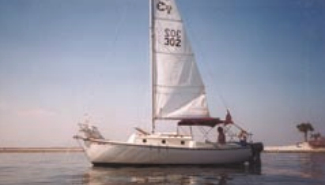
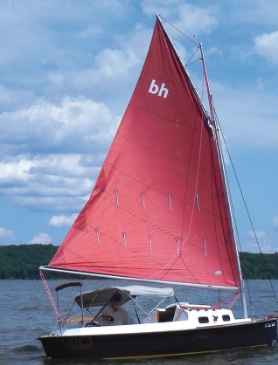
While the earlier Hens may have fit Reuben a little better than the longer and less beamy Bay Hen, the sailing principles remained much the same. The Bay Hen, with its plumb bow, canoe stern, relatively flat sheer, green or black topsides and tan deck, low freeboard, hidden motor and rudder, free-standing rig, and tanbark sail is an attractive boat with clean lines. Personally, I find it most charming with the Bimini up as well.
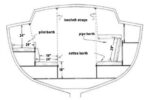
The Bay Hen is constructed of solid fiberglass using knitted fabrics — no woven roving — and resins with low-profile additives to prevent print-through. The bottom of the hull and the deck are cored with Divinycell. Reuben describes the hull-to-deck joint as a “coffee can with a flange.” It’s formed with a slurry of resin and microballoons with no mechanical fasteners and is tabbed on the inside with fiberglass. There is no interior pan or liner but the inside surfaces of the hull and deck are finished. The two bilgeboard trunks are outboard, leaving the center of the cabin open.
On deck
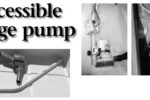
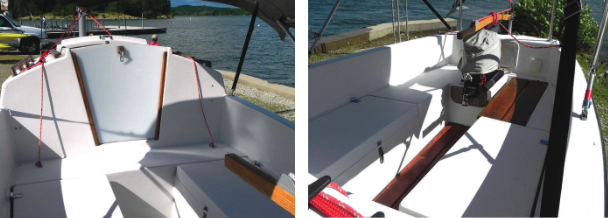
A prominent feature in the cockpit is the well for the outboard motor aft of the footwell, where the motor is right at hand and largely hidden from view from a distance. The literature says the motor can retract, but the tiller is in the way. An outboard motor will fit in the large starboard locker; there is also a port locker and a fuel tank space. The footwell is not self-draining. A Whale hand pump is used to clear water while under way and a pipe-plug allows the cockpit to drain when the boat is on a trailer. Above the canoe stern there is a short afterdeck with cleats and chocks. Access to storage in the stern is through a hatch behind the motor well.
The cockpit seats are a whopping 6 feet 9 inches long and quite wide, garnering a PNI (Penticoff Napability
Index) rating of 5. However, due to the narrow beam, the seats are a bit close together for comfortable bracing while heeled and the edges of the seats are quite sharp. The narrow coamings are not comfortable for sitting on, but are OK as seatbacks with a cushion covering the sharp upper edge. Control lines for the two bilge boards lead to the cockpit. A single synthetic board closes the companionway.
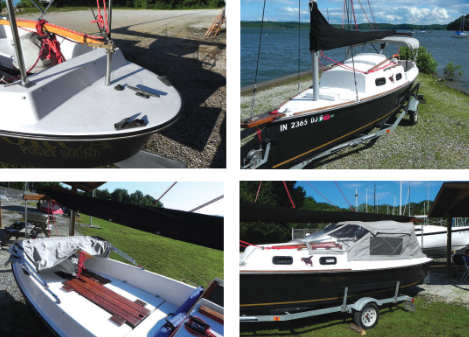
The deckhouse is high relative to the rest of the boat but teak handrails and companionway slides improve the look and add functionality. There is a large hatch in the foredeck, but getting there along the narrow sidedeck with no lifelines is a bit precarious. A short wooden bowsprit holds the anchor and a chain pipe feeds the anchor rode into and out of a locker in the bow. The rubrail is rubber with a jaunty rope edging. Because Orca has no electrical system, John uses navigation lights sold for kayaks and inflatables when sailing after dark.
A full cockpit-covering Bimini and a breezy “summer enclosure” were options on all Hens and are found on many of them, Orca included. In a small boat like this, you are expected to live outside in the cockpit. On the Bay Hen, the cockpit footwell floorboards can be used to fill the gap between the seats and transform the area to a large outdoor sleeping space inside the tent-like enclosure, which has removable roll-up curtains and screens that can be installed while the Bay Hen is afloat. John prefers to sail with the Bimini down unless it’s called for by sun or rain. When he sails with the Bimini up and no curtains, the cockpit is shaded and cool but his view of the sail is limited.
Rig
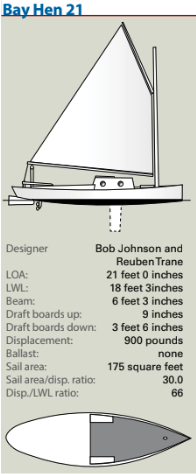
The basic Bay Hen has a tall deck-stepped tabernacle that allows the unstayed mast to be lowered over the 18-foot-long boom for trailering (or to scoot under a bridge) with both resting on a permanent gallows at the stern. The loose-footed mainsail is laced to the mast, which is a tapered aluminum tube.
One person can easily raise the mast and pin it in place, but Bay Hen owners have found that sailing loads are a bit much for the tabernacle, causing it to crack. Rather than overbuild the tabernacle, the builders of the Bay Hen installed pad-eyes so shrouds and a forestay of inexpensive 3⁄8-inch line can be attached to take some of the load off it. Orca also has a temporary bobstay to carry the forestay load to the towing eye on the bow.
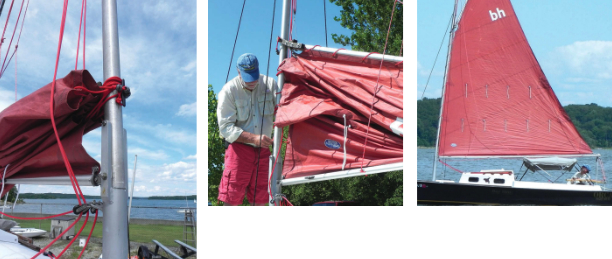
John has also rigged Orca with single-line reefing, which he says he uses “as though it were a jibsheet” to frequently reduce sail. Another way to quickly de-power the rig in a squall is to “scandalize” the sail by lowering the gaff. For a small simple-to-sail boat, the Bay Hen has a lot of line — four lines lead to the cockpit where they are tied off to horn cleats. The boom is end-sheeted to the top of the rudder stock with a cleat on the tiller.
Cabin
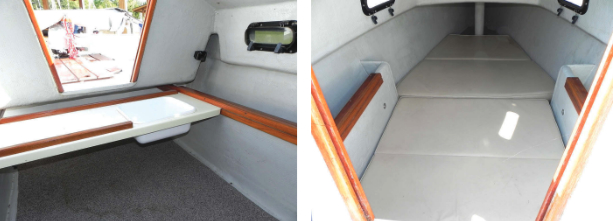
On first impression, the cabin appears spacious but, with no furniture to speak of, somewhat startling. Two large folding cushions make a full double berth on the cabin sole between the bilgeboards. Two can sleep inside and two outside under the “downpour-proof Bimini.” Seating in the cabin is on the berth cushions under more than adequate headroom. A small galley surface slides under the bridge deck. Four opening ports are fitted in the cabin sides (bronze in early boats, plastic later).
In addition to the usual “pile-it-on-the-berths” storage, there is some storage space between the hull and the bilgeboard trunks. John stows items in stuff bags he hangs on eyes mounted on a board on the port side.
Under sail
The Bay Hen is designed for a particular mission — to sail in the gunkiest of gunkholes. It will sail where the turtles live, yet can stand up to a stiff breeze with the sail properly reefed. John sails in conditions when others head back to shore and has only felt on the edge a time or two. When storms come, he heads for a creek or marsh to tie off to a tree, where he’s so well protected it’s the next thing to being on dry land. With the easily lowered mast, he can duck under fixed bridges and go where the bass boats go.
When you step aboard the Bay Hen, it feels a bit tippy due to its light weight and narrow beam. However, under sail in light to moderate conditions, it has enough form stability that crew location is not all that critical.
The bilgeboards should be tacked when sailing to windward. Fully down they draw 3 feet 6 inches, which John then uses as his “depth finder.” Raising them is quite easy, but pulling on the pendants can cause water to come out. Also, water can shoot out in a stream at higher speeds. I found the tiller a bit too high when sitting on the cockpit seat, but it was OK when sitting on the coaming . . . except sitting on the coaming is not comfortable.
Water gurgles in the motor well and, particularly while motoring, a little will splash out onto the the helmsman’s leg. Under sail, the balanced rudder has a good feel and the Bay Hen tacks quickly because it is essentially sitting on top of the water like a canoe. The helm is light when the sail is properly trimmed to the point that, with the tiller fixed in position, the heading can be adjusted with the mainsheet. As one would expect with a sharpie hull, it pounds in a chop and can have a quick motion unless heeled a bit to get the chine down. It accelerates well due to its light weight and minimal resistance. I liked being able to steer the boat while dragging my feet in the water — that’s low freeboard! Passengers and crew can do likewise to cool off on a hot summer day.
John says that Orca can surf in the right conditions but she also moves in a whisper of air. I found she was not directionally stable, but that was easily corrected with the rudder.
Most of the Bay Hen’s draft consists of the propeller and rudder protruding below the nearly flat hull. Unfortunately, the motor does not tilt up easily and the rudder not at all. However, with just 9 inches of draft, she will float in a puddle, sail in 12 inches of water, and go to windward in 18. I don’t doubt that some Bay Hens are outfitted with oars rather than an outboard.
When approaching a dock, some planning is needed as there is not much of a place for crew to stand while preparing to hop onto a dock with lines. It may be best to send crew to the bow through the forehatch, because the sidedecks are narrow and there are no lifelines or shrouds to hang on to.
Conclusion
The Bay Hen 21 is one of those boats that has a strong following among a certain set of sailors who find the traditional appearance, shoal draft, and ease of setup and trailering very appealing. I live near a river that is big enough to sail on but for many low fixed bridges. The Bay Hen would be an ideal boat for it.
It is not a very fast boat. John jokes about it, saying, “I think it has a PHRF of 900.” Although it has the sail area/displacement ratio of a ULDB, it was never intended to go fast or to sea. While he does enter Orca in some local races for fun, John’s usually last across the line.
Other than the problem with the tabernacle, there is little to go wrong on a Bay Hen since they were built with good-quality materials and craftsmanship. It’s important to remove the drain plug when storing the boat outside on land, although water will drain through the motor well before it overtops the bridge deck. And the motor well seems to be a place where missing things go, according to John.
Most Bay Hens seem to sell in the $7,500 price range and, if the enclosure is missing, John says a replacement will cost about $2,500. Several are usually listed on www.sailingtexas.com. The various Hens have an ardent following, and some information can be found at www.peephens.org.
Allen Penticoff, a Good Old Boat contributing editor, is a freelance writer, sailor, and longtime aviator. He has trailer-sailed on every Great Lake and on many inland waters and has had keelboat adventures on fresh and salt water. He owns an American 14.5, a MacGregor 26D, and a 1955 Beister 42-foot steel cutter that he stores as a “someday project.”
Thank you to Sailrite Enterprises, Inc., for providing free access to back issues of Good Old Boat through intellectual property rights. Sailrite.com