She looked the part . . . but now she also walks the walk
Issue 106 : Jan/Feb 2016
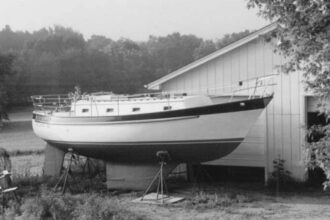
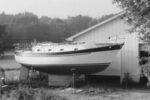
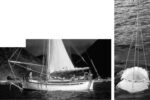
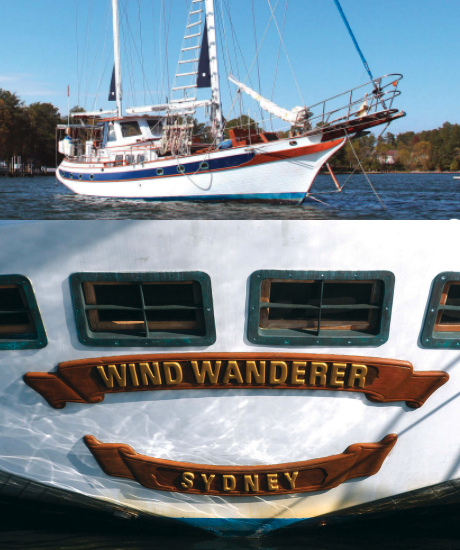
We bought our CT 54 from a couple who had been cruising on her for a few years, always with at least another couple as crew. This is not unusual for a full-keel heavy-displacement boat of 30 tons and close to 65 feet overall from bowsprit to the furthest edge of the dinghy on the davits. (That’s the way the Panama Canal Authority measures it and some marinas now do the same.)
We’d hunted far and wide for a boat we could call home for this chapter of our lives, fully expecting to find a Vagabond 47 or similar with an aura of faraway places and a piratey feel. We hadn’t planned to buy a small ship! But we bought our CT 54 when we’d run out of steam and just wanted to get on with it. Since she was already doing what we wanted her to, taking her on had to be easier than turning a dock queen into a bluewater cruiser from scratch.
We took over from the previous owners in the Cayman Islands . . . in hurricane season. We planned to sail to San Blas for the season and then make our way across the Pacific back home
once again to Australia. Within days, we realized we had much more to do to the boat before Sandy and I would be able to handle her. This called for a radical change of plan.
An old sailing buddy who lives on the Sassafras River, at the top of Chesapeake Bay, suggested bringing any boat we bought there if it needed work. We’d never dreamed of actually doing that, but never was an offer more welcome. Tom Lemm joined us in the Caymans and we headed for the west end of Cuba and on to Key West. The transmission failed a day into the trip so we had sails only. We sure needed the extra pair of hands, not to mention Tom’s experience having done half a circumnavigation in his own boat before putting an engine in it.
By the time we reached the Sassafras River, our list had grown dramatically. Not only had we repaired the transmission on the way, but the freshwater pump on the Lehman diesel engine had failed, too, and we repaired that in the friendly town of Southport, North Carolina. A large stainless-steel bracket on the boom holding three bails for the mainsheet also let go one night in 20 knots. Even without an engine we managed to turn into the wind and wrestle the sail down. So much for just taking over a boat that was already in use as a cruiser!
Our couple of months to tackle a few jobs turned into eight months. The list grew daily, but each decision brought us a step closer to having a home on the water that could take us anywhere. Naïveté is pricey, but we’d made a start and I must give enormous credit to the guys on Cruisers Forum for their input. They’re an amazingly friendly, helpful resource and we soon discovered which ones genuinely knew what they were talking about.
The list
The original list was short, just five items. Unfortunately, each item had several sub-categories. And then of course there were the “extras” we discovered along the way.
Ground tackle – Make a new, stronger, through-bowsprit stainless-steel fabrication for the anchor. The existing one flexed and jammed the links whenever the chain came in at an angle. We ran aground discovering that in North Sound in the Cayman Islands just after the anchor had broken free. A subsection was the chain locker. A chain mountain would quickly stop chain from going down the chain pipe. This meant that Sandy would be on the helm trying to prevent 30 tons of boat from hitting anything while I dashed below to knock over the mountain and back up again to get the rest of the chain in.
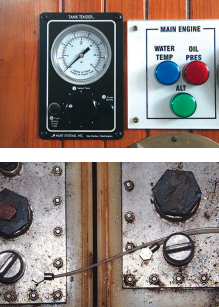
Tanks – The previous owner told us with great pride that they’d replaced the old tanks with polyethylene. But all four fuel tanks leaked diesel from the outlet connections and we couldn’t use one of the two water tanks because it had a split top seam. The fuel lines had been disconnected as “too complicated.” Instead, the previous owners had pumped diesel from each tank with a small transfer pump. This was hooked up to the battery bank with crocodile clips, and tubing snaked across the saloon floor into the tank that fed the engine and generator.
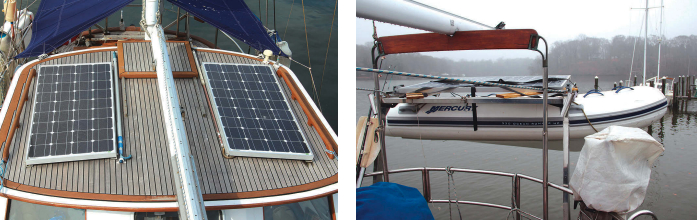
Solar panels – We quickly found ourselves having to run the generator for 2 to 3 hours, morning and evening, to keep the relatively new Trojans charged. The davits and cockpit dodger were going to start earning their keep!
Davits – There was no way to climb from the dinghy back onto the deck 7 feet above the water at the transom without serious gymnastic skills.
Sails – Even with lazy-jacks and an attached sailcover, the mainsail was a nightmare in a blow. The boom is 6 feet off the deck; the only way to reach it was to climb the ratlines and from there it was still a hazardous stretch over to the boom. It was manageable at anchor but a disaster waiting to happen if anything went wrong at sea. A drastic change was needed here. We later found out that, even with crew, the previous owners motored this boat more than they sailed.
So, there you have it: just five little jobs to turn what we thought was a cruising sailboat into a bluewater cruiser that would work for a sailing couple.
Attacking the list
Once we were secured at Tom’s home on the Sassafras River, the work began. A bonus was that we got to experience life in a small Maryland town complete with autumn colors and long wispy V formations of Canada geese overhead.
Ground tackle – While Tom built a new, heavier-gauge stainless-steel structure complete with new Delrin rollers and a split stainless-steel pipe to create a smooth, round entry, I concentrated on the rest of the ground tackle. The rusty chain needed re-galvanizing. A company in Baltimore said they could hot dip it and I could save time and money if I could first remove all the old rust. It’s amazing what a few miles of quiet dirt road can do for 280 feet of rusty chain dragged behind a pickup. Well, OK, some of the road was tarred.
After the Cayman experience I had no confidence in the 65-pound CQR. I was keen to get a new-generation Rocna-type anchor, but most have a rollover bar that can’t fit under a bowsprit without major surgery. In the end the decision was easy. I found a cheap secondhand 105-pound CQR and figured the 60-percent increase would do the trick. It has. Now we don’t drag. If we’ve ever moved, the continent has moved with us!
The chain locker had lost a deflector board, which caused the chain to pile up and jam at the chain pipe outlet instead of falling to the deepest part. Our reason for galvanizing the chain was because the rust kept it from sliding on itself. In the end, we fitted a 4-inch PVC down pipe at an angle, reinforced it with fiberglass, and secured it so the chain was able to fall and pile up properly.
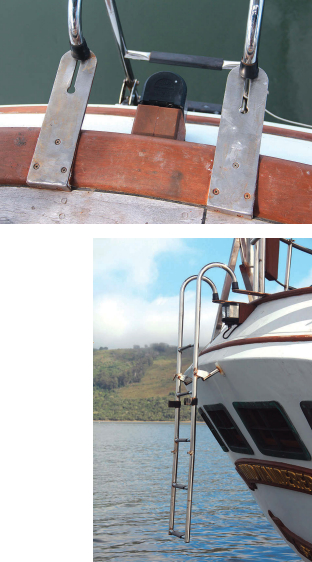
Davits – We tackled the other end of the boat next. That was partly triggered by the Annapolis Sailboat Show. The dinghy that came with our boat was a wreck and boat show specials certainly help stretch the budget. The most bang for our buck was a Mercury Oceanrunner 330 RIB.
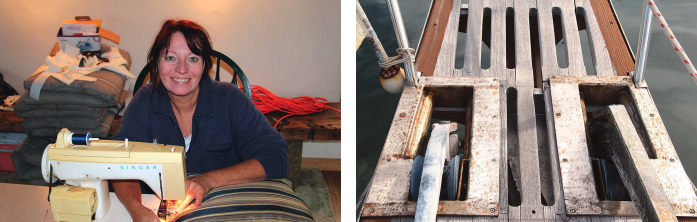
The problem of getting back on board once the dinghy was hooked to the davit lines was solved easily. There was already a gate in the middle of the pushpit rail. We mounted two heavy-duty stainless-steel tangs with keyhole slots on the teak caprail to hold a folding boarding ladder. Large round head bolts on the ladder’s arms slide into slotted deck fittings. When extended, it reaches to the dinghy and, once I’ve got the dinghy hooked on, I can clamber back on board. I then have to unhook the ladder because the rising dinghy would catch it, but that is a simple process.
Because of the transom’s profile, the two legs that hold the ladder away from the boat need to be rigid and at the correct angle, so we had to weld them. I also replaced the black rubber feet that wear through very quickly with white nylon plumbing tee pieces. A simple clip-on safety line ensures that I never drop the ladder overboard.
Solar panels – Our objective was to get as much solar power as we could without making Wind Wanderer look like an aircraft carrier. I should first confess that I understand electronics about as much as voodoo. Both require a high priest.
Our davits are too small for two panels of the types most commonly used and big enough to make just one panel feel like a wasted opportunity. I eventually found a 320-watt panel on eBay that was an ideal fit, but designed for domestic and commercial use with a much higher voltage output. This was a serendipitous discovery. The davits and boat had already been wired for a solar panel, but with a smaller gauge wire than we’d normally need if we didn’t want to lose most of the panel’s output by the time it got to the battery bank. The high-volt panel meant we could use the existing wire without that loss, according to the high priests. We just needed to buy the right controller, a TriStar MPPT, and it would work. We did, and it does.
The next location for solar panels was the top of the cockpit hard dodger. Again eBay came up with two 140-watt panels that would fit on either side of the sliding hatch. We mounted them on aluminum L sections. In this instance, there was no previous wiring, so we could pick the correct gauge for the current and distance. Of course, having shelled out for a top-quality controller, I figured I’d be able to use it for these panels too. The priests said no. So we shook the piggy bank again and bought another smaller, cheaper controller that would do the job.
So we now have 600 watts of solar power feeding a 1,125-ampere-hour battery bank of 10 Trojans wired to deliver 12 volts, and yes, we did end up replacing the supposedly 2-year-old bank of batteries because they’d been hammered. We now only need to run the generator on rainy days or at night for an hour and a half on passages when the autopilot, navigation lights, chart plotter, radar, AIS, refrigeration, and probably a movie are sucking the life out of the batteries.
Tanks – I spent days in the bilge tracking and then drawing the maze of disconnected fuel lines and trying to determine exactly where the tanks were leaking diesel. I learned that makers of polyethylene tanks use an “available to industry only” product called EM 69. Eventually, I managed to track down the manufacturer and buy a couple of tubes. I drained the tanks two at a time, removed the fittings, cleaned everything with acetone, and sealed them back in with the EM 69. To date we have had no more leaks. I also used this to seal the split water tank, which I was able to access after I’d taken out all the batteries that had to be replaced.
The fuel system was a maze of valves and filters with a potential leak point at every connection. We simplified it so that each tank had a valve and fed into a common line. All the filters had to go. They were a South African brand and elements were not available anywhere. We replaced them with two Racors, one port and one starboard.
Now fuel can be supplied from any tank simply by opening its outlet and return valves. The fuel gauges were brought into the 21st century too. Out went the notched sticks and, after much deliberation, we installed a Hart Tank Tender. Easy to install, no electronics, and we can monitor all of our four diesel tanks and two water tanks on the same gauge.
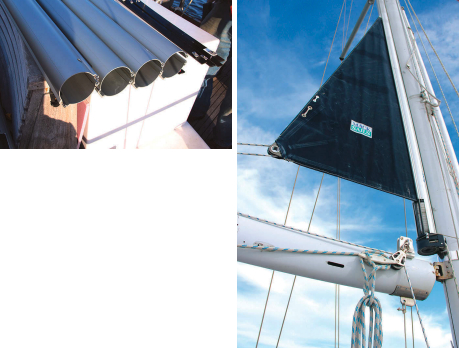
Sails – This broke my heart. The sails, lazy-jacks, and sailbags were all in good condition, but they simply were not manageable for a couple of oldies who did not want to rely on an ever-changing stream of backpackers for crew. After a ton of research, we decided the only system we could afford was behind-the-mast roller furling. If we’d had a bigger piggy bank, I’d have chosen one of the modern in-boom furling systems, but they were way out of reach.
After the haggling was done, we ended up with the Facnor system. I liked the fact it was designed as an install-it-yourself product, came from a company that is a supplier to the French entries in major ocean races, and was neat-looking with everything furling into an aluminum housing. I was assured their system could handle the size we needed.
Eventually all 14 boxes arrived, eight for the main and six for the mizzen. The old sails came off and I spent hours up the masts removing the old Battcar tracks and installing the new system. I don’t have a head for heights at the best of times, but in winter it was deadly. Every few hours they’d lower me down and shove a mug of hot coffee into my cramping hands to thaw me out.
The instructions had been translated from French, probably by someone in China, into an approximation of English, but we eventually had everything installed. Mack Sails supplied the new mainsail and mizzen and they fitted perfectly. We ran the outhaul and furling lines back to the cockpit, which is much easier said than done and in fact took a full week.
I would love to be able to say it was a success from the start, but it wasn’t. I can’t count the number of times I caught myself muttering, “The French really should stick to food and wine . . . ,” usually with some choice adjectives. Two years and 20,000 miles later, however, we had a properly working system. Numerous outhaul lines chafed through as we slowly moved, realigned, reengineered, redesigned, and reinforced blocks, brackets, bolts, and tracks.
The upside is that it has enabled just the two of us to sail a 30-ton ketch around this little blue planet. I believe, in spite of their reassurances, that the Facnor system was stretched beyond its limits on a boat of this size.
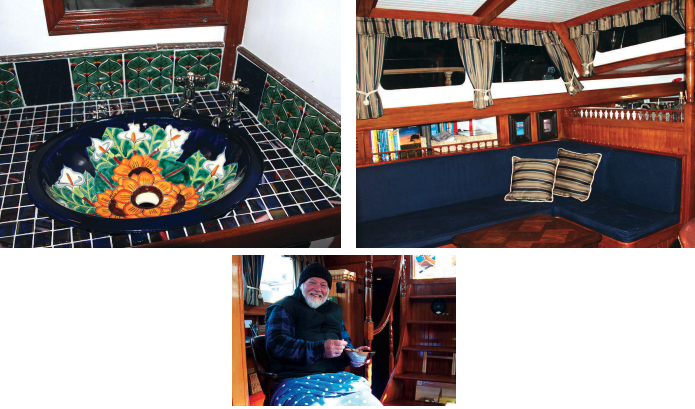
Just five little projects . . .
That would be the case if we don’t mention that Sandy replaced all the basins with beauties from Mexico complete with mosaic and tiling around them. She stripped the peeling Cetol from all the outside teak and recoated it with a teak oil sealer. And she made new curtains and cushion covers. Then there was the new name on the teak nameboard and a new exhaust system for the main engine.
Eventually it was all done and we set sail. We could not believe what we’d had to do to make an already outfitted cruising boat into a truly capable bluewater cruiser. As we near the completion of a circumnavigation in early 2016, I guess we must have got it mostly right. In hindsight, it’s been worth every bit of the work it took to prepare our boat for cruising.
Vic Hankins has messed around in boats since childhood in South Africa. He migrated to Australia in 1977 where he owned a number of boats. Sandy grew up in Australia with big dreams but no boating experience other than a bad Hobie Cat capsize. Together they decided there was just enough time to add a sailing chapter to their lives before Father Time pulls the pin. At press time, Wind Wanderer was in Luderitz, Namibia, preparing to cross the Atlantic and close the loop.
Thank you to Sailrite Enterprises, Inc., for providing free access to back issues of Good Old Boat through intellectual property rights. Sailrite.com