Keeping leafy greens fresh without a fridge
Issue 108: May/ June 2016
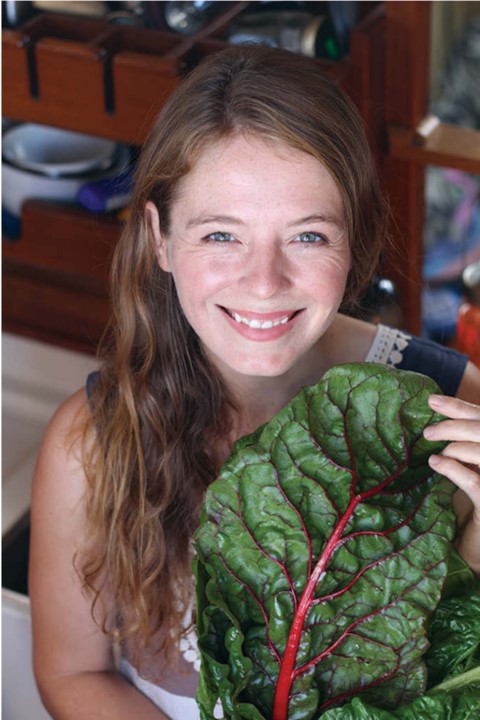
When my partner, Robin, wants to get my attention, he’ll come home with a big beautiful bouquet of freshly cut collard greens. If it’s a special occasion, maybe a dozen stems of rainbow chard. I’ve always liked greens and, as anyone who’s lived without refrigeration can attest, nothing says “I love you” like a fistful of organic arugula.
Robin and I have been together for three years and we’ve lived without a fridge for two, buying ice only when we have meat or dairy to keep. This is in large part due to our magical “green bar” (cue infomercial music) that allows us to keep our greens green for a week. If you’re looking to free up space in your fridge, reduce power consumption, or just plain don’t have refrigeration, read on.
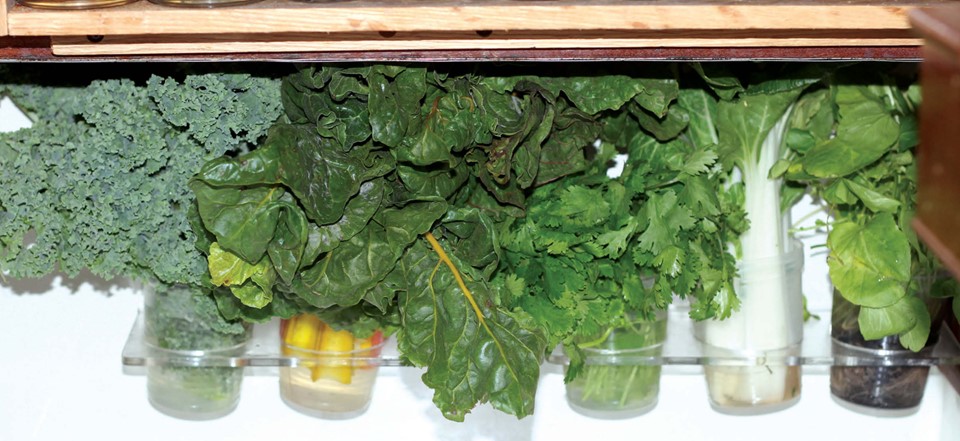
Our green bar is a rack that holds cups of water. At the moment, the residents include kale, bok choy, rainbow chard, cilantro, romaine, and watercress. With the exception of the cilantro (a problematic tenant), all of these can last a week if we don’t eat them first. It’s very clean, easy to maintain, and is rated to hold everything securely up to (and possibly beyond) a small craft warning (a rating we had the pleasure of testing off the Oregon coast last fall).
Cut greens wilt due to water loss, but if you keep them in water, capillary action will draw the water up into the plant, keeping the cells alive just as capillary action keeps cut flowers looking fresh. You can help your greens last longer by cutting an inch off the bottoms of their stems before putting them in water. Use clean water and change it every two or three days, otherwise the water will begin to foul.
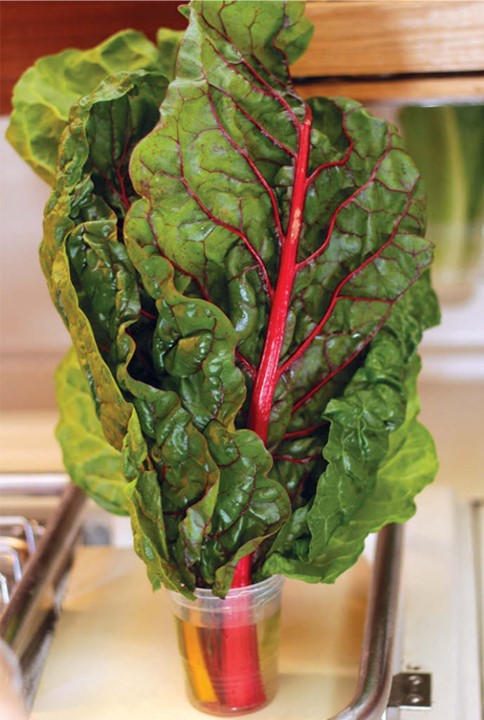
A simple rack
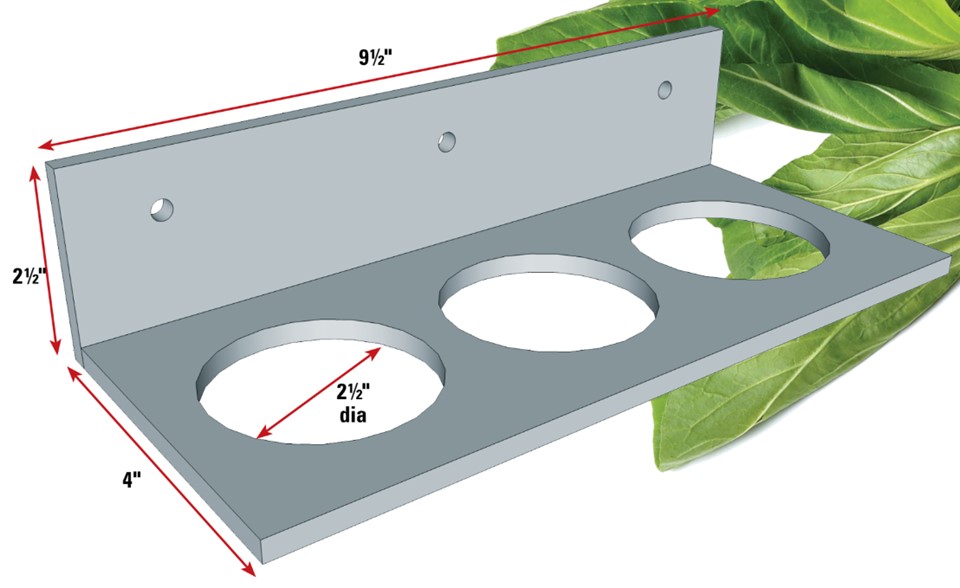
Designing and building a green bar is surprisingly easy. Ours consists of two 1⁄4-inch-thick Plexiglas racks measuring 4 x 9 1⁄2 inches for the base and 2 1⁄2 x 9 1⁄2 inches for the back mount. The rack has three 2 1⁄2-inch-diameter holes cut at regular intervals to hold the cups. Alternatives to Plexiglas are wood or StarBoard. Use a hole saw appropriate to the size of cup you plan to use.
It can be tricky to find cups that fit. I like Bernardin’s plastic freezer jars (with the purple lids) as they taper from 3 to 2 inches and can fit a range of cup racks. You can find them wherever canning supplies are sold. Once you have your bar set up, mount it in a cool place away from direct heat and sunlight.
If you’d like to discuss this or let us know how your green bar has worked for you, please reach us through our website. May your greens (and relationship) always be fresh!
Fiona McGlynn and her partner, Robin Urquhart, left Vancouver in 2015 to sail south on their 1979 Dufour 35, MonArk. Follow their voyage and their reflections on where it is taking them, physically and metaphysically, at www.happymonarch.com.
Thank you to Sailrite Enterprises, Inc., for providing free access to back issues of Good Old Boat through intellectual property rights. Sailrite.com