When the self is inseparable from The Water
Issue 109 : Jul/Aug 2016
The Water is always there. The Water forms a continuous thread through my life from my earliest memories to this moment. It has been the basis of my obsession and my identity. No matter what my occupation or status in life, my sense of self has always been, and remains, as a sailor. For years, I was fully immersed in this identity, living at sea for months at a time, practicing my profession in the deep waters. For many more years, The Water existed only between the covers of books about the sea and seafaring, as life imposed other demands. But, in one form or another, it was always there.
Stilt houses and a rowboat
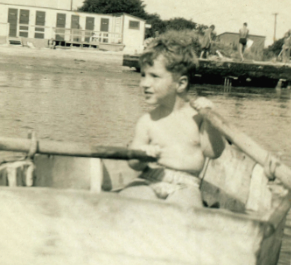
My first memory of The Water is of visiting friends of my parents at the age of 5 or 6 in 1945 or ’46. The Ryans had a summer house built on pilings in the middle of a Long Island harbor on the South Shore, probably in Hempstead. It was reached by boat from the public dock and parking lot. When we arrived, one of the Ryan sons picked us up in an outboard-driven wooden rowboat. I still remember the smell of the oil/gas fuel and its exhaust and the sheen it left on the water. I boarded the boat and took a seat in the middle, watching the “big kid” (probably 18 or so) pull the rope to start the engine. I watched in awe as he confidently piloted the small boat. Later that day I overheard Mrs. Ryan and my mom talking about him. Mrs. Ryan said he had dropped out of school because he could never learn to read, but they were not worried about him because he could fix any type of engine. He would always be able to find a job.
A boat dock on the pilings led to a stairway to the first-floor wraparound porch of the building that was described as an old “whaler’s hotel.” I suspect that Mr. Ryan and this house figured in some way in my father’s shadowy rum-running history. It was a very old building — much larger than the other stilt houses in the harbor — with a look of abandonment about it. It had one large room on the first floor with a dusty, unfinished, weathered bare wooden floor, much like a boardwalk, and a long bar, where we played bartender. The second floor had several modest bedrooms, some empty. In retrospect, it could have been a hotel or some other sort of short-term accommodation.
It was at this house that I had my first lessons in rowing a boat. Dad tied a long rope to a 6-foot rowboat the Ryan boys had outgrown and let me row around to its limits. Here, I learned how a boat moves. We took it home on the roof of our car. I had my first boat.
Adventures with Gus and Gert
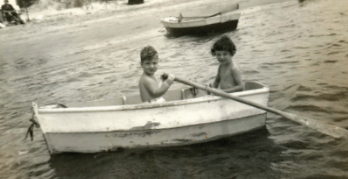
At home, our next-door neighbors, Gus and Gert Dietrich, owned the gas station on the corner of our street and had a cabin cruiser, the Gert D, they kept in the nearby port village of Freeport, Long Island. My parents and I went fishing with them several times each summer. The route from their boatyard to the open bay took us past the home of the famous bandleader Guy Lombardo and his boathouse, where his yacht, Tempo, and his national champion hydroplane raceboat, Tempo VI, were visible as we passed by. In the Gert D, I learned to steer a “real” boat with a wheel and inboard engine rather than just a pair of oars. We usually took my little boat along on these excursions for me to mess about in while the Gert D was anchored.
A frequent end to these outings involved Mom, Gert, and me. The three of us would take one of the cars home, leaving the other for Dad and Gus to drive in the morning after they had sobered up. They usually stayed at the dock after dropping us off, but occasionally would go out in the bay and anchor overnight. This sometimes led to interesting adventures, like the night the anchor floated.
As the tale is told, having reached an impressive level of intoxication, the sailors decided to anchor for the night. Capt. Gus picked what seemed a likely spot and deckhand Jack on the bow picked up the anchor and cast it overboard about 20 feet from the boat. He blinked, refocused his eyes as best he could, and saw the anchor floating on top of the water. “What the hell kind of damn anchor have you got that floats?” he yelled.
Gus turned the searchlight on the end of the anchor line and sure enough, there the 10-pound anchor sat, on top of the water. It turned out they were very close to a sandbar that was only covered by 1 or 2 inches of water, and that is where the anchor landed. From then on, whenever these two announced an overnight trip, someone would warn them, “Watch out for floating anchors.”
Understanding a wooden boat
When I was 12, we moved from my childhood home to a town where I could walk to a body of water for recreation and contemplation. I loved sitting on our town dock and watching storm waves break against the bulkhead, throwing spray and solid water toward me. I was always alone on these expeditions to the bay, as I was much of the rest of my time. I had few friends at school as I had recently left my childhood playmates behind.
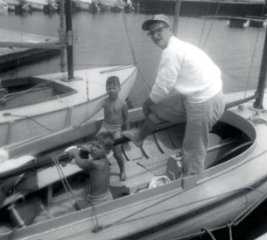
As compensation for this dislocation, my father bought me an 18-foot wooden Cape Cod sloop, vintage 1920s or ’30s, to restore and make my own. He found it in the backyard of a couple whose son had not returned from World War II. By 1952 it had been sitting in the yard for several years and was very much the worse for wear.
When we came to collect the boat with Dad’s pickup truck and improvised trailer, I had the feeling they were saying goodbye to an important link to their past, something valued at far more than its $100 price. Here, I began to learn the difference between value and price.
That boat became a focus of my days. In fall and winter, with my carpenter father’s help and skill, it was an object of work and restoration in the backyard. I spent hours on my back with a scraper cleaning the toxic and pungent red copper-based paint from the bottom, cleaning out the seams between the wooden planks and filling them with cotton and putty, my arms aching. Here, I learned how a wooden boat works and how it relates to the water. The boat floats on the water, it is true, but the relationship is much deeper than that. A dry wooden boat will leak and possibly sink when first launched. The water has to slowly penetrate the fibers of the planks and swell them tight one to another. The relationship of a wooden boat to water is intensely intimate.
Freedom to roam
In summer, the boat was an escape and a vehicle of freedom. I kept it at the town dock, which was free to local residents, including the watermen who tonged for Blue Point oysters in the waters of the Great South Bay.
On a sailboat, once free of the land, you can go anywhere. The entire 5- by 20-mile expanse of the Great South Bay was open to my exploration, from the Long Island shore to the Fire Island barrier beach. With no motor or radio, my experience on those waters was no different from that of a boy in the 18th or 19th centuries. I learned to visualize the wind, waves, and currents as forces to be accommodated and adapted to in order to get my boat to its destination. I also learned the feeling of motion in multiple dimensions, plunging forward while heeling and also rising and dropping with the waves. After a day of sailing, that feeling would remain as a pleasant vertigo for a while, like a ghost of the experience.
I was fortunate to live in a time when early adolescence meant freedom to explore and wander without adult oversight, interference, and supervision. I could leave the house on a summer morning with an “I’m going sailing” and not be accountable to anyone until after dark. I regret that my grandchildren will never know such secure freedom.
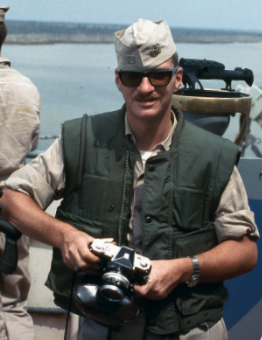
From that point until my early 30s, I either owned a boat or lived and worked on a ship at sea. As a part of those experiences I learned much more: how to find my way across an ocean by the stars and planets, the excitement of entering a foreign port for the first time, the challenge of surviving a storm at sea, and how to lead a team of men to cooperate in moving a vessel from Point A to Point B over the sea. For the rest of my life, the idea of interacting with the The Water in some way, either physically or through intellect and imagination, has given me my sense of self.
Jerry Richter has been messing about in boats since about the age of 5 and started solo sailing at 12. He has owned and crewed on coastal and offshore sailboats for the past 20 years. He served as a celestial navigator on an LST for two trans-Pacific crossings during seven and a half years of Navy sea duty. Jerry is now reliving some of his maritime experiences in writing.
Thank you to Sailrite Enterprises, Inc., for providing free access to back issues of Good Old Boat through intellectual property rights. Sailrite.com