Clip-on solar lights illuminate and identify
Issue 114: May/June 2017
For about $5 each, I made wireless lights that I can install anyplace on the boat we have a 1-inch rail to clip them on to. They burn almost all night and take no power from the house batteries. Rather than barbecue in the cockpit with a headlamp, I clip one of the lights nearby and have plenty of light to see what I’m doing. When Country Dancer is on the hook, the lights help us find her in the anchorage, and they are better than a masthead anchor light at making the boat visible to close-in traffic. For overnight passages, the lights can be quickly unclipped and stuffed into a bag or ice chest.
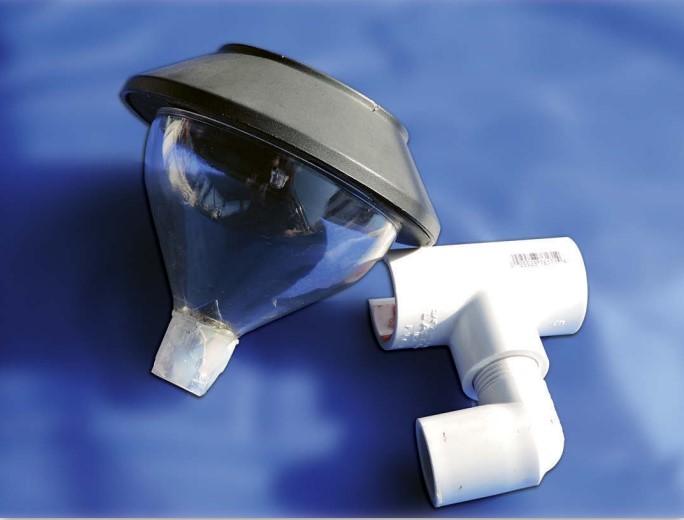
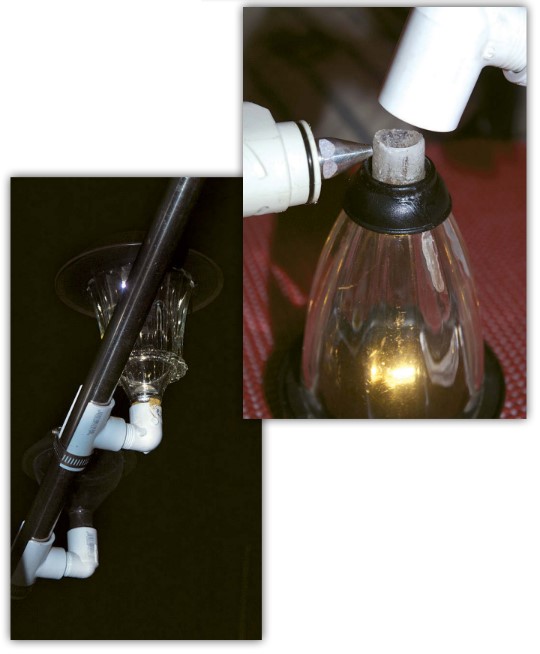
All I used to make these lights were high-intensity solar yard lights and 1/2-inch white schedule 40 PVC plumbing parts. I use yard lights with a rated light output of 7 lumens; anything lower is a waste. Also, I found that lights with plastic lenses are lighter than those with glass lenses and thus less likely to cause their mounts to rotate.
To mount each solar light, I used a 1/2-inch PVC saddle tee with a threaded female end and a PVC elbow with a threaded male end. (These components are used in sprinkler systems to add a sprinkler head in the middle of a run without cutting pipe.)
To assemble my lights, I first screwed the elbow into the tee — snugly but not too tightly, as I needed to be able to rotate the elbow later. Next, I cut the plastic “leg” on the solar light down to a stub, then secured the stub into the female end of the elbow with hot-melt glue.
Multiple uses
On Country Dancer, I clip these lights on to our bimini frame, lifeline stanchions, or bow pulpit rail. Sometimes I’ll clip a few to our solar-panel array, where they don’t interfere with night vision, don’t tangle in the sheets, and are high enough to be easily visible on our late-night dinghy rides. Whether I mount them on a vertical rail or horizontal rail (or something in between), I can rotate the elbow in the tee to orient the light.
Lights of various colors can be added to distinguish a boat from others in a crowded anchorage. For offshore duty, or if a saddle tee is a bit loose, a small hose clamp will hold them very securely.
While in the Bahamas, I decided to make a couple more lights to better mark our boat in the anchorage, but I couldn’t find a store that sold the saddle tees. Instead, I bought regular PVC tees and used our Dremel tool to cut away material until I had saddle tees. (I’ve also done this to make lights for rails of different diameters from PVC tees of matching diameters.) When a saddle tee slides around on the rail too easily, I stick a layer of electrical tape on the underside of the saddle to increase friction.
I highly recommend using the cheapest lights available, as long as they’re 7 lumens or brighter. Because of the way we use ours, they become gifts to Poseidon more often even than expensive sunglasses, so it pays to make a few extra.
Gary Bratton went to the University of Washington, was a professional motocross racer, home builder, realtor, general manager of a boatyard, line supervisor at Endeavour Yachts, and started an IT consultancy in 1990 that he sold in 2007. He and his wife have been full-time cruisers since 2013.
Thank you to Sailrite Enterprises, Inc., for providing free access to back issues of Good Old Boat through intellectual property rights. Sailrite.com