It removes the aroma before it can envelop you
Issue 115: July/Aug 2017
Ah, the holding tank, that place where we store our waste until we can find a pump-out station. In a perfect world, a marine holding tank will hold the waste in an environment where helpful bacteria and oxygen digest it into a non-toxic low-odor liquid. But holding tanks are small, and don’t allow the bacteria enough time to do their job — a family on a weekend outing might easily fill a 30-gallon tank — so the contents never lose their redolence.
Our boat, a 1997 Packet Cat, has a single 30-gallon aluminum tank that receives waste from two heads. All the hoses connected to the tank, including the vent line, are 1 1⁄2-inches in diameter and are of the highest quality I could find, the least likely to become permeated. To me, they’re worth the extra cost because they’re effective; we don’t suffer with head smell down below. Topsides, well, that’s another story.
With every flush, the unmistakable aroma discharged from the vent made us retch, or at least scrunch up our noses. At times, depending on the strength and direction of the wind, the stench dissipated quickly. But when conditions were not favorable, the unpleasantness lingered . . . until I solved the problem.
In theory, a well-ventilated tank that contains aerobic bacteria will produce no noxious fumes. But, as noted above, even in a system that’s well-designed and well-maintained, if nature lacks the time to perform its function, that odor is the result. So, what can be done?
Looking for solutions
For many sailors, the answer is holding-tank additives, which fall into several categories: enzymes to boost digestion, deodorants, and surfactants that disperse fats and solids. Holding tanks can benefit from any of these additives, but each has shortcomings. Enzymes promise no odors, but need time to work on the waste. Deodorants are very harsh chemical compounds with toxic side effects and their own recognizable smells. Surfactants may keep the tank’s interior clean, but they do nothing to eliminate odor.
Others tackle the problem by relocating the holding-tank vent discharge in the hope that airflow around the boat will carry the problem away. But airflow around a boat is never constant, changing with the wind’s direction and strength and the boat’s heading and speed. Some builders have located the vent discharge on the transom, but many hull designs tend to generate an airflow eddy back there while under way, a low-pressure area that can cause the smell to follow the boat for miles; think of a station wagon’s dirty rear window. And on quiet nights with little or no breeze, odors often dissipate slowly, seeming to envelope the boat in a cloud no matter where the vent discharge is located.
I needed a solution that would work all the time, no matter the state of the aerobic condition of the tank or the vent discharge location. That solution was an adsorptive filter in the vent line.
Filter facts
An adsorptive filter contains a medium, usually charcoal, that traps odor-causing gas molecules on its surface. Every flush sends water and other material into the holding tank. The gases thus displaced from the tank pass through the filter, which removes the offending molecules. The result is no more foul tank odors on quiet nights on the hook or while in the marina.
To remain effective, the filter and its medium must remain dry. In fact, if the filter housing should fill with liquid, due to backup from an over-filled tank or spillage when a sailboat heels, the vent line will become blocked and no air will pass in or out of the tank. The result is bad, bad news. Without the ability to vent, the holding tank and connecting hoses will become pressurized. Think about a hose popping off a fitting. At pump-out time, waste would overflow the deck fitting, and a blocked vent line could lead to a vacuum in the tank, and possibly to the collapse of the tank and hoses and damage to head valves.
Bearing in mind these cautionary notes, I decided on the vent filter because of the way we use our boat and the reported success of these filters in removing the offending aromas.
The installation
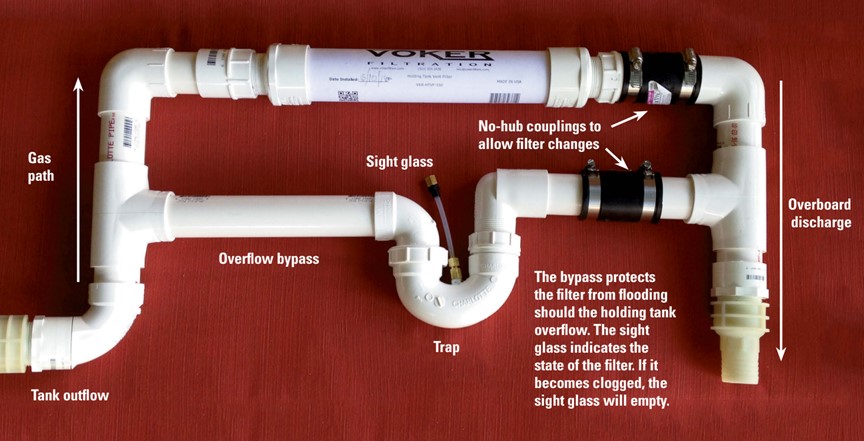
To prevent liquids from reaching the filter, I designed a system with a bypass plumbed into the 1 1⁄2-inch vent line. Having a vent line this large was both good and bad. Good because there is excellent air movement in and out of the system, bad because of the space 1 1⁄2-inch marine sanitation hose takes up.
My first attempt at fitting the filter and bypass was good in theory, but my execution was poor and the system was leak-prone and ineffective. I created two paths for air to move into or out of the tank. One path was through the filter. The other was a waste overflow line with a water trap intended to keep tank gases from escaping the tank, in the same way the trap under a kitchen sink keeps sewer gases from entering a home.
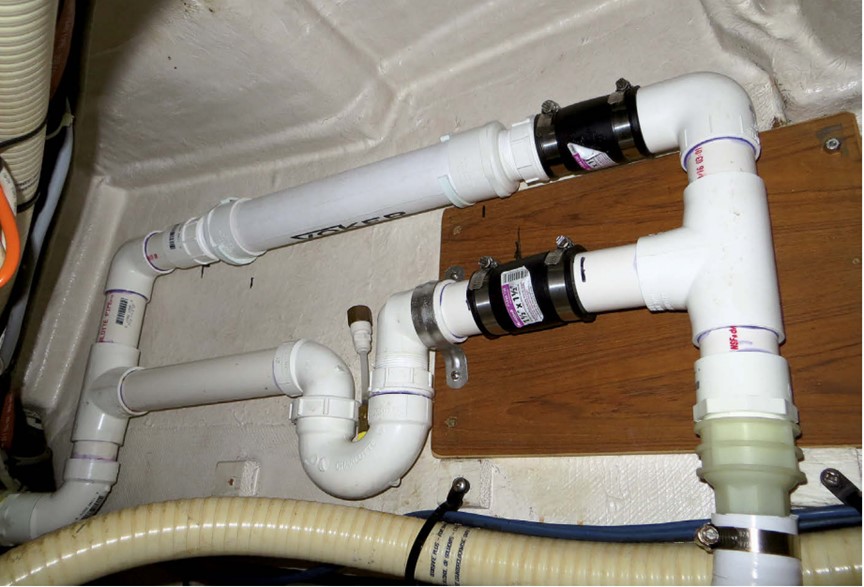
My second attempt was a leak-free success. In the center of the trap, I included a sight glass through which I could monitor the water level in the overflow bypass. I also added two no-hub couplings to make changing the filter element easy.
The filter is an off-the-shelf charcoal-filled chamber and features threaded end caps that accept adaptors for hose — in my case the couplings — or PVC slip joints.
Four months after I installed our system, the difference in air quality around our boat was still remarkable — the odors were gone. I pump our tank regularly and after each pump-out I flush the system with clear water as a rinse. I then remove the cap on the sight glass and pour approximately one cup of water into the trap. We’ve had no problems with a blocked filter because, if the tank overflows, all the liquid passes to the vent discharge via the lower bypass loop.
I’ll add that, because our boat is a catamaran, heeling is minimal, so I was able to assemble our filter system athwartships. For monohulls, I recommend a fore-and-aft orientation.
I’ll also add that the suction pumps used by pump-out stations will pull the water out of the trap. The sight glass I installed, as well as providing a ready measure of this water level, has another benefit. Should the filter ever become restricted, operating the head normally will push the water out of the trap and overboard through the vent. So seeing the trap full of water reassures me that the filter is not clogged.
While we do still use an enzyme additive in our system to help dissolve the toilet paper and to keep the tank free of buildup, we have no need for deodorants. Aboard our boat, the noxious gases that form in our tank are removed before they ever reach our noses.
Alan Wilson began boating in childhood in wooden-hulled skiffs and lobster boats off the New England coast. He holds a U.S. Coast Guard Vessel Master’s Rating for Steam, Motor, and Auxiliary Sail. As a freelance writer, he has had several articles published on navigation and boat maintenance. He enjoys boating on Biscayne Bay and in the Florida Keys and the Bahamas.
Thank you to Sailrite Enterprises, Inc., for providing free access to back issues of Good Old Boat through intellectual property rights. Sailrite.com