The onboard “just in case” locker supplied the parts
Issue 117: Nov/Dec 2017
Over the years, our method for boarding the boat from the dinghy has changed. In our South Coast 25 days, we used the swim ladder, heedless of the damage the rubber feet might have been doing to the paint. But once we moved aboard Eurisko, we needed a better solution.
At the time, we were spending a “boat unit” a week outfitting her for sailing away, and we added the typical $50 white plastic boarding step to one week’s shopping list at West Marine. Surprisingly, it lasted 15 years and survived three boys.
Then, a few years ago, a customer gave Dave a varnished three-step wooden beauty. Though pretty, it was cumbersome to store when we were sailing and too bulky to remove (or flip up on deck as we did the plastic one) when we were anchored. The ladder was always hanging off the side of the boat, being slammed into the hull when people came alongside in rubber dinghies, and bouncing off the hull in the wrong combination of wind and tide.
While on the hard recently, we decided to revert back to our old step, and donated the wooden ladder to the local chandlery. On our first day at anchor, our piece of plastic cracked, leaving us stepless and cursing ourselves for giving away our ladder.
There was a West Marine a few blocks from the dinghy dock so, once again, we added “boarding step” to our shopping list. After all, you can’t argue with $3.33 a year for a boarding ladder. But Dave had long coveted a “proper” step, a board wide enough to stand on with both feet, light enough to throw in the aft cabin when not needed, and easy to flip up onto the sidedeck when at anchor. The wind was howling, so Dave postponed the row ashore and, because he was bored anyway, started gathering materials we had on board to see what he could create.
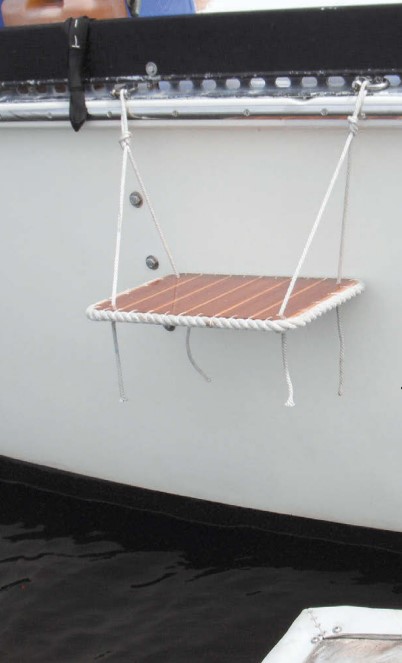
Dave’s relationship with Eurisko is somewhat like that of the cobbler with his children. If he were building this step for a customer, it would be a perfect showpiece. But for our own use, perfection is secondary to function. And to price. And to convenience. Digging through a locker, we found a discarded piece of cabin sole (7/8-inch teak-and-holly plywood donated by a customer and stored for years, just in case).
Dave stows many of his power tools under the dinette, but we were packed ready for offshore sailing, with water jugs secured under the dinette and the dinette platform screwed down. I thought the project had reached a premature conclusion after Dave said, “I’m not getting under the table for my jigsaw or router.” Thinking there was a period at the end of that sentence, I went back to writing. But the rest of the sentence, which Dave didn’t utter, was “so I’ll just use hand tools.”
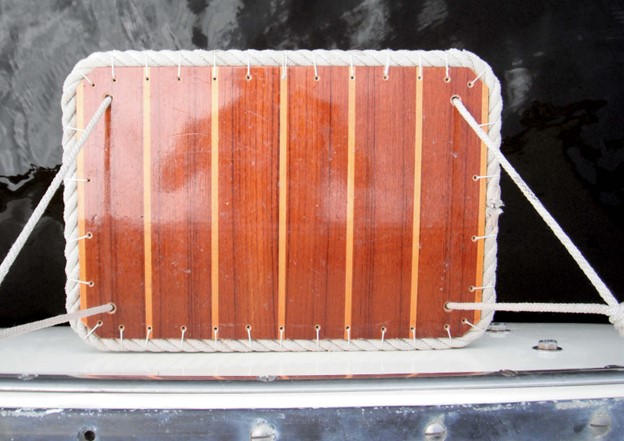
He hand-sawed a rectangle out of the piece of cabin sole, cut each corner at 45 degrees, and used a couple of rasps to hollow a half-round into all the edges. He wrapped an old dockline around the perimeter (secured from slipping by the half-round) and sewed the ends together. Next, he drilled a few holes in the wood so he could stitch the line securely to the board. He added a couple of lines with knots in their ends and two D-shackles from the rigging box and we had a free boarding step. Is it perfect? That depends on the criteria by which it’s judged. It’s light, small, wide, secure, and free. So yes, I’d say it’s perfect.
Connie McBride and her husband, Dave, raised three boys aboard their 34-foot sailboat, Eurisko, while cruising the Caribbean. After 15 years, they now divide their time between enjoying being empty-nesters and visiting their grandson, the third-generation McBride cruiser. Follow their adventures at www.facebook.com/simplysailingonline.
Thank you to Sailrite Enterprises, Inc., for providing free access to back issues of Good Old Boat through intellectual property rights. Sailrite.com