An elegant solution to the dropboard problem
Issue 34: Jan/Feb 2004
VERN ALLEN IS A retired pilot. He spent many years in Alaska, flying helicopters and fixed-wing aircraft for charters, sightseeing, and fire-and-rescue work. Most summer days he can be found on Flapdoodle, a 34-foot Columbia berthed in the Seward boat harbor.
I stopped by Flapdoodle to give Vern the Good Old Boat issue with the history of Columbia Yachts (May 2002). While I was there, Vern showed me his latest project.
Vern dislikes dropboards. They do seem to be a necessary evil. Dropboards keep water out when sailing under tumultuous conditions. But most of your time aboard a sailboat isn’t spent testing raucous, big graybeards intent on your destruction. Dropboards are cumbersome to remove when passing back and forth to the cabin interior, and what is there to do with them once they’re out? I have trouble just getting the things back in the proper order and orientation.
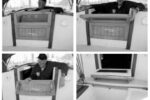
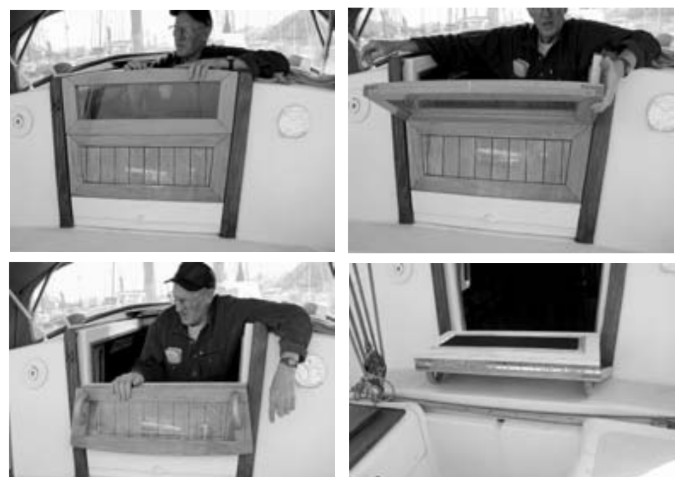
A common solution is companionway doors with hinges that permit quick unshipping so you can insert dropboards when the weather pipes up. Vern has a better idea. He says the idea came from an airplane hangar he once owned in Texas. The doors folded up out of the way on a series of hinges.
Folded down, the middle dropboard becomes a seat, and the top dropboard becomes its brace. There is nothing to store. The dropboard seat makes a comfortable place to sit under the dodger out of the rain and keep a lookout. When not used as a seat, it is simply an additional step to the companionway ladder.
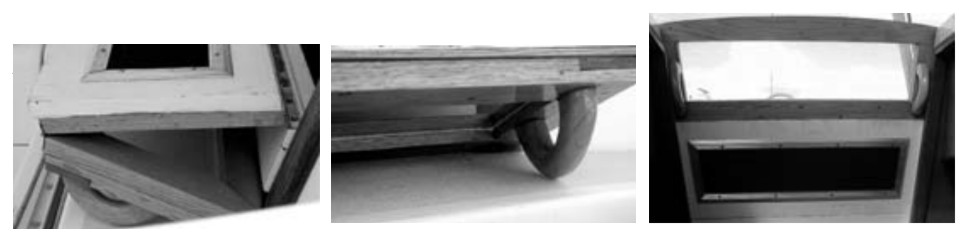
Vern used 3⁄4-inch oak boards on the inner and outer surfaces for a 1 1⁄2-inch-thick door. Corner half-lap joints were used for the interior of the door. Stainless steel #6 screws 1 1⁄4 inch long go from the inside boards into the outside boards.
He used doweled miter joints on the exterior of the door. The bottom dropboard is long enough to fit into the dropboard slots, securing the companionway door. It’s hinged to two more dropboards that have been shortened to clear the dropboard slot.
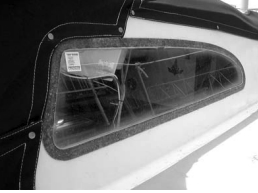
Hinges are 1 1⁄16-inch stainless continuous hinges. A 3⁄16-inch flange is routed into the bottom of each dropboard for a water seal. Barrel bolts could be used to secure the boards in the dropboard slots. The window is 3⁄8-inch polycarbonate.
Vern’s idea is not just a good idea, it is an elegant solution. But that’s normal for Vern.
Thank you to Sailrite Enterprises, Inc., for providing free access to back issues of Good Old Boat through intellectual property rights. Sailrite.com