Issue 18: May/June 2001
THE IMPORTANT THING TO remember about this boat is the “D” behind her name. There are about 26 different Cape Dory yachts, power and sail, ranging from the original Cape Dory 10 to the Cape Dory 45. There are, in addition, two Cape Dory 25s, but only one is the Cape Dory 25D. And she is quite different from the Cape Dory 25 without the “D” — which, incidentally, stands for diesel.
The very name Cape Dory conjures up images of traditional designs, high-quality building, and extraordinary customer loyalty. In short, the 25D is a cult boat, with active owners’ associations, sites on the Web, and high resale value.
That should be “comparatively high resale value,” of course, because as ocean cruisers go, the 25D is not expensive. On the East Coast and Gulf Coast, where most of them are, you can expect to pay between $12,000 and $15,000 for one.
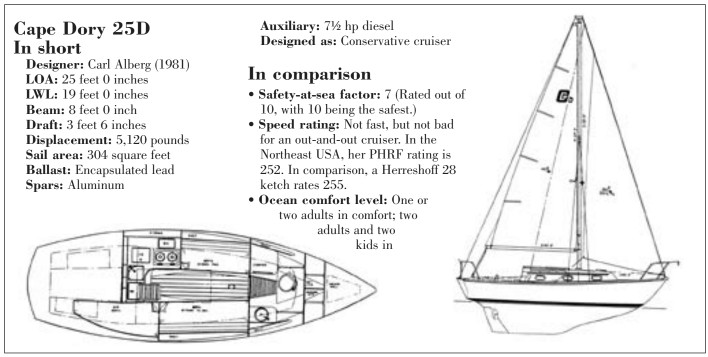
She is a pedigreed design — an Alberg, like almost all the Cape Dory line — but she doesn’t have the usual skinny hull of his older boats. She has a beam of 8 feet on a waterline of 19 feet, a reasonably generous modern proportion, and it shows in her interior. Down below, she is probably one of the most functional mini-cruisers ever designed for two people.
She is in no way an updated Cape Dory 25, which was designed by George Stadel and originally produced by Allied as the Greenwich 24. Andrew Vavolotis, owner of Cape Dory Yachts, bought the tooling and redesigned the boat, relaunching her as the Cape Dory 25 in 1973.
And then, in the fall of 1981, the Cape Dory 25D came along, sowing great confusion everywhere. She was also a Cape Dory, and she was also 25 feet long, but she was wider, heavier, deeper, and derived auxiliary power from a small inboard diesel instead of a gasoline outboard.
The 25D has been compared with the classic 25-foot British design, the Vertue. Numbers of this Laurent Giles favorite are found all over the world, and many have made circumnavigations. In theory, even though the 25D is about half the displacement of a Vertue, she’s equally capable of deepsea work; but for some reason she has not yet developed the same kind of reputation. Perhaps her time is yet to come.
Basic design
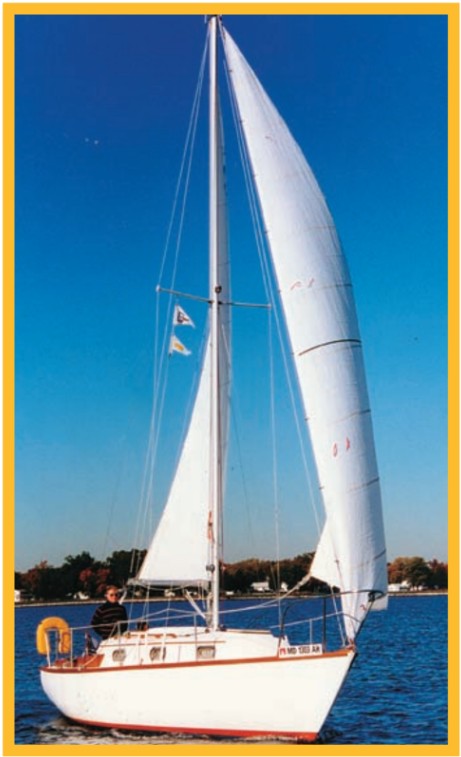
She has a solid GRP hull, but her decks and the cabintop are GRP/balsa sandwiches. End-grain balsa is extremely light, and it’s highly resistant to crushing. It also provides good insulation against heat, cold, and sound. But it has a wicked habit of soaking up water and turning to slush if you don’t take a lot of trouble to seal the through-holes for deck fittings. Luckily, balsa that has deteriorated is usually quite easy to detect, either by tapping the deck with a screwdriver handle and listening for a dull thud instead of a good solid ring, or else simply by jumping up and down on it heavily.
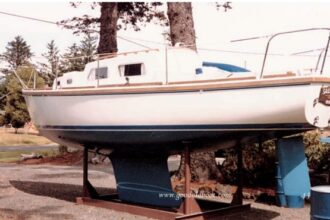
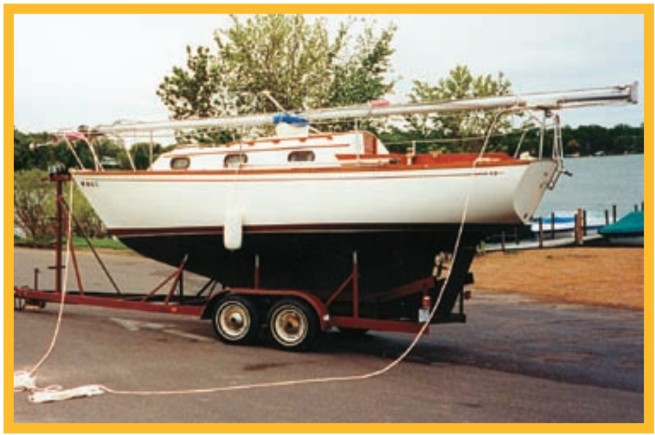
The 25D has an old-fashioned, hard-bilged, full keel — a true seagoing keel, slightly cut away up forward — and a deep-displacement hull. Her rudder has a straight afteredge and is squared off at the bottom. It hangs off the end of the keel, with the rudderstock appearing well aft in the cockpit. The propeller spins in an aperture cut half from the rudder and half from the deadwood. This is a real cruising underbody, strong and very resistant to tangling with crabbers’ underwater lines.
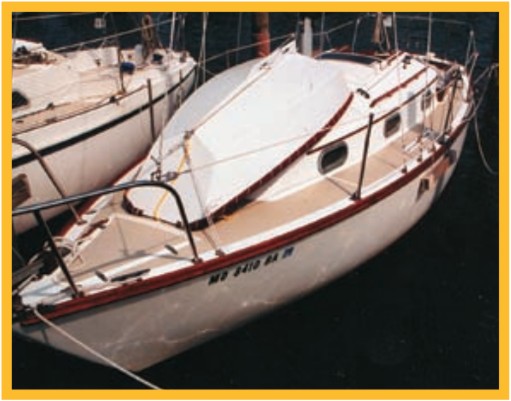
Above the waterline she looks solidly and pleasingly traditional, although her mast is taller and her sailplan more efficient than those of most traditional boats. Her cabinhouse has the chunky, purposeful appearance of a boat that works for its living, yet it avoids looking boxy. Her cocky sheerline manages well the important task of resolving the aesthetic conflict between a straight, sawn-off counter stern and a rounded bow with a moderate overhang.
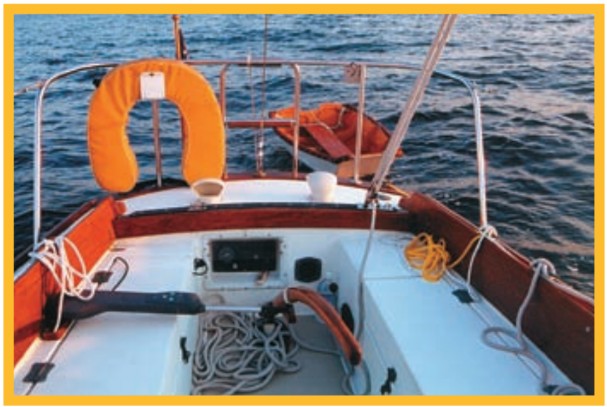
The cockpit is generously sized — in fact it’s bordering on too large for serious ocean work — but it does have a sensible bridgedeck to prevent water cascading down below in the event of a pooping. There is a shallow cockpit locker to starboard and a deeper one to port.
An anchor roller is built into the stemhead forestay fitting, and the foredeck also accommodates a reasonably-sized anchor locker capable of holding an anchor, some chain, and a normal nylon rode. In general, the foredeck is free of toe-stubbing fittings and feels bigger than it really is.
The standard engine is the little 7 1⁄2-hp Yanmar diesel, a neat installation that weighs little more than 150 pounds. It’s cooled by raw sea water and drives a two-bladed bronze propeller. The 25D’s nominal range under power at cruising speed is about 200 to 250 miles, drawing about a quart of fuel an hour from her 13-gallon tank. Access to the engine is pretty good, via a lift-out bin in the top of the covering box, and also — if you need to get really up close and serious — by taking away the companionway steps and unscrewing the front panel of the box.
Accommodations
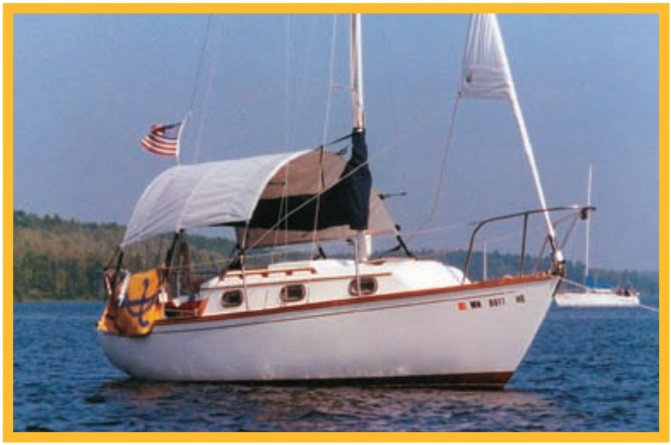
As far as the accommodations go, Carl Alberg did a very sensible thing by putting the head where the V-berth would normally be. By opting to do without a cramped V-berth, he opened up a large toilet and storage area capable of being closed off completely from the rest of the boat — a real luxury in a 25-footer. This arrangement makes a great deal of sense for a cruising couple, for whom a V-berth would just be a place to store random odds and ends such as blown-out sails and expired flares anyway.
There are two settee berths in the main cabin, a short-looking one to port whose footlocker protrudes through the main bulkhead to form a countertop in the head compartment, and a normal-looking one to starboard that pulls out to form a double. There’s also a fourth bunk if anyone should need it, a quarterberth to starboard.
A cabin sole located low in the bilge provides standing headroom throughout the boat — 5 feet 11 inches in the saloon and 5 feet 9 inches in the head compartment, which has its own deck-opening hatch and two opening ports for ventilation.
Unfortunately, there’s a design law that says if you stick four full-sized bunks and an oversized head into a 25-footer, you don’t have any room left over for a chart table and precious little for a galley. There is a galley, to be sure, but it would delight only the heart of a Spartan. It features a twin-burner alcohol stove, which produces little heat at great expense, and a stainless steel sink whose main feature seems to be inaccessibility. It is largely hidden beneath the bridgedeck and its fresh-water pump is so artfully concealed and difficult to work that it might have been conceived deliberately to save water.
In fact, bachelor sailors might be tempted to wash their dishes in the head, where there’s a sink right out in the open within reach, but for more fastidious crews, washing up on this boat will mean sitting in the cockpit with a bucket. Still it’s not a bad swap for such a comfortable sleeping cabin and head compartment. And if you’re handy with tools, the galley situation could be improved fairly easily.
The ports in the main cabin all open to provide wonderful cross-breezes in hot climates and almost certainly the odd drip of rainwater in more temperate climates. They are solid bronze and add greatly to the 25D’s air of old-fashioned reliability.
The rig
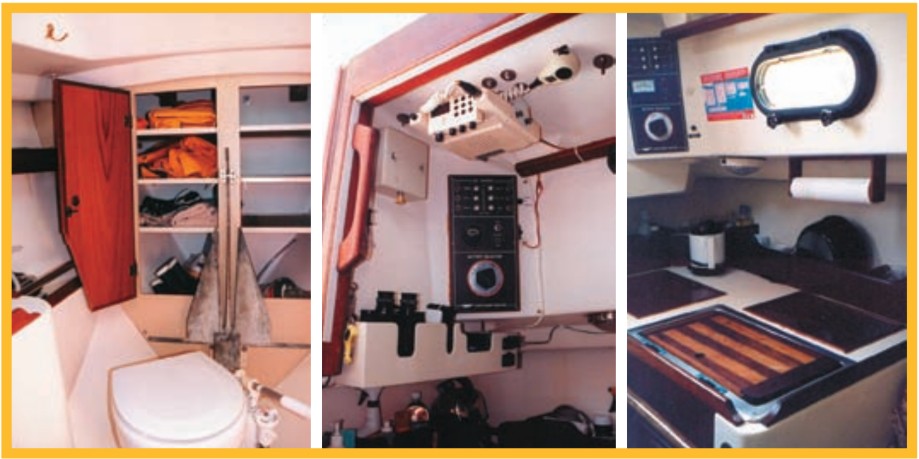
The 25D carries a comparatively tall mast, stepped on deck but supported underneath by a compression post that takes the load straight to the keel. This avoids the very common problem of deck beams and bulkheads buckling under the constant downward pressure exerted by the mast.
The masthead sloop rig is simple, efficient, and easily managed. The mainsail has an area of 140 square feet, and the foretriangle measures 164 square feet, making cockpit sheet winches more of a cruising convenience than a necessity. The mainsheet traveler is sensibly located aft of the tiller.
Double lower shrouds support the mast at each side, and a single forestay and backstay running to the truck take care of fore-and-aft movement.
The shrouds terminate at their lower ends in massive chainplates set into the hull/deck joint, and while that interferes with the sheeting angle of the jib, it provides the widest — and therefore most stable — base of support for the mast. That’s an important consideration with a high-aspect-ratio rig.
Performance
Her hard bilges and high ballast ratio make her quite stiff, and she stands up to her canvas well but, as in any small boat, you’ll need to reef her mainsail when the wind gets up to around 16 or 20 knots. She is modern enough (just) to have come equipped with efficient jiffy reefing instead of the troublesome main-boom roller reefing so favored by builders in earlier years.
She’s no racer, but her PHRF rating of 252 proves she’s no sluggard, either. She’ll need a bit of help in calm weather to overcome the frictional resistance of her large underwater area though, and large light foresails will provide it.
You’ll find the shrouds prevent you from sheeting in a 100-percent foresail tight enough for really high pointing, but if you’re willing to go to the trouble of re-arranging the sheeting, you can bring the foresail sheet inboard of the shrouds for a beat, making use of a length of track on the cabintop, and take it back outside the shrouds for a reach or a run.
If you’re beating in any kind of chop, you probably won’t bother to change the sheeting position because you’ll need to fall off the wind a little, in any case, to gain enough power to drive you through the waves.
Known weaknesses
- Poor access to the galley sink.
- Water capacity. She carries only 20 gallons of drinking water in a plastic tank. For an ocean crossing, you’d need to double that amount at least, carrying the extra in small cans or a flexible bladder.
- No chart table. It’s not an unusual failing, even in much larger boats, but the appointments of the 25D seem so solid and complete that you notice it more here. A cunningly placed sheet of plywood or a folding table would suffice.
Owners’ opinions
Bob Ohler sails his Cape Dory 25D, Aloha Spirit, hull #2, out of Deale, Maryland, and cruises in the Middle Chesapeake. He has been sailing for 20 years and does a lot of singlehanding. He says the 25D is ideal for that.
In his part of the world they talk about “Cape Dory days.” That’s when the wind is in the northwest, blowing 18 to 22 knots, and the bay is covered with whitecaps. The boat loves it.
The first thing he does when the wind starts to rise is take one reef in the mainsail. That happens at about 16 knots. “She’s well balanced and very easy to control then,” he says. “My wife never has any trouble with her. The boat has a little weather helm, but that’s a good thing, and it never gets excessive if you reef in time.”
Bob finds the boat to be good and stiff. In fact, he has sailed her in 30 knots and 5-foot seas with a working foresail and just one reef in the main. It’s not the sort of thing he’d recommend you to do for long, especially at sea, but it shows the boat can take it.
He raked the mast back 6 inches to make her point better, and when he’s going to windward he uses the Cunningham cringle for a flattening reef. “It makes her point 10 degrees higher,” Bob claims.
“She needs some sort of headsail at all times,” he notes. “It seems to help to windward, especially — prevents her hobbyhorsing and plugging away in the same hole. She’ll do that if you don’t have a jib to pull her over the waves.” He says she’s also a star performer on a reach under foresail only.
Aloha Spirit has a Yanmar 1GM single-cylinder, 7-hp diesel, which Bob cautiously describes as “adequate.”
He always wears a safety harness when he’s alone and strings jacklines of 1-inch nylon webbing from the bow, around each side of the cabintop, and then back to the cockpit.
His headsail has a downhaul that leads back to the cockpit, just as the foresail halyard does, so he can drop the sail at will. Then he trims and cleats the sheet to keep the sail firmly in place on deck.
Bob’s against roller furling on the foresail. “I’ve had it on other boats,” he says. “You just never know when it will go wrong. I’d never go back to it.”
For deep-sea work, Bob advises that you:
- Check the chainplates for rust.
- Get a solar panel to keep the batteries charged.
- Fit a self-steering wind vane.
Mike Smith sails his Cape Dory 25D, Solitude, out of Niantic, Connecticut. He has owned her since 1986 and has put in a lot of hours in all kinds of weather up and down the coast.
Solitude has a 135-percent genoa on a roller furler gear, so the first thing Mike does when the wind pipes up is crank in the jib. At about 16 to 20 knots, the jib will need to be down to about 100 percent, and he’ll take in the first of the two jiffy reefs he has in the mainsail.
“She gets weather helm as she heels over,” Mike says, “but as soon as you take that reef in the main and flatten out the sail, she’s perfect — easy to handle.”
He finds the boat to be the ideal size for singlehanding, although she’s also comfortable with two aboard. “She’s not a handful,” he notes. “Everything is set up nicely in the cockpit for a singlehander. Even docking is no problem.”
Mike, too, has the standard Yanmar 7-hp diesel, but has stronger views about it, perhaps because Solitude often needs a very strong push upriver. “It’s grossly underpowered,” he feels. “I’d like to replace it with a 12-horse, two-cylinder diesel in a couple of years.”
His advice for anyone contemplating an ocean voyage in a 25D:
- Beef up the lower shrouds. Make the standing rigging 1⁄4-inch diameter all around.
- Secure the companionway hatchboards in place at sea.
- Add padeyes in the cockpit for your safety harness.
- Run safety jacklines of nylon webbing or tubing from the bow cleats to the stern cleats.
Conclusion
You’d go a long way to find a 25-foot boat with a better interior than this for serious cruising. Doing away with the V-berth up forward was a radical design concept but a real winner in a boat dedicated from the start to cruising.
For $12,000 to $15,000 (maybe a little more if she has been upgraded and maintained to meticulous standards) you can buy a classic Alberg that will take you anywhere in a lot more safety and comfort than you’ll find in almost any other 25-footer you care to name.
Further thoughts
Bruce Barber sails Nancy Dawson, a 1982 model, hull #77, in the Chesapeake. Some of his thoughts, taken from a letter to Good Old Boat:
Few changes had been made to the boat before I purchased it, so I found myself improving, in modest ways, an already fine boat, rather than undoing or reworking (or perhaps even accepting!) previous owners’ efforts. A blank canvas, as it were . . . If a boat has to have a “worst feature,” the 25D’s is the location of the galley sink, which is tucked under the bridge deck and nearly inaccessible. The best that can be said of the sink is that its removal improves maintenance access to the engine . . . On the Chesapeake, the primary need for prolonged use of the engine is motoring in calms, and for this the engine (1GM) is perfectly suited. Powering upwind in waves, though, can try your patience . . . Capacities — of water, provisions storage, and holding tank — are the factors that limit cruising independence. The “berths for four” provide two people a good level of comfort. The head compartment is downright luxurious . . . The water tank is poorly plumbed. Both the deck fill hose and the vent hose enter from the side, so both are full of water much of the time, and venting is poor. I removed both hoses, and fill the tank at its quarterberth access. The vent is now a small hole drilled in the cap . . . The holding tank is under the engine, with the head about 10 feet distant in the bow. These were originally connected by a hose passing through the locker under the port settee. One of my first revisions was to replace the hose with rigid PVC . . . There is a lot of teak, which increases the time spent on annual maintenance, but due to the simple systems and small size, this is still a low-maintenance boat . . . The original bronze fittings are all still available from Spartan, so new cleats, for instance, can be matched to those existing . . . All things considered, the 25D is a good-performing, confidence-inspiring boat, sturdily built and well-equipped. What attracted me was its traditional appearance, the Cape Dory reputation for seaworthiness, an expectation of easy singlehanding and one-person maintenance, the likelihood of few expense-related surprises, and the 3 1⁄2-foot draft, which allows access where many others fear to tread.
John Vigor is a professional journalist. The author of The Practical Mariner’s Book of Knowledge, The Sailor’s Assistant, and The Seaworthy Offshore Sailboat, he has worked for major newspapers around the world and is a frequent contributor to leading sailing magazines. This series of boat reviews is based on articles from John’s book: Twenty Small Sailboats to Take You Anywhere, which is available from The Good Old Bookshelf. In the course of writing this book, John sold his Santana 22 and bought a Cape Dory 25D, which he and his wife, June, sail in the Pacific Northwest.
Thank you to Sailrite Enterprises, Inc., for providing free access to back issues of Good Old Boat through intellectual property rights. Sailrite.com