Hull number one is shipped to Germany
Issue 55 : Jul/Aug 2007
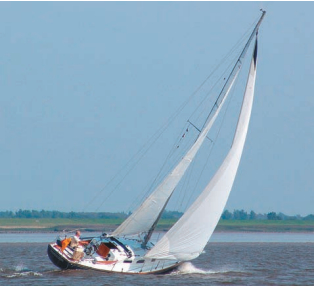
Being first in anything is exiting. Rubicon, hull number one of the Tartan 34 Classic design, recently crossed the Atlantic to become the first of her model in Europe. As the first of the line and with a unique history, Rubicon serves beautifully as the Tartan 34 C Association’s “poster boat.”
The Tartan 34 C is celebrating a 40-year anniversary this year. (Visit http://www.tca34.org for event information.) In 1967, the builders of the successful Tartan 27, Charles Britton and the Douglas & McLeod Company, commissioned a 34-foot, high-performance, offshore cruising and racing boat. They asked Olin Stephens of Sparkman & Stephens, who at the time was designing the racing yachts America and Intrepid, to design the Tartan 34. His design resulted in a 10-year production run of 525 boats, the majority of which are still sailing today.
Launched in December 1967, the first hull in this series was immediately taken south, where she won her class in the 1968 Southern Ocean Racing Conference. As we celebrate the 40th anniversary of this classic design, we might wonder, “Where is she now?” Her new owner, Jürgen Mohrmann, tells how this boat, now named Rubicon, wound up in Hamburg, Germany, as the first Tartan 34 Classic in Europe.
“Distance means nothing when you are looking for the boat of your dreams and finally find her on the other side of the Atlantic Ocean,” Jürgen explains.
“Everything started at the beginning of the sailing season 2004, when we made up our minds to sell our beautiful 1920 Norwegian sailing boat, Nordstern, and look for a classic racer/cruiser. This was not an easy decision for us. We had lovingly restored our traditional wooden boat and sailed her for the past 12 years over thousands of miles on the Baltic Sea and the Elbe River. In addition, the little old Norwegian was a gift from my parents, who had owned her since the late 1950s and had taken me out on her for my first sailing trip when I was only 6 weeks old.
Sometimes too small
“But after years of good times, we had to admit that a 27-footer is sometimes too small for longer cruising trips, and the sailing abilities of vessels of that era were completely different from those of more modern yacht designs. Sailing her in strong winds and the choppy waves of our northern waters was sometimes more than hard work. Once our decision was made, Nordstern quickly found a new owner.
“Since we have been secretly in love with the incredibly great designs of Sparkman & Stephens, my wife, Susanna, and I started looking among the S&S designs for the new boat of our dreams. Among these production beauties, one special design seemed to be exactly what we were looking for: the Tartan 34 C.
“Unfortunately, not even one of these beautiful boats existed anywhere in Europe. From this moment, we entered a completely new dimension of boat buying. Thanks to the Tartan 34 Classic Association, our dream became reality. With the great support of Deane Holt, founder of the association, who helped us like a real friend, we considered a couple of interesting offers from around the U.S. East Coast and finally found the perfect boat: Rubicon, Tartan 34 C, hull number one.
“From her description, Rubicon seemed to have everything we were looking for: sound hull, decks, and rigging, and a beautifully upgraded teak interior and cabin sole, along with a very new Yanmar 3GM 30-F diesel. She was different from almost every other T 34 C, in that she came with a fractional rig and running backstays.
“We sent a message to the seller. When we received a very friendly reply, we began to feel certain that this really could be our new boat. Only a few days later the surveyor said, ‘Go for it!’
Hurricane season
“The next step for me was a flight from Hamburg, Germany, to Miami, Florida. It was the middle of the cha- otic 2004 hurricane season, between hurricanes Frances and Ivan, so the weather did not allow much more than a two-day trip for this final examination. I had no time to lose, but that’s the way real challenges are.
“Except for a few minor cosmetic necessities, I found Rubicon to be well cared for and in great basic condition to be shipped across the Atlantic. In preparation, the sails had to be taken off and smaller items had to be stowed under berths and in lockers. Some electrical equipment, including the newly installed shorepower, had to be removed, due to the different electrical power system in Europe.
“There were, of course, some questions about European Union import regulations. The mysterious CE certification turned out to be unnecessary, but there was no way to escape 17.7 percent EU tax and import fees on top of the purchase price and shipping.
“The remaining preparations had to be done by local companies. While Susanna and I watched the whole project from afar, a transportation cradle was built, the decommissioning was completed, and a truck was arranged to take Rubicon 500 miles from Miami to Jacksonville Seaport. Meanwhile a shipping broker in Hamburg scheduled the ocean transportation by ferry.
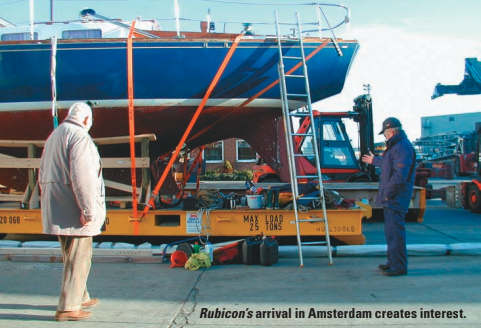
“After some major delays, Rubicon left her old home port for Amsterdam in the Netherlands. There she was shifted to yet another ferry to Hamburg. She arrived safely in late November, on Thanksgiving Day. A large crane lifted her off the trailer and carefully launched her into the water.
“Finally on the last leg of her journey, Rubicon reported to the customs dock on the Elbe and then two hours later, just after sunset, to her new home marina. The next morning, although the marina was closed for winter, the manager and two members of his crew appeared to haul her out for winter storage.
“We are so proud to sail the first Tartan 34 C ever built and to be the first T 34 C owners in Europe,” Jürgen sums up. “We would be neither without the incredibly great help and support of our friends in America.”
Home marina
Although active regional clubs for racing and cruising have been around for years, the new international dimension made possible by the Internet allowed Jürgen’s story to have a happy ending. It provides the medium for an active exchange of questions and answers via email lists that include more than 500 Tartan owners from all over the world. Another even newer and more robust source of support comes from Tartan clubs that have set up and maintain lively sites online. Here sailors can find graphics, photos, historic texts, and current events that bring a whole new virtual dimension to sailing.
Speaking from his own successful experience with the Internet and the Tartan 34 Classic Association website, Jürgen says it best: “Distance means nothing . . . ”
Thank you to Sailrite Enterprises, Inc., for providing free access to back issues of Good Old Boat through intellectual property rights. Sailrite.com