A famous designer makes the case for fractional rigs
Issue 41 : Mar/Apr 2005
In the November 2004 issue I touched on the history of the sloops and cutters of two centuries ago and discussed the changes that had been made to those two rigs over the years. Today, it can be difficult to define the sloop or cutter. Many contemporary sloops have the masts placed well aft with large fore-triangles and relatively small mainsails, not unlike a cutter. Similarly, many modern cutters are designed without bowsprits, so there is no longer any hard and fast rule as to which is what.
So, for what it’s worth, here is the Brewer definition of cutter and sloop. A cutter must have its mast located 35 to 40 percent of the waterline length aft and must have a double- or triple-headsail rig. If the mast is that far aft but the boat has only a single headsail in a large foretriangle, it is a sloop. If the mast is forward of that 35 percent and the boat has a double headsail rig, the boat is a double-headsail sloop.
There is a very narrow dividing line. Many of today’s modern double-headsail yachts could be called sloops or cutters, whichever the owners prefer. The differences can be that slight.
Strangely, some owners of ketches — those fitted with a bowsprit and double-headsail rig — refer to their boats as cutter/ketches. It’s like calling the Bluenose a cutter/schooner. Sorry, but there is no such bird as a cutter/ketch, never has been, never will be. A cutter has one mast; a ketch has two. The ketch with a double-headsail rig — with or without a bowsprit — is a double-headsail ketch. It’s that simple.
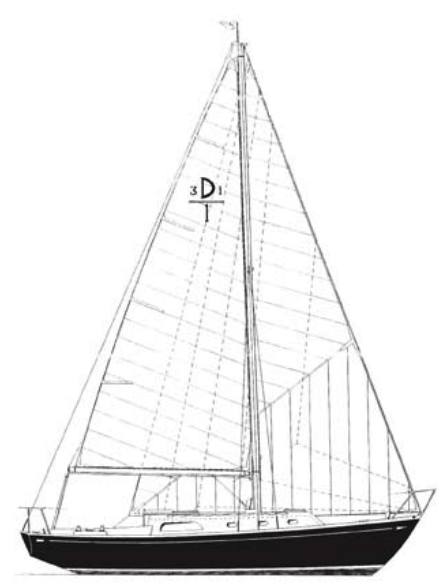
Unfortunately, too many of our good old boats — particularly those designed between 1950 and 1975 — tend to be somewhat under canvassed. To a large extent, this was the result of the Cruising Club of America (CCA) rating rule of that era, which allowed a yacht to carry a 150-percent genoa with no sail area penalty. That 150 percent refers to the longest perpendicular (LP) measurement from the luff of a headsail to its clew; the percentage is the LP divided by the J measurement, the distance from the tack to the mast. Thus, a yacht with a 12-foot 6-inch J and a 37-foot 6-inch hoist at the mast, like my 1969 Douglas 31 (shown above), carried a 150-percent genoa with an LP of 18 feet 9 inches and an area of 352 square feet, equal to 76 percent of its total measured mainsail and foretriangle area of 460 square feet.
Low ratings
Naturally, many designers (and I’m one of them) chose to undercanvas the standard rig in order to obtain as low a rating as possible for racing and then use those big 150-percent jibs to get the yacht through the lighter breezes. The Douglas 31 has a modest sail area/displacement ratio (SA/D) of 15.8, but even that was higher than many of her contemporaries. For example, the Cape Dory 30 had a SA/D ratio of only 15.1, and the famous Finisterre, with her winning ways, had a meager 14.5 SA/D ratio. If I were designing the Douglas 31 today, I’d increase the area to about 500 square feet. Then a smaller genoa would give equal light-air performance to that we now get with that 150-percent jib. The result would be an easier-handled boat. Not having to drag a 20-foot-long genoa around the mast can greatly increase the pleasure of sailing in the typically light-weather summers of the Pacific Northwest, Long Island Sound, and the Chesapeake.
In any event, the masthead racing rig with its 150-percent genoa is still a very inefficient rig for the total amount of sail that it spreads. The 150-percent overlapping jib pays its way for racing yachts simply because the overlap area is not included in the sail area; it is “free area,” at least as far as the racing rules are concerned. If every square foot of sail area were counted for rating purposes, the result would be boats with small, non-overlapping jibs and large mainsails. This was proven to me in the highly competitive 5.5-Meter class in the 1960s. Designers had the choice of staying with a minimum-size jib and maximum mainsail or increasing the jib overlap and reducing the mainsail area. Once the class settled down, every 5.5 fl ew the minimum jib and the maximum mainsail as any other distribution of the sail area resulted in a losing boat.
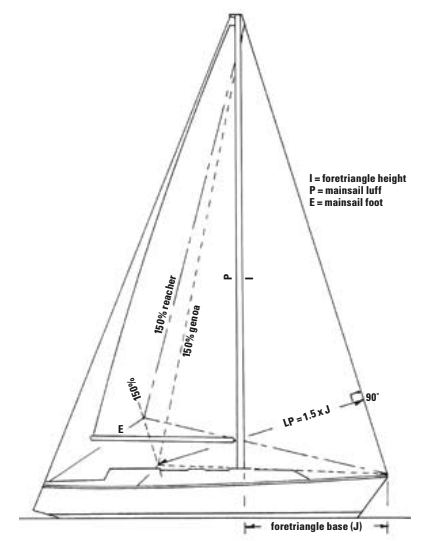
For the coastal cruiser one answer to obtaining greater sail area in an easily handled rig is to design sail plans with larger mainsails and smaller jibs. Provided it is equipped with proper lazy-jacks and full-length battens, it’s much easier and faster to reef a large mainsail when it comes on to blow than it is to replace a 150-percent genoa with a 125-percent sail. As you no doubt know from experience, a mainsail is more readily controlled than a flogging genoa, and it can even be locked into a boom gallows while crewmembers take their time to do the work. Reefing the main is also safer than changing a jib since there is no need to go forward of the mast on a slippery heaving foredeck. With modern slab reefing and proper deck layout, it’s possible to take in a reef or two without leaving the cockpit.
Just as much work
Roller-furling genoas can reduce the necessity of changing sail when the wind pipes up, of course, but tacking a large roller-furling jib is just as much work for a small crew as tacking a large hanked-on jib. And when the sail is rolled from 150 to 125 percent or so, there is that fat lump of rolled cloth down the luff interfering with the air flow to the sail and greatly reducing its efficiency. In addition, a large genoa may be of cloth that is too light to stand up to a stiff breeze without distortion or even damage.
Finally, if you do roll the sail down to, say, 125 percent, and the wind keeps on strengthening, what do you do next? You can’t unroll the genoa in half a gale in order to take it down and — unless you have a double headsail rig — there is no stay on which to raise a working jib or a storm jib. (Note: ATN has come up with a workable solution with its Gale Sail –Ed.) Adding to the misery is the problem that the small mainsail may not adequately power the yacht by itself. There are answers to the predicament, but none of them is quite as satisfactory or efficient as getting rid of that 150-percent monster when you first need to reduce sail and replacing it with a smaller sail, either hanked on or in a leading-edge foil.
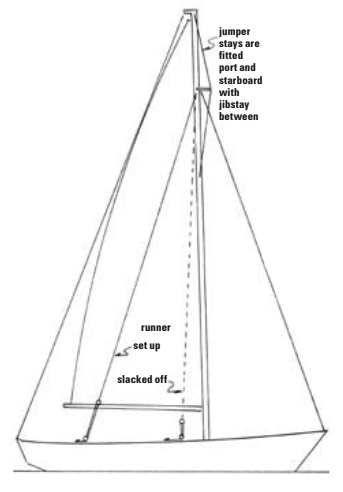
One way to design a sail plan with a large main and a smaller jib is to go with a fractional rig. Fractional rigs, such as 3⁄4 and 7⁄8 rigs, were popular on cruising yachts in the 1930s and ’40s but have been almost completely replaced by the masthead rig in production yachts today. The fractional rig is rarely seen now except on trailersailers, one-design racing classes and, of course, the International Rule yachts such as the 5.5-Meter, 6-Meter, and 12-Meter classes.
One problem with the rig is that it requires either running backstays or jumper stays in order to keep the jibstay taut (see illustration at left), and neither of these solutions finds favor with cruising sailors these days. It does seem strange that a crew that doesn’t object to tacking a huge, overlapping headsail will balk at switching over a backstay runner. Still, for most cruising sailors, the answer is jumper stays, eliminating the need for changing over running backstays with every tack. Jumpers, once common, are also out of style now, yet they make sense. I have used them on coastal cruisers with owners who understood their advantages or were willing to experiment. One of my clients insisted on jumpers rather than running backstays for his 52-foot, double-headsail yawl and managed to sail the oceans for many years with nary a problem.
A better idea
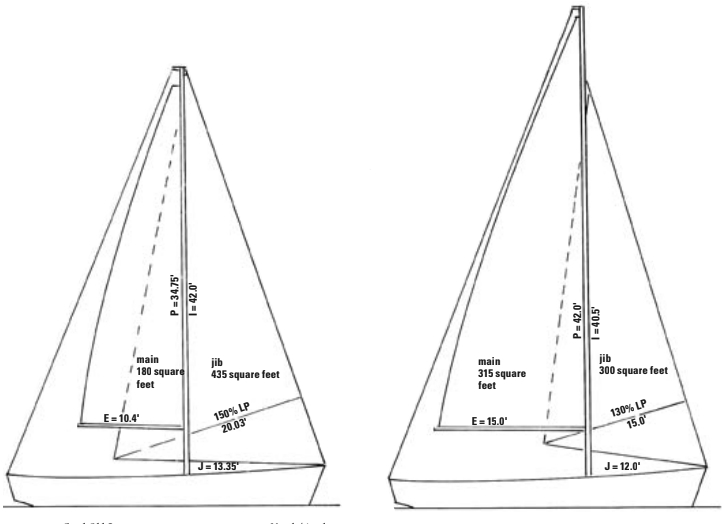
My feeling is that the typical familycruising crew would be better served by a yacht with a well-designed fractional rig — one with a large mainsail and a relatively small jib — rather than the typical production cruiser with its small main and great overlapping genoa. The illustration below shows a typical production yacht with a masthead rig. This is based on an actual rig, not something created solely for this article. Its small 180-square-foot “mainsail” is less than half the area of the 401- square-foot genoa. In truth, this boat’s genoa jib is her “main” sail in our usual summer sailing conditions, and that can pose a big problem when the wind strength builds to 25 to 30 knots.
The fractional rig yacht alongside it sets the same sail area as her masthead sister but with a 50-percent larger mainsail and a 25-percent smaller jib. There is no question that the smaller jib will be much easier for a small crew to handle when tacking to weather or reducing sail in a blow. Indeed, the first sail reduction will be to reef the main not to change (or roller furl) the big genoa of the masthead sloop. Furthermore, the mainsail is large enough and far enough forward to power the boat by itself in tight quarters where a big overlapping jib would be a dangerous nuisance.
Finally, based on my years of experience with the 5.5-Meter yachts, I’m confident that, given equal sail area, the fractional rig would outperform the masthead rig. It would rate higher for racing, of course, even though it spreads the same total area, but that’s the fault of the rating rules, not of the rig. So here you have a more easily handled rig, even a safer one, with better performance. Why isn’t it widely accepted for cruising yachts? Well, Douglas Phillips-Birt may have said it all when he wrote that the only human more conservative than the average yachtsman is a High-Church bishop. Change does not come easily to either and the masthead-sloop rig has been solidly entrenched for well over 50 years now. Obviously, a fractional rig sloop of generous sail area makes good sense for inshore work. It has much to offer in the way of light-air summer cruising convenience and performance over the standard masthead sloop as well as over the cutter for cruising.
Still, the double-headsail sloop and cutter have the advantages of a single-masted rig for deep-water ocean cruising. If fitted with running backstays, they also have the additional safety of the staysail stay (or forestay) forward and are less likely to have a complete rig failure. I know of one of my boats that lost her main backstay while a long way from help, yet the mast stayed up, supported by the running backstays. Sailing with a jury rig of the staysail and reduced main, these sailors were able to get to a port where they could find repairs. A single-headsail sloop would probably have been dismasted completely, and the middle of the Indian Ocean is no place to lose the entire rig.
The use of the staysail along with a reefed main also gives the double-head rigs a wider variety of reduced sail combinations in severe situations. The storm jib is usually set on the staysail stay and — combined with a double-or triple-reefed main, or even a storm trysail — provides a well-balanced rig that can handle very wild conditions indeed.
Better loose-footed
The double-headsail rigs do have a number of disadvantages though. Most cruisers set the staysail on a club so that it is selftacking, but this can result in a sail that is too flat to be efficient. Where performance is important, it is best to set the staysail loose-footed, but then there are two headsails to tack and, if the boat has running backstays, it becomes unmanageable for a short-handed cruising crew. Too, the staysail alters the airflow in the slot between the main and the jib. If it’s not set perfectly, it may reduce performance, rather than add to it.
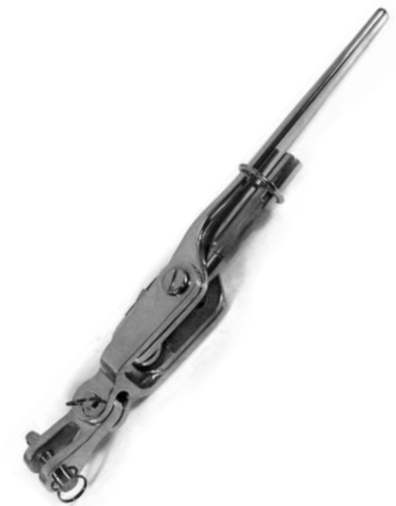
A large Yankee jib is usually a better choice for a double-headsail rig than a deck-sweeping genoa. Visibility forward is much improved, and the high-cut Yankee works better in combination with the staysail. Tacking the jib — whether large Yankee or genoa — through the gap between the headstay and the staysail stay can pose a problem, but it’s usually easier to tack a high-cut Yankee through that narrow slot than a deck-sweeping genoa. One option is to drop the jib and sail with staysail and main in crowded waters. However, for most double-headsail cruisers, the better solution is to have the staysail stay set up on a quick-release lever such as the ABI Marine unit shown at left. With the lever in place, the staysail stay can be released, brought aft, and secured to the shrouds. Then the boat can be sailed as a masthead sloop, using only the genoa or the large Yankee as a single headsail to speed tacking. When offshore or in heavier weather, the stay is hooked back up and the staysail set again, of course. Fitting a good staysail-stay release lever can give the singlehander the best of both worlds: the handiness of the masthead sloop in coastal waters along with the safety and the heavy weather sail combinations of the double-head rigs when offshore.
However, for those coastal cruising sailors who have no intention of rounding Cape Horn and heading for Pitcairn Island, the fractional rig sloop, with its large mainsail and small, handy, and efficient jib, deserves serious consideration. I hope other designers will give it some thought as well.
Thank you to Sailrite Enterprises, Inc., for providing free access to back issues of Good Old Boat through intellectual property rights. Sailrite.com