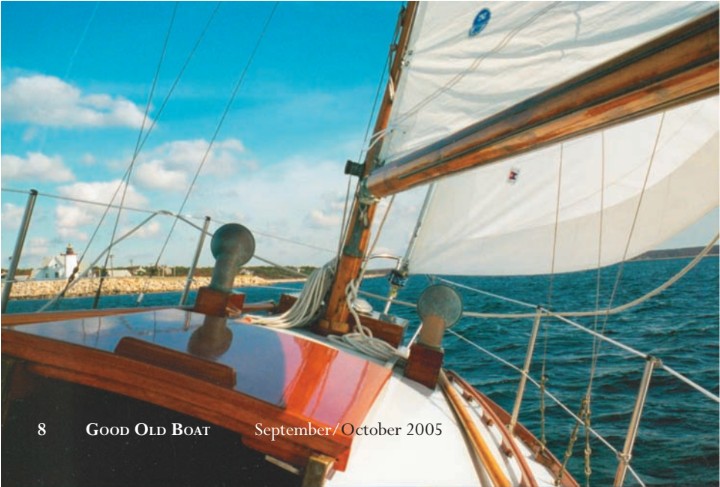
A whole pod of Dolphins continues to delight
Issue 44: Sept/Oct 2005
It was the mid-1950s. Enter Bill Shaw, the man who later designed a great many of Pearson Yachts’ fi nest and was at that fi rm’s helm as it became one of the top boatbuilders in the country. But in his formative years Bill was designing for Sparkman & Stephens. One task was working with Olin Stephens on converting the CCA Rule (on which the Sparkman & Stephens fi rm was arguably the leading expert) to a new Midget Ocean Racing Club (MORC) Rule for smaller off-shore boats up to 24 feet (this was later raised to 30 feet).
As an after-hours project, Bill designed a 24-footer to see if factors affecting safety and comfort, such as proper pitching and righting moments, encouraged by the CCA Rule, translated well into smaller boats designed for MORC. Those sketches were to became the Shaw 24 and then modified to become the 24-foot Dolphin, a boat that has been built in wood and fiberglass by many yards and is known by several names: Yankee Dolphin, O’Day Dolphin, Pacific Dolphin, Dolphin 24, and Shaw 24.
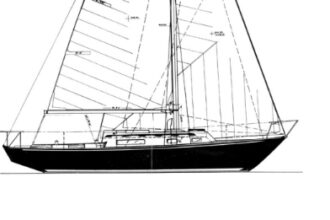
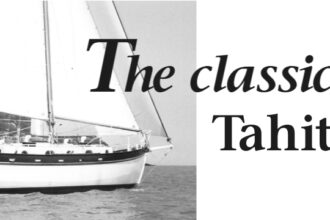
The Sparkman & Stephens-designed Dolphin was built from 1959 through the 1970s by at least five firms. The Yankee Dolphin built by Yankee Yachts was perhaps the best of the breed, but they’re all basically the same hull shape and rig design. Thus, while describing the Yankee Dolphin, all the Dolphins are included here in one way or another. It’s not clear how many Dolphins were built. There are at least 270 and perhaps as many as 300 or more. The 24-foot Dolphin is a medium-displacement masthead sloop with a hollow bow, cutaway forefoot, keel/centerboard, and attached rudder. Her classic appearance comes from a traditional profile, transom, and counter. Her overhangs are short, the waterline long, the wetted surface low. The boat has always been, and is yet today, quite fast.
The start of the story
In the 1950s, the CCA Rule was the reigning big boat, offshore handicap rule. It encouraged and rewarded de-signs that were seaworthy, seakindly, and comfortable. CCA rigs had shorter hoists and longer booms — a lower-aspect ratio that kept the center of effort and heeling moment down. By measuring mizzen sail area at only one-half or not at all, the CCA Rule encouraged yawl rigs because they could comfortably and safely weather almost any blow by setting just headsail and mizzen (jib ’n jigger). Creature comforts below were rewarded. Stripped-out hulls were penalized. It was a great rule. By contrast, CCA’s successor, the IOR (International Offshore Rule) of the 1970s, resulted in high masts, short booms, empty hulls, oddly humped stern sections, and some wholly inadequate rudders.
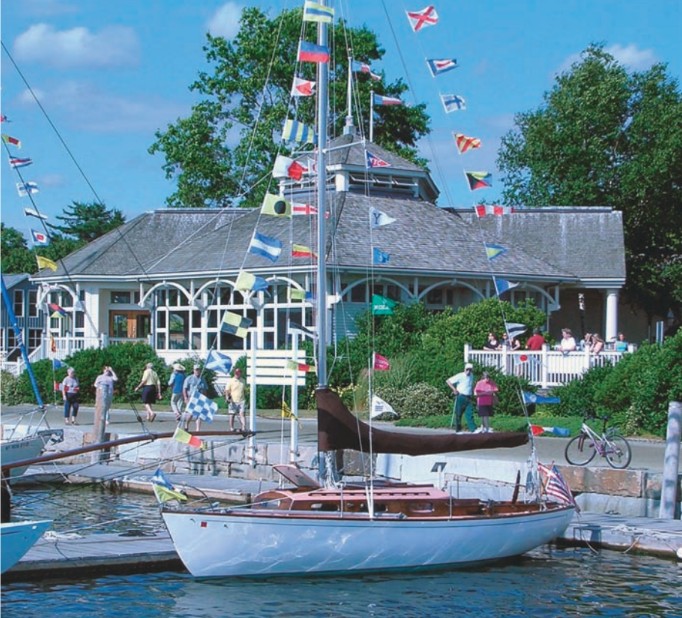
Of his 24-foot MORC design, Bill Shaw later said, “I did a half-size prototype of Finisterre, just to test the principles.” For those who don’t recognize the pedigree, Finisterre is known as the first of the light, wide, keel/centerboard breakthrough yawls by Sparkman & Stephens. She was raced illustriously all over the world by Carleton Mitchell.
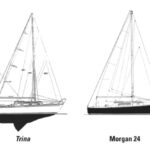
The initial Shaw numbers on paper looked good. Willard (Bill) Scranton heard about this design and commissioned a boat to be built by Jensen in Denmark — double-planked mahogany and cedar over oak, keel/center-board, complete accommodations for four, and a yawl rig. The result was the first Shaw 24, Trina, the first MORC boat built. Her intended function was to be fast, safe, and comfortable. She won 27 consecutive races in three years following her launching in 1957 under four different handicap rules, including MORC. She excelled in all weather and was a light air flyer. Naval architect Gary Mull said of the Shaw 24 yawl: “That boat — with a jib and a jigger — could sail through anything.”
Legends from afar
Her sister ships (24 built in wood, some as sloops) created apocryphal legends of heavy-air survival in places as far afield as the Aegean. (Truth in writing is called for here. Your author is the owner of the restored Trina. I am looking for a new “curator” to take this historic craft safely well into the new century. If serious, contact me at yawlbear@aol.com.)
Olympic medalist and boatbuilder George O’Day heard about Trina and approached Olin Stephens. The story I have from Bill Shaw is that George wanted to build a 24-footer. Olin said Sparkman & Stephens would never do a boat that small (watch out later for dozens of them) and called Bill Shaw into his office. Bill got out his Shaw 24 plans, and they conferred. Olin suggested two changes: a sweet Sparkman & Stephens sheerline to replace the Shaw 24’s slight reverse sheer and broader aft sections to help carry masthead spinnakers in a blow. Thus, in April of 1959 the first Dolphin 24 was finalized on paper as Sparkman & Stephens design #1497.
The design
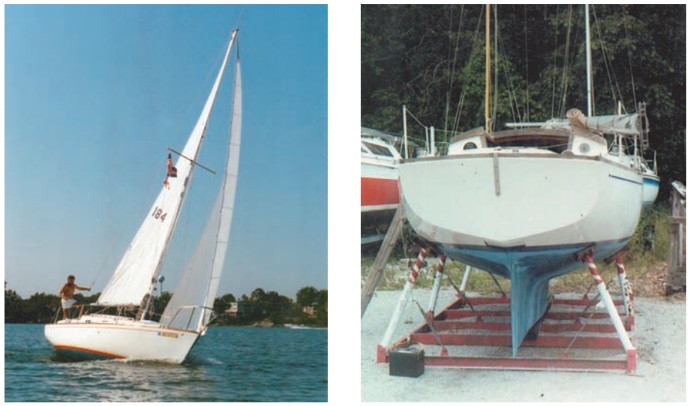
The Dolphin was designed to be good at everything she does without also trying to meet special constraints: price points, ultra-light trailerability, headroom, massive interior. Her classic sheer, overhangs, ample cockpit, and elegant transom were the norm then and are echoed today by new boats reviving that traditional look. In the Dolphin size range, check out the Bridges Point 24 and the Quickstep 24. Going bigger, look at Joel White’s Center Harbor 31. And there are hints of classic lines in the new J/100 and J/124. Even bigger are the new “daysailers”: the Morris 36 and the Hinckley DS 42.
The Dolphins that resulted from the Shaw 24 have a quick hull and powerful rig, moving the boat well in light air and easily reefable for heavy air. The masthead foretriangle is quite large for its day. Many designers (Ted Hood is a staunch proponent) believe it’s the genoa that provides a boat’s serious drive. It should be noted, though, that Shaw 24 yawl owners think the Dolphin owners are “missin’ a mizzen.” Since waterline largely determines top speed, you might think boats with shorter waterlines would be slow. However, as soon as they heel a bit, as the wind gets up to where top speed is possible, the bow and stern overhangs enter the water, effectively lengthening the waterline. In light air, the less drag, the better.
Many sailors prize the proper feel and behavior of a boat while under way over having vast spaces inside. After all, we spend way more sailing time on a boat than in it. Romaine Corbin of Pacific Dolphin, Inc., noted, “Standing headroom is a dockside extra — one sits down or lies down as soon as possible when moving about at sea.” Chris Vandersteen, the owner of a J. J. Taylor Dolphin on Lake Ontario, wrote, “I spotted the boat the summer before I actually purchased it and remember thinking that, though she was smallish, I really liked the shape of her. She looked sturdy and safe for my first boat, and I fell in love with the transom. She has proven to be very reliable, despite her age [45 years].”
Small is beautiful. Many sailors are really just dinghy sailors at heart. One of the Herreshoffs observed that the amount of use a boat receives is inversely proportional to its length. This certainly seems true — there is nothing like a boat you can arrive at and be under way in less than five minutes. I’ve always felt that if you can’t pull or work something with one hand, it’s too big. On the other hand, if you are looking for a good old boat one size up from the Dolphin, look at the Tartan 27. This is the Dolphin enlarged by Sparkman & Stephens.
The O’Day Dolphins
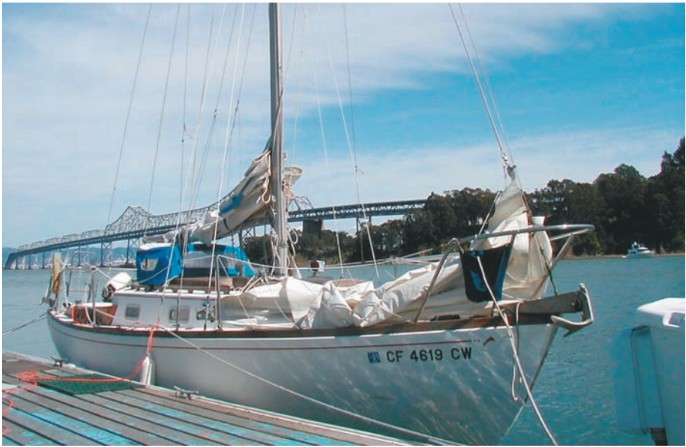
Beginning in 1959, the O’Day Dolphins came from Marscot Plastics, a division of the O’Day Corporation in Massachusetts. A few were classic transition boats. By that I mean they had glass hulls and wooden everything else, in part because a factory fire burned the deck/cabin/cockpit mold. The all-glass O’Day’s hulls and decks were solid … no cores. Some had wooden masts, and some of those have since been replaced with aluminum. The O’Day interior lay-out mirrored Trina’s: double V-berth, two quarter berths, head under the starboard seat, and a seat and galley to port. Power was provided by a gas Palmer Huskie inboard. Some boats were bought as kits — a completed glass hull and boxes of parts to be added by the owner. O’Day built 60 to 100 Dolphins.
I was a young whippersnapper racing International 14s in the Northeast when a friend and competitor, Sandy Van Zandt, announced one day that he’d be sailing 14s less because he’d be sailing a new Dolphin more. “What? A keel-boat?” we cried. “How could you?”
We failed to comprehend. Sandy, you must understand, was the sailor who didn’t like the sail shapes then made for 14s, so at first he built his own on his kitchen table and eventually became the sailmaker from whom we bought our sails. Trend leader? You bet. Did we “dinghy youngsters” under-stand the attraction of fast keelboats? Not then . . . but most of us do now. It must have been one of those first O’Day Dolphins that lured Sandy into leading the next trend.
The Yankee Dolphin
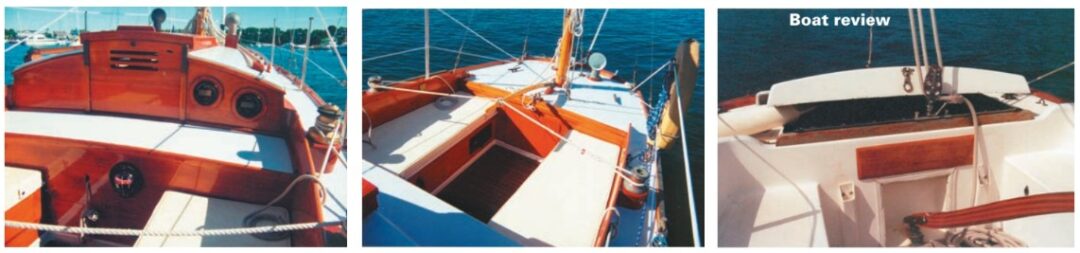
The late 1960s (through 1972) saw the Dolphin become the Yankee Dolphin as construction shifted to Yankee Yachts in Inglewood, California. Yankee Dolphin decks, cabins, and cockpits became a one-piece fiberglass unit. The company did use consider-able teak exterior trim (toerails, coamings, eyebrows, handrails, hatches, and so on) and a mostly mahogany interior, so the Yankee Dolphins have the “air” of classic wooden boats without any of the complications. The Yankee Dolphin brochure boasts of the boat’s hull molding, thickness, woven roving content, and “longer-lived” isophthalic resin. “The Dolphin is a sound investment in racing and family fun,” it states. “Truly a maximum boat with minimum maintenance — a real value.” Base price in 1969 was $5,195.
Sparkman & Stephens designed an improved high-lift centerboard (lead-ballasted fiberglass), a cockpit-operated board hoist, and an updated rudder. Keel ballast is 1,650 pounds of lead. The self-bailing motor well accommodates outboards up to a 9-hp standard shaft, though today’s four-strokes have a hard time fitting. The spars are aluminum; the mast hinges and steps on deck and is more than adequate in size and strength. The mainsheet acquired a traveler with cam controls.
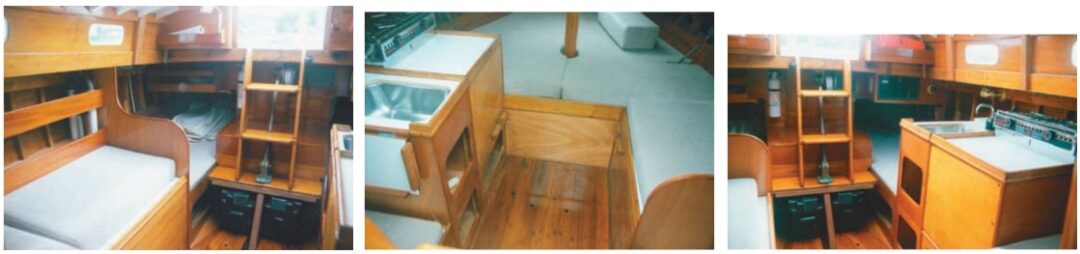
Yankee offered a new interior plan that made very efficient use of space with a complete glass headliner and hull liner. The double V-berth remained, but aft of that was a fully enclosed head compartment with a head to starboard and a hanging locker and shelves to port. The wooden sliding door disappears into the main bulk-head and thus takes up no swinging room at all. Several lockers and drawers provide storage, and the galley includes a sink, pump, water tank, stove, and icebox. A dinette to starboard con-verts into a double berth, and to port are a small seat, galley, and icebox. Cockpit lockers without quarter berths are thus capacious.
The Pacific Dolphin
In 1976, Pacific Dolphin, Inc., of Anaheim, California, became the last major manufacturer of the design. As a supplier to Yankee Yachts, the owners of this company had inherited the molds when Yankee folded. Base price had risen to $9,750 by then. Construction began with a close replica of the Yankee version, complete with teak exterior trim and a teak interior. Later versions eliminated almost all exterior wood. Options introduced wheel steering, a slide-out galley that disappears aft toward the port locker (providing a fifth berth), jiffy reefing, and Vire or Yanmar inboards.
Other Dolphins
Other firms made a few Dolphins each. J. J. Taylor in Toronto offered some — about 10 to 12 — which were probably O’Day hulls finished in Canada. They had a galvanized rudder, the removal of which for replating became a problem. Lunn Laminates of Long Island built copies of the O’Day boat complete with Palmer inboards after O’Day ceased production. There may well be more builders. One caveat: the 23-foot Olympic Dolphin is something else entirely — a 2,000-pound trailersailer designed by Derek Angus in 1970.
Trailering
In the words of Dolphin sailors, the experts themselves:
- Jim Sutro (Yankee Dolphin #84): “My trailer is fairly substantial — GVW 7,000 pounds — and hauls Duckling handily. The roof of my E-250 (3/4 ton) stretch van supports a sawhorse, which makes a tolerable workplace for rigging the mast, whether for sea or for the road. The mast is supported by a tabernacle, and the boom is rigged as a gin-pole for erecting the mast. I can do it alone. The trailer has a caster wheel and rolls into the water on a chain.”
- Ron Breault (O’Day Dolphin #12): “I don’t really trailer this boat, except to and from her home in our barn in the spring and fall. I step the mast at my yacht club where we have a hoist. Stepping/unstepping on a trailer or at a dock can be done, but it’s a heavy mast and a bit exciting for two people, never mind one. I think this boat is at the heavy end of what one would call “trailerable.” I thought about trailering her back from Maine, but in the end it was easier, less hassle, and more fun to sail her back.”
- Duane Post (Yankee Dolphin #184): “At best it would take three of us four hours to launch, rig, tune, and prepare for the cruise. And that was working really fast.”
Value and hazards
What should you do if a certain 24-foot hull in the boatyard turns your head? First, realize that this may be an emotional reaction and that owning a Dolphin is not like a relationship, it is a relationship. You may not be thinking clearly. If corporate hiring people make up their minds in the first 30 seconds and spend the rest of the interview rationalizing that decision, watch your-self. In your saner moments, however, you do have pedigree working for you. It should give you some measure of confidence that Sparkman & Stephens and Bill Shaw have each designed volumes of well-known and well-regarded boats. That fact will for sure matter to many potential buyers when you come to sell.
Moreover, licenses from Sparkman & Stephens to build Dolphins required each builder to adhere to very strict layup and construction standards. For example, hand-laid combinations of fiberglass cloth, mat, and roving are multiplied to create thicknesses of 7⁄8 inch in the keel wall, 3⁄4 inch at the keel/hull curve, 7⁄16 inch at the water-line, and 3⁄8 inch at the sheer. And the hull/deck bond requires 153 alternating stainless-steel screws and bolts every 4 inches all the way around with epoxy resin between. Furthermore, the keel cavity is filled with a mixture of lead shot and epoxy resin whereby the keel and 3 inches of the hull become one solid mass. These are covered with heavy mat, roving layers, and resin to 18 inches up the side of the hull. In the words of Romaine Corbin of Pacific Dolphin, Inc., “No one is ever going to worry about dropping a keel or holing below the waterline.”
Outboards vs. inboards
Dolphins may come with outboards or inboards or both. The outboard wells work nicely, except that the new four-strokes take more room than two-strokes and may not fit or rotate as well. Owner Ron Breault reports that his 4-hp two-stroke moves his boat at 4.5 knots in a calm. It stores under the cockpit in a heavy-wall plastic tube. He loses 0.3 knots to drag while sailing with the prop in the water. But out-boards leave more storage space below and are easy to afford, reach, service, and remove. It’s also easy to install a loaner while yours is being fixed. In-boards are more expensive, have more moving parts, and are harder to reach, service, and remove. A new inboard could well be of greater dollar value than the rest of the boat. On the other hand, inboards put the prop directly in front of the rudder for improved slow-speed maneuvering, and they start and shift with readily accessible buttons and levers. The older I get, the more I value that.
What to look out for
Many Dolphin owners contributed to the following list of what to look at, watch out for, and have a surveyor render an opinion on (note that this list applies almost verbatim to virtually any similar-sized boat):
- Moisture-meter the hull and especially the cored decks. O’Days have wood in the hull-to-deck joint that is often “gone.” Check near stanchions, fittings, and genoa tracks.
- Check shroud chainplates, their through-deck passages, the bulk-heads to which they are bolted, and the bulkhead-to-hull bond. Water damage here may be the most common Dolphin problem.
- Check for compression or corrosion on the prop under the on-deck mast step.
- Check the topsides and bottom for gelcoat cracks or crazing from the extra-heavy gelcoating of the era. It is easy to live with these; one can redo the surfaces as time and funds allow.
- Check whether the trailer size and condition are up to the distances you plan. Do you have access to a big enough vehicle?
- Check the hull-to-deck juncture, ports, hatches, and so on for signs of leaks from caulking failure or tired fasteners.
- Check the rudder movement for bearing wear and the fittings for electrolysis.
- Wooden spars with original resorcinol glue may begin to separate. These can be cleaned up and epoxied back together.
Renew or restore
You can buy a used boat and just sail away. As for me, I hate surprises. I want a boat that’s trustworthy. If I had a new old Dolphin, I would at least renew it by checking and replacing every last thing that was remotely suspicious or could stop the boat from getting me home. If possible, I’d budget an extra $2,000 to $3,000 (more if a yard does the work) to get a substantially new boat (and my own peace of mind).
Will it be worth it? Some think you need a masochistic streak to renew or restore a boat. My rule is: “Always try to buy from a distressed owner; do not buy a distressed boat.” But there is considerable satisfaction in preserving something worth saving and making it work well and safely again. Dolphins are selling for anywhere from $3,000 to $10,000 today, more for Mr. Fuss-budget’s boat. You probably won’t get your refit investment back in cash, but you’re a sailor so you know what you get back in purely subjective ways.
As Romaine Corbin said of Dolphins, “Boats that will get them there and bring them back — swiftly, safely, comfortably.” In my book, that’s the highest praise any boat could receive.
Thank you to Sailrite Enterprises, Inc., for providing free access to back issues of Good Old Boat through intellectual property rights. Sailrite.com