“Post-trauma syndrome” might describe the impact on the Mississippi Gulf Coast
Issue 50 : Sept/Oct 2006
I was in a marine store the other day and saw an attractive ice chest for my boat on sale. I thought of buying it . . . but then again, I have three ice chests at home . . . or do I? I keep thinking I have something when, in fact, all our house-hold goods were lost last year to Hurricane Katrina. This experience is common among those whose lives have been forever changed by the hurricane. One person I knew was looking for a new dinghy. I had to remind him that his boat was lost and he no longer needed a dink. Such is the disconnect so many people on the Mississippi Gulf Coast feel.
The difference between those who lost everything and those who did not is profound. I have experienced several hurricanes up close and personal. When Hurricane Carol’s eye went right over Oyster Bay, New York, for example, I went out in a sea skiff to re-moor boats that were on a lee shore that had suddenly become a windward shore. For a 16-year-old kid, it was fun. Hurricane Katrina was not fun at the time and still is not.
Never again
Boatowners who stayed on their boats through the storm, and lived, swear they will never do it again. Several of our local shrimpers are among this group. The force of the wind and the surge had to be witnessed to be believed. Interstate 10 (8 miles inland from the coast and well elevated, as required by federal guidelines) was under 14 feet of silt-laden salt water. After the hurricane, a neighbor in Pass Christian, Mississippi, said that he swam past my house while trying to survive. He was not joking; he really did swim to a tall tree when his one-story home, next-door to mine, flooded to the rafters.
Many boatowners say they will never sail again. This is sad but understandable. Among the people in the region, there has been a great exodus to places in the mountains and well inland. For many of us, the sensation is like that of the displaced person who is determined to go home . . . but the home is no longer there. On one level, he knows the home is gone, but he wants to return anyway. There is an unreality somehow disconnected from the facts of the destruction. One’s mind is unwilling to accept the truth. Hurricanes of this severity can do strange things to the mind.
Before Hurricane Katrina there were probably 120 good old boats in Pass Christian Harbor. Many were evacuated from the harbor; yet only about 10 survived the storm. There was a beautiful Beneteau 41 left in the harbor. The only thing that remains of it is a 4-foot section of the keel. The destruction of so many boats makes you wonder if any boats can survive a storm of this magnitude. The steel shrimp boats did all right, but most of the wooden shrimpers were damaged beyond repair. It did not matter how well the boat was built, only where it was located and how good was its luck.
I’m thankful that my boat was one of the ones that survived, but it was due to a merciful God and little help from me. I took my boat to a narrow bayou behind Pass Christian and tied her to pilings on one side and large trees on the other with six 3⁄4-inch three-stranded nylon ropes. The bayou was only about 60 feet wide, and I used 75 feet of rope for each line.
The surge that came through has been offi cially calculated at 35 feet above the high tide level, so my boat went up and down 35 feet. There was a 21-foot Boston Whaler 30 feet up in a tree behind my boat, so I know the water went at least that high. Inside our boat, it looked as if she had been turned over: everything was jumbled up on the cabin sole. She sustained a little rain water (it was fresh water) above the cabin sole, but that was handled by the onboard bilge pumps.
Scarred for life
I believe the people who were affected by the storm in this way will bear the psychological scars for years to come. It is, perhaps, like the psychological reactions of soldiers who return from battle and jump when a car backfires. The 2006 hurricane season is going to be interesting, as most of the survivors, my wife and myself included, will probably evacuate early to high parts of the state. Many will be convinced it is too dangerous to live near the coast; those will not return.
New Orleans is having this problem as I write this early in 2006. Almost 50 percent of the population does not plan to return to the city. This leaves a lot of jobs unfilled, a lot of tax revenue un-generated, a lot of empty derelict homes that were flooded and are now decaying and full of rodents. Homes are being bulldozed in many parts of the city to clear the rubble. It is sad that 200-year-old homes that survived for so long are now lost.
The beaches are a sad story too. There is so much debris in and on the beaches and under water that nautical charts have become useless. The U.S. Coast Guard is sweeping the area up to 4 miles off the coast in an effort to clear the bottom of cars, refrigerators, washers, and driers that the surge took out to sea when it retreated. The offshore islands have been breached and the underwater profile has been radically altered. Smugglers Cove on Cat Island — where we spent so many weekends in the past — is no more. It was filled in to a shallow depth by the storm. The island wildlife (deer, hogs, bobcats, raccoons, and so on) are all assumed drowned. Perhaps only alligators survived.
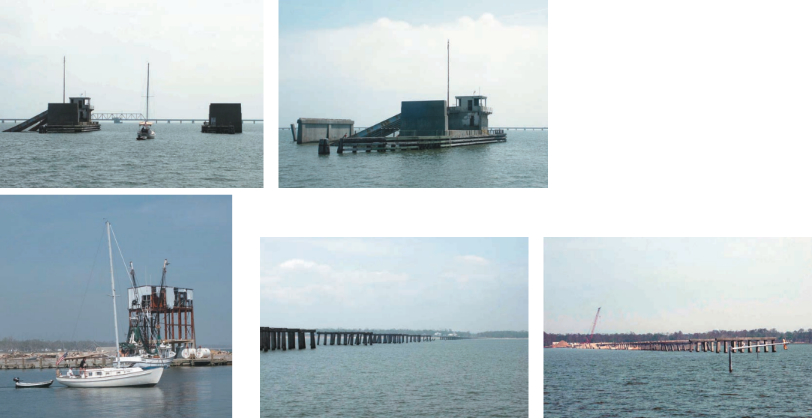
The Interstate 90/Bay St. Louis Bridge collapsed into Bay St. Louis, as did the Biloxi Back Bay Bridge between Biloxi and Ocean Springs, Mississippi. The waterways near the bridges are blocked with debris.
My boat was in need of a bottom job before the hurricane and she is now, months later, even more in need, but there are no boatyards available for this type of work. It is a strange feeling when your entire personal infrastructure — including the marine supplier, hardware store, yacht club, stores, and favorite restaurant — disappears. These are all gone, probably never to return. The huge new Wal-Mart store was also washed away. The hurricane played no favorites.
Pass Christian Yacht Club was washed away even though it was elevated 12 feet above mean high tide on steel I-beams. The club is valiantly trying to come back; members purchased a double-wide trailer as a temporary club- house. You have to salute the commodore for her valiant efforts to save the club.
Where do we go from here? I’ve never before been in a start-up position in what is a 200-year-old town with an illustrious history. The urban planners have a real life laboratory to work with. The sailors are challenged to see what they are made of. The jury, which will see if this experiment can work, is out and will remain so for years. Only time will tell.
Pray for the Mississippi Gulf Coast.
Thank you to Sailrite Enterprises, Inc., for providing free access to back issues of Good Old Boat through intellectual property rights. Sailrite.com