. . . and a trio of Canadian contemporaries
Issue 118: Jan/Feb 2018
George Hinterhoeller, with his company, Hinterhoeller Yachts, was one of the four founding members of C&C Yachts in 1969. By 1975, George had had enough of the politics and corporate life of a public company. After a year of being the president, he parted company with C&C to re-establish his own company with a new product line he called Niagara, reflecting his location in the Niagara Peninsula of Ontario.
The first in this new series of boats was the Niagara 26, which he designed himself using the concept of light weight and a long waterline he had pioneered with the 24-foot Shark in 1959. The 26 was soon followed by larger Niagaras designed by either German Frers or Mark Ellis, and of course the iconic Ellis-designed Nonsuch in a wide variety of sizes.
By 1975 there was a number of competing boatbuilders in Central Canada, the largest of them being C&C Yachts. Dick Steffen of Mirage Yachts and Hans Tanzer of Tanzer Industries, both near Montreal, were also gaining prominence in the still-growing sailboat market. After entering the business as a Hinterhoeller dealer, Steffen started building the Cuthbertson & Cassian-designed Mirage 24. But the creation of C&C Yachts cut off that design avenue, so Steffen turned to West Coast designer Bob Perry to meet his design needs with his Mirage 26. Also in 1976, C&C produced its own 26-footer, the C&C 26. For the sake of full disclosure, I should mention that I was the project manager for this boat in the C&C design office.
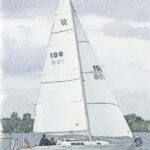
On the assumption that all politics is local, it can probably be argued that all competition is also local, so it’s interesting to compare and contrast these four Canadian 26-footers, all of which made their debuts in 1976. I could not resist the remarkable coincidence of all four boats from local builders being introduced in the same year.
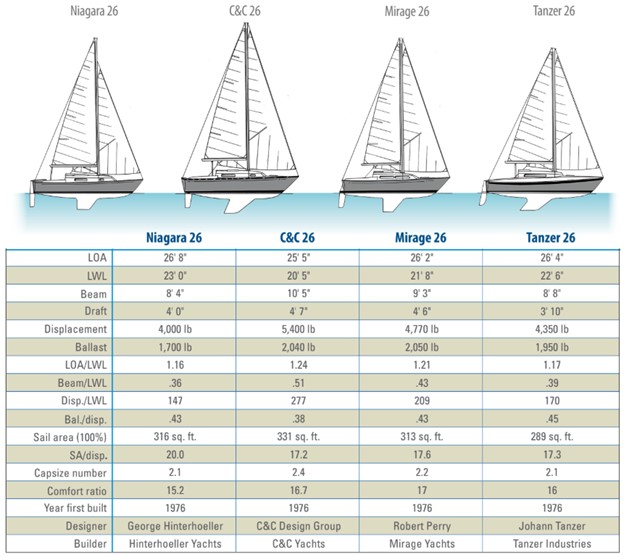
Of the four boats featured, the Niagara has the lightest displacement, 4,000 pounds, and the longest waterline length, 23 feet, resulting in the lowest displacement/length (D/L) ratio of a very competitive 147. Combined with a sail area of 316 square feet, that light displacement produces a very competitive sail area/displacement (SA/D) ratio of 20.0.
The next-most-competitive boat in that regard is the Tanzer, with its displacement of 4,350 pounds on a waterline of 22 feet 6 inches giving it a D/L ratio of 170. A smaller sail area of 289 square feet gives it a lower, but still competitive, SA/D ratio of 17.3. The Mirage is a little more conservative, with its heavier displacement of 4,770 pounds on a shorter waterline of 21 feet 8 inches yielding a higher, but still competitive, D/L ratio of 209. Her sail area of 313 square feet produces an SA/D ratio of 17.6, almost equal to the Tanzer’s.
The odd man out in this group is the C&C 26. Despite being the project manager for this boat, with the benefit of hindsight, I am scratching my head at the boat that evolved. In my design comparison on the Pearson 323 (November 2017), I pointed out the influence of the International Offshore Rule (IOR), introduced just a few years earlier, on designs of this period. Here we see the exaggerated beam of 10 feet 5 inches — a full 2 feet wider than the Niagara 26 — and the consequent pinched ends so typical of IOR designs. (This wider beam does contribute to increased interior volume.) The C&C is also the shortest of this quartet of 26-footers, actually being closer to 25 feet, while the other three boats are all over 26 feet. This shorter length is most evident in its LWL of only 20 feet 5 inches, a full 2 feet 7 inches shorter than the Niagara. (Sailboatdata.com showed a waterline length of 23 feet 5 inches, which fit in well with the other boats featured but, after further research, I found that the actual LWL is in fact 20 feet 5 inches.) This shorter LWL, combined with the heaviest displacement of 5,400 pounds, results in a somewhat conservative D/L ratio of 277. The sail area of 331 square feet (the largest in the group) produces an SA/D ratio of 17.2, still somewhat in line with the Tanzer and the Mirage.
The Niagara and the Tanzer have transom-hung rudders. On the Mirage, the rudder is recessed into the transom, a feature originally developed by Cuthbertson & Cassian on the Mirage 24. The C&C is the only one of the four to have a cantilevered spade. Hinterhoeller’s 26 is the only one of the four with a fractional rig, another development from his earlier Shark design and a harbinger of what would appear on the J/24 the very next year.
All of these boats have capsize numbers above 2, which is not ideal, but not uncommon for smaller boats with lighter displacements. The C&C has the highest capsize number of 2.4, due primarily to her wide beam but partially offset by her heavier displacement. Comfort ratios are also low, again not atypical for smaller boats.
In the mid-1970s, sailboat production was approaching the high-water mark in North America, and it’s intriguing to look at these four 26-footers, all produced by Canadian builders in the same year.
Rob Mazza is a Good Old Boat contributing editor who, in his long career with C&C and in other design offices, designed many boats that are now good and old.
Thank you to Sailrite Enterprises, Inc., for providing free access to back issues of Good Old Boat through intellectual property rights. Sailrite.com