Can’t wait any longer? Stay warm and double your fun by sailing each spring and late fall
Issue 18: May/June 2001
There is a myth out on the sparkling waves that probably originated from folks gazing at summer sails through shoreside barbecue haze. It is a sweetly beckoning myth with all the power of the Sirens, calling the unwary as surely as the pitchman at a sideshow.
The myth goes thus: to every sport there belongs a season and summers are the sine qua non for sailing. It follows that when temperatures drop, birds fly south, and mortals huddle by firesides. It would seem the antithesis of pleasure to be anywhere near the cold, cold briny. Logic would indicate that life afloat mirrors life ashore and, since most boats are seen during the summer months, isn’t that the affirmation for turning this myth into fact? Hardly.
What the casual observer on shore can’t see are the slatting sails in the summer doldrums as frustrated skippers search astern for swirls to indicate movement . . . or the skipper and crew sitting mesmerized watching two trees ashore which are lined up and remain that way. It’s also difficult to see, from a distance, the crewmembers’ growing restlessness and discomfort as they fry in the direct heat of the sun or bake below in a windless cabin.
Hence, it often comes to pass that a novice sailor loses interest simply because of the belief that summer sailing is as good as it gets. The new sailor sets sail in July, is disappointed with zero activity, and looks elsewhere for ways to spend discretionary time and money. We lose an important part of our unique community: the replacement sailors who will keep our future viable. Another voice is lost when laws are promulgated or recreational sanctions considered.
Contrary to this myth is this simple fact: the very best sailing is anytime but summer. As it turns out, early spring and late fall are the best of times for breezes and brisk sails. In the summer, unless you’re fortunate enough to be out during the few hours prior to a front, you will quite possibly do more motoring than sailing. Your ice will run low, your patience will run out, and your crew may run to another avocation. It doesn’t have to be.
With a little preparation, you can double your normal cruising season. Better yet, you will enjoy the “less-than-primetime” sailing seasons twice as much as the months of July and August. You will sail more, farther, faster, harder. You’ll develop smile wrinkles from hours of grinning. You’ll be more comfortable, sleep better, find shorter waiting lines, moorages that aren’t buzzing with PWCs, and facilities where you can pick and choose your berth.
How, you ask, is this possible? By staying dry, staying warm, and staying fed. From a considerable amount of time adrift, mostly north of the Mason-Dixon Line, come these planning and preparation tips for your new-found freedom of extended sailing. I can’t take credit for them, only for knowing some great instructors from sailing meccas like Newport, British Columbia, and New Zealand.

Clothing
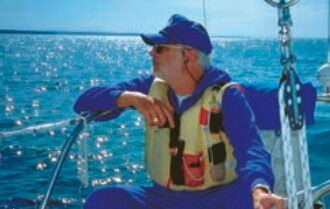
Dress well, but not to excess. Don’t wear so many clothes you can be mistaken for the Michelin man. Dress in layers. The layer closest to your skin should wick moisture away. Synthetic fibers and silk are good for this. The next layer(s) should provide insulation by preventing heat loss through air movement. Use waffleweave, Polar fleece, or bulky sweaters. Multiple layers allow for adjusting heat retention by layer removal and are much better than a single thick layer. The outside layer should be wind-resistant or waterproof depending upon the weather. That means that all of that outside layer should be wind-resistant and/or waterproof: coat, pants, hat, gloves, and boots. Multiple insulating layers also should apply to all of your clothing, not just the shirt, sweater, or coat over your upper body.
Do you like hats? Neither do I. However, our head and neck areas are our greatest sources of heat loss. Try a fleece cap topped by a wind-resistant hood capable of being snugged down tightly with a drawstring. A billed cap keeps rain, as well as the sun, out of your face. By the way, there’s a reason why old photographs of whaler crews show them wearing wool scarves: they work.
Cushions
Cockpit cushions are indispensable for extended cruising. What do you use in your cockpit? Hard, stiff vinyl-covered ones that cut into your legs and slide all over, flotation cushions you could pound nails with? All of your clothing layers will compress and lose effectiveness where you sit down and lean back. Cushions provide comfort with their softness but equally important is their insulation value. An excellent sail-slatting summertime project is making back cushions for the cockpit; you’ll find the crew using them in all seasons. Warm, soft, cushions are also valuable in the saloon. If your cushions are more than 10 years old, sit on (don’t just look at) some of the new closed-cell foam cushions and softer fabrics.
Weathercloths
Weathercloths around the cockpit lifelines offer many advantages. They’re a not-so-subtle way of displaying your boat’s name, hailing port, or anything else you wish to proclaim. If you have to be found for any reason, folks will remember your boat with its distinctive weathercloths. Besides, weathercloths give a boat a salty professional look.
Of course, the everyday value of weathercloths is the comfort they bring. With apparent wind from abeam, you will retain heat much better in the lee of these cloths. They are easy to put up, take down and stow; a minimal hassle for the increased comfort they bring. Contrary to the opinions of some club-racers, weathercloths will not bring you to a complete stop with their windage nor will they make it impossible to come about. If you’re racing, take ’em down. But if you’re cruising, they’re definitely worth it.
Rigging
Lead your lines aft to the cockpit. Many of yours may be led aft already, but here’s one you may have missed: a downhaul for your foresail. Underway, the most dreaded place to go on deck is forward. A very light line (3⁄16 inch) from the top of your genoa or jib to a deck fairlead and then aft will save many moments fraught with anxiety. When planning this downhaul fairlead, pick a spot near boat center (to keep the sail inboard when down) and slightly aft of the sail’s clew so tension can be maintained to reduce flapping.
Food
Here’s a great hot beverage plan I learned from another liveaboard couple on the inner quay at the Empress Hotel, Victoria, British Columbia. First, start with a two-quart vacuum flask. Not one quart, not one liter, but two quarts. Two quarts will stay hotter longer than a smaller amount. At home (or at anchor, if you’re doing some extended cruising) boil four quarts of water. Fill your flask with boiling water, wait about three minutes and empty it, filling it anew with boiling water. If you drink drip/percolated coffee, make a pot’s worth but use one ounce of water instead of one cup. In other words, make a small amount of very strong concentrated coffee. Store it in any watertight container. Then, when you’re out where the wind meets the canvas, just pour a small amount of concentrate into a mug and top it off with very hot water from your flask. Instant coffee and cocoa also work. Unless you’re chipping ice from the topsides, you will have hot beverages for a weekend with this method. (As an aside, the 60-ish couple who gave us this suggestion sail year-round on Puget Sound.)
Just as salty chips and similar snacks are served during the summer season with cold beverages, coffee and cocoa are complemented by cookies, doughnuts, and bagels. Their high-calorie content will keep your crew’s fires burning and measurably raise comfort levels. A particularly convenient type are the tinned butter cookie assortments widely available in stores and catalogs. If you have an elevated cholesterol level, as I do, a better choice is our old sailing standby: oatmeal-and-raisin cookies. We humbly offer our Friday Harbor recipe.
Another great addition to the extended galley is a vacuum flask of hot soup prepared in advance. Skip the crackers and spoons, just serve in mugs and drink as a beverage. Glorious! We routinely cruise with three flasks: the big one with boiling hot water, a quart one with tomato soup, and a wide-mouthed quart Thermos with “chunky” style soup. All of our vacuum bottles are packed in a soft-sided cooler/warmer to further retain heat.
While we’re on the subject of food, watch out for alcoholic beverages. They may feel warm going down (so does an ounce of hot sauce), but they actually depress the central nervous system and lower body temperature after the quick alcohol burn-off.
Heat
Heating your cabin is the difference between ordeal and delight. Yet many cruisers, myself included, don’t have heaters. Further, I’m just cautious enough to distrust something burning below as I sail. Here’s one alternative method used by some cold-weather sailors. Before getting underway, place a large cast-iron pot on your galley stove, the larger the pot the better. In the pot, put at least 5 pounds (10 pounds are better) of broken clay pots. Heat this for about 15 minutes or until good and hot. Turn off the stove, shut off the solenoid if using propane, secure the pot, and shove off. The warm mass will take the cabin chill off for quite a while.
If someone is using the cabin, do not try to make it airtight. You need circulation to carry stale air and condensation out. It’s better to be a little cooler than dripping wet.
Part of your extended cruising will almost certainly be done under power. A very effective idea is hot-water heat, compliments of your motor’s freshwater cooling system. Systems for marine use are available in several catalogs. For about $120 plus shipping (winter 1999-2000 prices), these gadgets provide the heater and dual-speed 12-volt electric blower. Along with insulating your hull and overhead (much more difficult), a hot-water heater may just be the single greatest asset for off-season cruising. Remember to use high quality, reinforced, hot-water hose, double your hose clamps, and place protective grommets wherever a hose passes through a bulkhead.

Weather
I left the good part for last, just like Mom always wanted. In places that I’ve sailed — north, south, east, or west — spring and fall are seasons of change. With that change comes wind. Seldom will glass-smooth calms be seen on April’s and May’s waters, or October’s. If you’ve yearned to bury the lee rail, to push the envelope, or just to sail without being surrounded by diesel fumes, these months are for you. From the Great Lakes to Puget Sound, I’d guess that summer zephyrs have half the strength of those you’ll encounter in spring and fall, maybe even less than half. Further, since spring and fall winds are partially developed by solar warming of cool land and water, nights tend to be calmer.
Some miscellaneous advantages: your fuel will last longer with more sailing time. Many shoreside restaurants lower their prices outside traditional tourist seasons. Chilling beverages is as simple as lowering them over the side (of course, that can be done year-round in Puget Sound and some of the Great Lakes). On a per-usage cost basis, the expense of owning a boat is lowered and justified dramatically . . . in case your accountant keeps hounding you for that. Lastly, you get to use the salt with little grains of rice that much longer.
And a couple of caveats: if you’re really extending the cruising into frosty season, it’s better to drain your water tanks and bring bottled water. Similarly, mothball your head and holding tank with antifreeze made for that purpose and use a Porta Potti. Cruising or not, fuel tanks should stay topped off to reduce condensation.
Friday Harbor Oatmeal Cookies
3 Tbs canola oil
3 Tbs oil substitute (Smucker’s Baking Healthy or similar substitute. Applesauce also works.)
1⁄2 c brown sugar
1⁄4 c white sugar
1 egg white
4 Tbs water
1⁄2 tsp vanilla
1 1⁄2 c quick oatmeal (one-minute cooking variety)
1⁄2 c all-purpose flour
1⁄2 tsp baking soda
1⁄2 tsp salt
1⁄2 c raisins
Stir together canola oil, oil substitute, brown sugar, white sugar, egg white, water, and vanilla. Add oatmeal, flour, baking soda, and salt. Mix well. Mix in raisins. Drop on cookie sheet by rounded teaspoon and bake about 14 minutes in pre-heated 350°F oven. Let cool completely before sealing in plastic bag(s). May be frozen for a week or two. Enjoy as many as you wish with a clear conscience! Makes about 30 cookies. Recipe can be easily doubled. In fact, we recommend it. (Recipe was tested in the Good Old Boat “test kitchens” and awarded 3 stars.)
Bob learned to sail on small O’Days more than 30 years ago. He has owned an odd assortment of sailboats and sailed them in waters from the Florida Keys to British Columbia’s Gulf Islands and from New York’s Finger Lakes to the reservoirs of Colorado and Idaho.
Thank you to Sailrite Enterprises, Inc., for providing free access to back issues of Good Old Boat through intellectual property rights. Sailrite.com