Almost the answer but not quite
Issue 40 : Jan/Feb 2005
When Magnus, our newly refitted motorsailer, needed an appropriate dinghy, I surveyed my fleet. There was a gorgeous Phil Bolger-designed Gloucester light dory, a flat-iron skiff, a plastic canoe, a Force 4 inflatable dinghy, and a 7-foot plywood pram that I designed to fit on the foredeck of our previous sailboat.
None of them would do.
The dinghy, says cruising guru Tom Neale, is “the family car, the family pickup truck, the fuel tanker and water barge; it will probably be your towboat or tugboat, your fishing boat, and your reef-diving boat; it will be your far-off and rough terrain exploration four-wheeler. And that’s just the beginning.”
Absolutely. But the dinghy is always a problem. You can hoist a wooden or fiberglass dinghy aboard, which is not much fun, and then it will cover your hatches, block your vision, attack your shins, and snag your lines. Towing one is literally a drag. In a breeze, the towed dinghy will blow around, fill with water, or perch on the waves astern and then charge downhill at the mother ship.
Alternatively, you can get nesting dinghies — two or three boxes that nest inside one another and can be bolted together to make a boat. You’ll love doing that in a lumpy, windy anchorage.
So most people use inflatables. Alas, even the best small inflatables are poor boats. Rowing an inflatable is like levering a doughnut through Jello, almost impossible in any wind. With an outboard, an inflatable moves like a doughnut driven by an eggbeater. Inflatables are desperately wet in a chop, and they are always vulnerable to abrasion, chafe, and puncture. You can’t let them rub on things or drag them up a rocky beach. The nails of a dog can do them in.
Hardly ever deflated
Furthermore, most sailors never deflate their inflatables anyway. The boats are inflated in the spring and (maybe) deflated in the fall. So the inflatable proves to be just as much of a bulky nuisance as a hard dinghy . . . and much less of a boat.
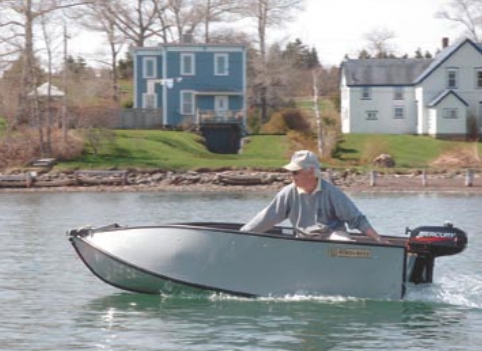
That’s why I bought a Porta-Bote — a folding boat made of polypropylene. The Porta-Bote’s two sides fold down against the bottom and the two halves fold together, making a surfboard-sized package 4 inches thick, 2 feet wide, and 8, 10, or 12 feet in length. Our 8-footer weighs just 47 pounds. Prices are very competitive with inflatables.
A folding boat sounds gimmicky, but Porta-Botes have been around for 30 years, and more than 50,000 have been sold. The hulls are guaranteed for 10 years, and the boats are almost indestructible. The Japanese Coast Guard tests every import shipment by loading a Porta-Bote with 600 pounds of concrete and dropping it 21 feet into a pool of water.
Porta-Botes get rave reviews from cold-eyed judges such as Practical Sailor, Field and Stream, and Canadian Yachting, not to mention several Nova Scotian owners. They’re also popular with hunters, fishermen, and R.V. owners.
To open a Porta-Bote, you simply unfold it, hold it open with a spreader stick, insert the seats and the transom, and remove the spreader. How hard is it? Practical Sailor assembled the boat in six minutes. The day our boat arrived, I opened the package, assembled the boat, dragged the boat down the rocky beach into the water, took it for a row around the wharf, and dragged it back on the shore . . . all in well under an hour.
Flexible hull
The 8-foot version is over 4 feet wide and very stable. I can stand up in it anywhere, though the flexible hull material yields easily underfoot, which gives a disconcerting sensation of standing on a pad of jelly. With its drooping nose, the boat looks odd but rows well, it’s unsinkable, and it carries a huge load. There is even a sailing kit for it.
Practical Sailor describes the Porta-Bote’s performance under power as “startling,” which it is. With a 2.5-hp outboard, our boat planes easily and rockets across the harbor. It rides softly and quietly, and steers nimbly. Practical Sailor clocked a 10-footer with a 4-hp motor at more than 15 knots.
Any complaints? Of course — it’s a boat, and no boat is perfect. The boat would benefit from better oars and additional oarlock sockets, and the two fat seats and the transom are awkward to stow. Some owners substitute plywood seats. And I haven’t yet found a really good place to stow the folded boat on Magnus without blocking the view from one of the helm stations, though I believe I may be able to hang it along the side, slightly below the stanchions.
In the meantime I tow it, and it tows just fine . . . though it needs the tiny foredeck to keep spray out, and the foredeck is flimsily attached. I eventually laced it tightly in place.
I see more and more Porta-Botes as I cruise, and no wonder. No solution to the dinghy dilemma is perfect, but for me, the Porta-Bote is hard to beat.
Thank you to Sailrite Enterprises, Inc., for providing free access to back issues of Good Old Boat through intellectual property rights. Sailrite.com