Capitalizing on the 1970’s trailersailer boom
Issue 58 : Jan/Feb 2008
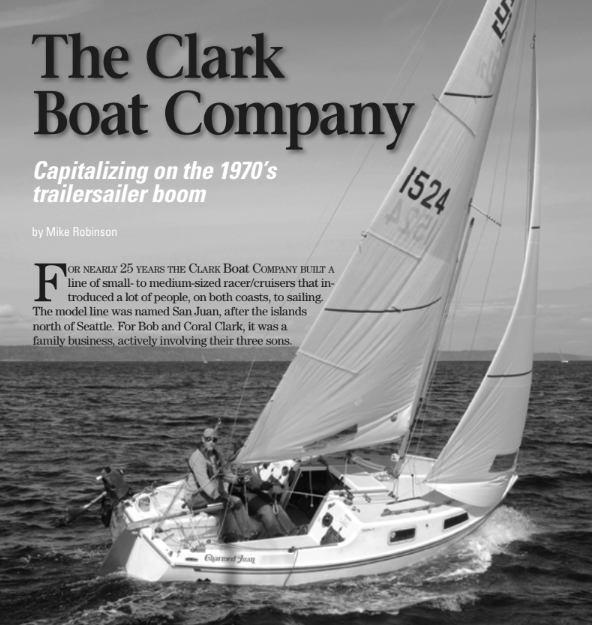
For nearly 25 years the Clark Boat Company built a line of small- to medium-sized racer/cruisers that introduced a lot of people, on both coasts, to sailing. The model line was named San Juan, after the islands north of Seattle. For Bob and Coral Clark, it was a family business, actively involving their three sons.
The beginning
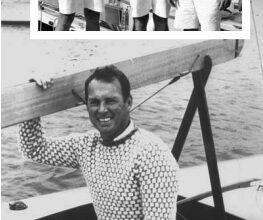
Coral Clark wrote a book titled Learning to Sail — The Hard Way, in which she tells how she and Bob got started, in Ohio, circa 1939. “We had been married a short time when Bob . . . announced he had bought a sailboat . . . Being from North Dakota, [I] said, ‘What’s that?’ . . . We put her in the water at the Toledo Yacht Club and proceeded to learn how to sail. In those days you didn’t go buy a book about it — there were none!”
After the Japanese attack on Pearl Harbor, Bob joined the Marines. While he was gone, Coral put a new canvas deck on their little boat and sold it, since she couldn’t justify paying $2.50 a month for storage. When Bob returned home he soon began building a Lightning in their basement.
“She was beautiful,” Coral wrote, “ . . . mahagony planked, solid oak keelson . . . 685 brass screws, all plugged . . . and weighed 1,200 pounds; she was supposed to weigh 700!”
In 1960, the Clarks moved to Kent, Washington, to start a fiberglass boat-building business. While Coral worked as a nurse supervisor, Bob set about building the Clark Boat Company into a viable business. Their three sons — Don, Dave, and Dennis — attended school but helped out when they could. The first boat with the “Manufactured by Clark Boat Company” label was a Lightning, one of the first built of fiberglass. They also built OK dinghies, 505s, and Stars. Two Clark-built Stars took first and second places in the 1970 World Championships.
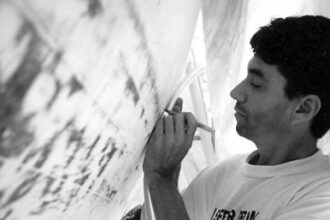
All the Clarks were involved in one-design racing. The success of their sons, mainly Dennis, would influence the design of the San Juan 21 in ways that clearly separated it from the competition. Dennis would later become a champion in four classes, including the International 14 and Thistle. He started the Clark Sails Loft in 1971. Don had a degree in engineering with additional training in naval architecture. He was very involved in the design of a number of their boats. Dave had a degree in management and entered the sales and marketing side of the business.
The C-Lark
The Clark’s version of the International 14 was called the C-Lark 14, an open 295-pound daysailer. More than 1,000 were built. With a 5-foot 8-inch beam and 133 square feet of sail area, the C-Lark promised excitement somewhat stabilized by a swinging centerboard drawing 4 feet 9 inches. In its day, there probably were not many faster dinghies. Nevertheless, the boat has a roomy cockpit that will accommodate up to four on a leisurely daysail.
The Clarks used common manufacturing methods of the time: gelcoat applied to a hull mold, followed by a hand-laid laminate. The San Juan hulls, therefore, are quite solid when compared to boats manufactured entirely with a chopper gun. Less critical components, like the interior liner or pan, however, were sprayed in a mold using a less-expensive chopper gun. The decks were typically of end-grain balsa core sandwich construction, which was and remains the industry standard.
San Juan 21 is born
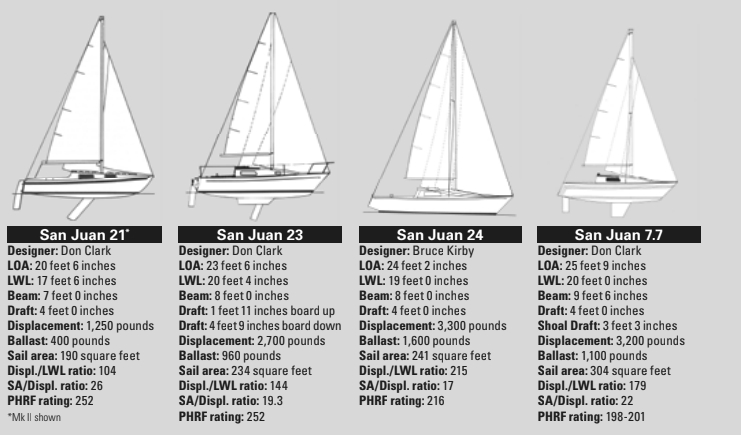
The young company’s first model with interior accommodations was a trailersailer — the San Juan 21 (see review in March 2003). In addition to above-average construction, Don Clark gave it some unusual features: a fiberglass-skinned, foil-shaped keel and rudder, a real rarity at the time. In addition, the swing keel retracts completely into the hull, allowing for the ultimate in easy trailering and shallow-water launching. The third unusual feature is a gasketed keel trunk to minimize turbulence from the keel slot when the keel is in the down position.
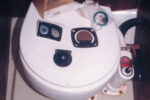
The Clarks were confident they had a winner, but they needed to hustle to make the Seattle Boat Show in the winter of 1970. The first San Juan 21 was barely ready in time, but it was a hit, with seven orders. The San Juan 21 Mk I was designed for the Northwest, where rainy day sailing is a common occurrence and ventilation down below is nice but not essential. Hence, the first boats have no forward hatch. This contributed to a strong foredeck but little air circulation below for sleeping. Some later first-generation boats had a large, round, screw-in deck plate added for ventilation. The 1973 redesign of the Mk I deck added a forward hatch and softened the line of the cockpit coamings.
The boat’s broad entry made it pound in a chop, but there was a reason for it. If the cross section were nar- rower, when crew went forward to tend the jib or set an anchor, the bow would sink or, worse, the boat might tend to roll. The SJ 21’s broad entry eliminated that problem.
The 21 was easy to trailer and launch. Thanks to its narrow 7-foot beam and completely retracting keel, it rides low on the trailer (between the wheels, not above) and can be launched in 2 feet of water.
The 21 was a great success. The Clarks organized the first San Juan 21 Championships in 1971, and by 1972 the company had produced 400, with another 250 projected for the following year. Overall, 2,600 San Juan 21s were sold, a success by almost any measure.
The Eastern U.S.
The Clarks, Don in particular, saw new markets east of the Mississippi River and began a push toward a larger East Coast presence. They responded by searching for a site for an East Coast factory. By late 1970, it was evident that the Clark sons could manage the western operation (Don was now president and chief engineer), so Bob and Coral moved to New Bern, North Carolina, to assist with the management of the new factory.
In 1972, Bob and Coral helped form the Blackbeard Sailing Club, which remains a hotbed of San Juan racing. In 1973, they sponsored the first in-the-water boat show the eastern North Carolina area had ever seen.
San Juan 24
Riding the success of the SJ 21, the Clarks embarked on a larger boat, a true keelboat — the San Juan 24, designed by Canadian Bruce Kirby. Most noted for his design of the Laser, Bruce was brought in to develop a boat that would be competitive in the IOR quarter-ton class. Bruce was well known to the Clarks; they’d been building his Mk IV International 14 for a few years. The San Juan 24 has typical IOR features, like the pinched-in stern and tiny transom. For cruising and trailering, Don restricted draft to 4 feet and beam to 8 feet.
Bruce recalls the SJ 24 as “ . . . one of my favorite wee yachts, and still my most successful design, except for the Laser. Looking back after 30 years . . . I feel that Don’s decisions might have been right, as the boat became remarkably popular and, in fact the restrictions might not have hurt performance very much. More beam would have helped with stability by getting the crew farther outboard, and later quarter-tonnners were much wider.”
The San Juan 24 was the first keelboat Bruce had designed. In doing his research, he polled friends in the sailing community, particularly George Cuthbertson of C&C Yachts. George helped Bruce understand some of the terminology in the IOR. Bruce confessed to being nervous about the boat’s performance, saying later, “I was particularly happy when Don Clark phoned me after the first sail in the boat to say that it had all gone very well. I asked him what the wake looked like, and he said, ‘What wake?’”
As hull number 1,000 rolled off the line in 1978, the boat’s IOR days were heading to a close, but its one-design future was and remains bright. The San Juan 24’s legacy also is assured: it is the most popular quarter-tonner ever.
Changes to the 21
A radical redesign of the SJ 21’s deck led to the Mk II in late 1974. This occurred around number 1,000. The hull remained unchanged, but the deck was transformed to allow for more interior space. The cabin sides were now flush with the sides of the hull, the cabin came 18 inches farther aft, and the foredeck was one continuous line from the mast to the bow.
All things come at a price, and the cockpit was reduced. Both the Mk I and II were built concurrently until the last Mk I was produced in 1977. New molds were made from time to time, to preserve quality.
San Juan 30 and 26
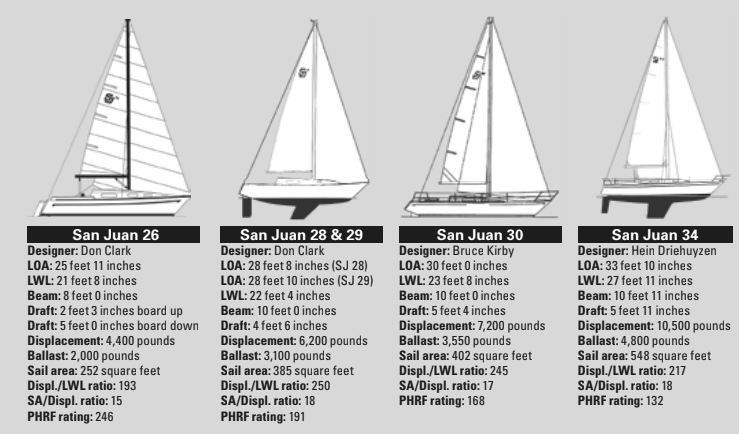
In 1975, Bruce Kirby again teamed up with the Clarks to develop the San Juan 30 half-tonner. This big San Juan was designed to build on the success of the SJ 21 in one-design and PHRF racing and the SJ 24 in IOR racing. Bruce did a lot of work on the project, but the Clarks believed it might not be wise to spend the money on the bigger boat and put the project on hold. Bruce, however, had grown fond of the design and had one built by the Gougeon Brothers as their first major monohull project. The boat was the 30-foot Accolade, cold molded in cedar and finished with varnished topsides. In addition to being beautiful, she was fast, winning a lot of races.
Bruce recounts, “We won class and overall in the Riverside-Stratford Shoal Race by 22 minutes corrected time in a large mixed fleet.” Accolade also won class in the 230-mile Vineyard Race by 36 minutes and beat all of the boats in three of the five classes above them.
These racing successes sold the Clarks on the design. They bought the mold over which Accolade had been built, added 5⁄8 inch to it (the thickness of Accolade’s skin) and made the plug for the San Juan 30. They offered two interiors, one just like Accolade’s with upper and lower quarter berths and only a head forward of the mast. The cruising version has a traditional layout.
The Don Clark-designed San Juan 26 also debuted in 1975. This was a keel/centerboard boat for the large trailerable cruiser market. It had a deep keel option, though few were made. With its shallow draft and easy launch capability, it was targeted for East Coast sailors. For racing, the San Juan 26 has a PHRF rating of 246, which is not much faster than the 21, and certainly behind her little sister, the SJ 24, at around 216 in the larger fleets.
The 26 has standing headroom and a head compartment. As the advertised weight was 4,400 pounds, one needed more than a small car to trailer it. The SJ 26 did not fit the raceboat culture of Clark, however, and was deemed by some as not attractive. In 1979, the more race-friendly San Juan 7.7 replaced it.
San Juan 23 and 28
The San Juan 23, one of 1977’s new entries, was a scaled-down SJ 26, with a large cabin and smaller cockpit than many of its contemporaries. The 23 was listed at 2,700 pounds with 960 of that in the keel/centerboard, though like many Clark boats, it came in heavier than intended. It was advertised with more than 5 feet 8 inches of headroom and accommodations for five.
With a PHRF of 240, it was at least as fast as the SJ 26 and much easier to trailer. The 23 also came in a fi xed keel/tall mast version, although the vast majority built had the keel/centerboard/short mast combination. This boat showed its Clark racing heritage by offering some items not usually found on cruising boats of that era: mid-boom sheeting, traveler, and racing blocks. It is a solidly built boat, featuring a through-bolted hull-to-deck joint incorporating an inward-turning hull flange on which the deck rests.
The 23 was similar to the SJ 24 in styling and in rig — both are masthead sloops able to set large genoas. The 23 doesn’t sail well under main alone and likes to be kept on its feet to sail swiftly. That said, it can be quite competitive in PHRF. The SJ 23 sold well; close to 700 were built.
On the heels of the SJ 23 was the San Juan 28 and, later, the San Juan 29, designed by Don Clark. More than 300 San Juan 28s were built after its introduction in 1978. It became one of the most popular boats in the Clark line. The difference between the SJ 28 and 29 is really nothing more than the builder. The 28 was built by the Clark Boat Company; the 29 (an SJ 28 with a few cosmetic changes) was built by the company that succeeded it, San Juan Manufacturing. There is a rumor that the 28 was simply a downsized version of the San Juan 30, but this is not true.
The San Juan 30 is a Bruce Kirby design and, while there is a family resemblance, the SJ 28 is a different boat. A quick look at the underbody of the hull confirms that. A year after its introduction, the SJ 28 finished second at Yachting’s One-of-a-Kind-Regatta in Annapolis, Maryland, finishing behind a San Juan 24.
A shortcoming the SJ 28 shares with the SJ 21 Mk II, as well as the 23, 24, and 26 is the potential for rot in the wooden bulkhead in the cabin to which the chainplates are attached. The early Clark boats had no cap over the slot in the deck through which the chainplates pass, relying entirely on caulk to prevent water from migrating to the bulkhead. Later boats had caps fitted.
San Juan 7.7
The San Juan 7.7 was introduced in 1979. With the IOR rule no longer a factor, and the San Juan 26 not performing as hoped, Don Clark decided to fix the shortcomings that the IOR rule had imposed on the popular SJ 24. Its narrow beam, a requirement for trailering, had significant limitations. Downwind performance had always been an issue, due to its narrow aft sections. The bar for Don Clark’s new design had been set very high. He had to design something faster than the famous SJ 24, and something that would challenge the hot newcomer from the East — the J/24. The result was a whole new raceboat in the mid 20-foot range, the San Juan 7.7. The Clarks still believed in the concept of the racer/cruiser, so the SJ 7.7 had significantly better accommodations than a J/24.
In the days before extensive computer testing, exact ballast amount and placement was often a designer’s best guess until sea trials could be completed. The SJ 7.7 displaced 3,200 pounds with a 9-foot 6-inch beam. It came only with a fixed keel and was a bit under-ballasted at the outset. The thought was that light weight improved speed and that adding ballast was easy with a wide beam boat by just putting more crew on the rail.
As a result, the SJ 7.7, as initially designed, was simply overpowered. The fix was a shoe fitted to the bottom of the keel, adding 4 1⁄2 inches to its 4-foot draft and 125 pounds to its displacement. The boat is listed as 1,000 pounds lighter than the 26 it replaced and the performance improvement was nothing short of incredible. The improvement over the performance of the SJ 24 was not so dramatic, however the downwind stability was distinctly better.
Though not meant to be an ocean racer, an SJ 7.7 won a leg of the Conch Republic Cup race in May 2002. The race series, from Key West to Cuba, pitted American and Cuban boats during a lull in the hostilities between the countries. The SJ 7.7 carried on the “wedge deck” styling that was popular from the mid-1970s on, something of a San Juan family trademark. It gave a sleek look to the boat but limited headroom forward. Around 200 SJ 7.7s were built.
Into the 1980s
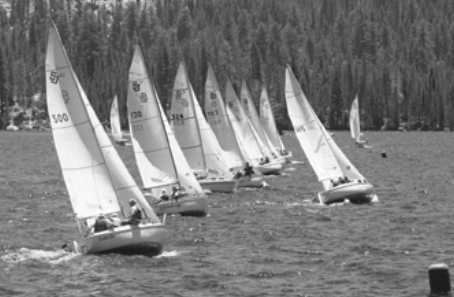
The racing future for Clark boats continued to look promising. The 1977 San Juan 21 Eastern Nationals in Columbia, South Carolina, drew an amazing 58 boats. The 1980 and 1981 events in Columbia and Charlotte drew even more: 70 and 63 boats respectively. And by 1978, Clark Sails was the largest sail loft in the Pacific Northwest.
San Juan 34 and 33
In 1980, the company introduced its largest sailboat yet, the San Juan 34. The hull is foam-cored. Standing rigging is rod. Draft is 6 feet. Many owners have described the 34 as bulletproof and very fast. The 34 generally rates 130 PHRF. Many of the 34s were configured as racers with pipe berths, but others were cruising class with more finished interiors. The layout is classic with a very long forward V-berth. The head is a little cramped for showering.
The SJ 34 began life as the Crown 34, manufactured by several Pacific North-west companies. The original design was by Hein Driehuyzen, who worked as the manager of Calgan Marine in North Vancouver, British Columbia. It was designed in 1974 to the IOR rule with a large foretriangle, tall mast, and narrow transom. Hull #3 was launched in August of 1975 as Moody Too and is still owned and actively raced by the original owners. The molds were sold to GlassFab of Monroe, Washington, which built the boat as the Sun Yacht 1030. The molds were later sold to the Clark Boat Company. Don Clark mildly redesigned the boat, removing the skeg, modifying the galley, and adding mid-boom sheeting. Around 50 San Juan 34s were sold between 1980 and 1988. All three versions of this design are active in the Pacific Northwest PRHF racing scene.
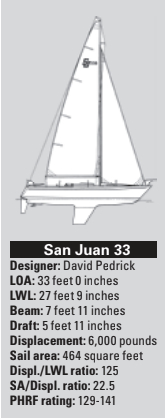
The last Clark boat, the San Juan 33, is a bit of a mystery boat; it was produced by Clark for only two years — 1981 and 1982. Designed by Dave Pedrick, the San Juan 33 displaces just 6,000 pounds. It is a fast racer with a PHRF of 129 to 141 in fleets in Tennessee, Arizona, Florida, and Lake Champlain. The San Juan 33S is also known as an Eagle 33.
Boom and the bust
The sailboat market that had boomed in the 1970s was quickly fading as the 1980s progressed. The Clarks sold their company in the spring of 1984 to San Juan Manufacturing, which made boats for a few years. The bankruptcy of this group led the boat molds and rights to be split between two groups, one on the West Coast and one on the East Coast.
The eastern group used the molds to make a few boats in the Tanzer factory in Edenton, North Carolina. Both of these groups continued to make boats until 1988. Boats made in mid-1984 and after would be post-Clark. Many of the post-Clark boats had minor cosmetic changes to keep up with the changing styles.
Bob and Coral Clark continued to live and support San Juan sailing in North Carolina until their deaths. They sailed a San Juan 34 named Big Juan for many years in eastern North Carolina. Don runs a bicycle shop in Ventura Beach, California, and Dennis owns a cabinetmaking shop in Gig Harbor, Washington. Dennis still sails actively, most often in the Laser Class.
Mike Robinson loves sailboats so much his wife Nan has asked him to put a cap on the number of boats the family can own. Mike holds a 50 GT Masters license and is an active racer of a San Juan 21 and a Sunfish. He enjoys cruising North Carolina’s Outer banks.
Thank you to Sailrite Enterprises, Inc., for providing free access to back issues of Good Old Boat through intellectual property rights. Sailrite.com