It’s a seamanlike act that brings great satisfaction
Issue 58 : Jan/Feb 2008
“Tow? Why on earth would we need a tow? We can sail her back in. The wind’s perfect!”
The Old Master was responding to my dejected report that our auxiliary engine was simply not going to start.
“OK . . . sure,” I said, weighing the possibility, “but how will we weigh anchor if we can’t motor up as we haul in the rode?”
The Old Master shook his head in amazement to my reliance on mechanical contrivances. He then patiently and methodically set about sailing us off the hook . . .
Learning this once-common practice not only reduces reliance on the engine, it improves basic seamanship, enhances crew coordination, and sharpens boathandling skills. Many techniques exist, but this simple, short-handed, method has served me well since the day the Old Master first demonstrated it. It’s a technique best learned and practiced in an uncrowded anchorage with light winds, slack current, and the help of a trusted crewmember.
Analyze the situation
Take a good look around before you begin. Ideally, the boat should be pointed into the wind while lying at anchor. If the often-underestimated factor of current is causing it to lie otherwise, consider waiting for more favorable conditions.
The wind direction will dictate the course you are able to steer out of the anchorage. Ensure that it favors a safe route that will allow departure on either a run or a reach. Wind speed, as always, determines how much power a sail will produce. Stronger winds may give the boat power to overcome a contentious current, but they may also make control more difficult. Be certain there is adequate wind to drive the boat but not so much that events unfold more quickly, and with greater force, than you and your crew are ready to handle. If conditions are sportier than you like, consider tying in a reef or two as you set the mainsail — the only sail you will be using — or just relaxing until the breeze calms down a bit.
Identify any obstacles such as other boats, structures, or shoaling that may impede your departure route. Are you satisfied you can avoid them by a comfortable margin?
Finally, how about your crew? A seasoned singlehander might pull this off solo, and even make it look easy, but sailing off anchor is a dance best performed by two. Choose a partner with whom you’ve sailed before, who is knowledgeable of general anchoring procedures, and is easy to work with.
Make your plan
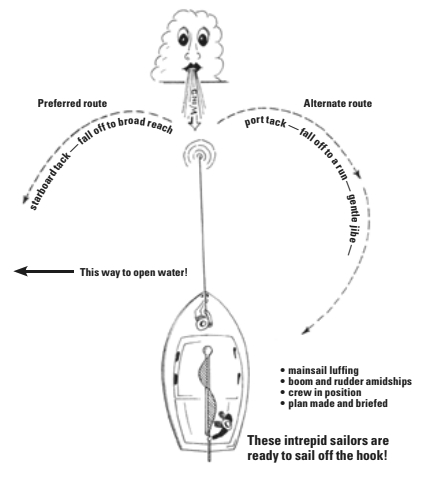
Visualize two suitable courses out of the anchorage — one that allows initially falling off on a port tack, the other that allows for falling off on a starboard tack.
Assign crew duties. One person will be the helmsman, responsible for boat handling, coordinating the maneuver, and issuing the appropriate commands. The second will be the foredeck crew, or bowman, responsible for hauling the ground tackle aboard, securing it, and relaying concise information to the helmsman. Should a third crewmember be available, he or she is best utilized at the mainsheet, providing sail trim as commanded by the helmsman.
Explain your intentions. Crewmembers must understand the plan and their role in it. They must also possess a vocabulary of mutually understood communications, backed up by simple hand signals.
Prepare boat and crew
For ease of handling and to keep the foredeck clear, the main sail is the only sail that will be used. Center the rudder, hoist the main, and sheet the boom amidships. Prepare other sails so they may be easily deployed after you are under way.
Position the crew, rehearse your commands and hand signals, and have a last look around. Check that the decks are clear of tripping hazards, particularly the foredeck, and see that no boats are heading into your maneuvering area.
Execute the plan
Lying at anchor with the mainsail and rudder set amidships, notice that the boat tends to gently turn, first in one direction, then the opposite. Observe this rhythm . . . it sets the tempo for the dance to come.
As the mainsail momentarily fills, the boat lazily drives forward a few feet. Then, the resistance of the anchor pulls the bow back toward the wind. The sail empties and begins to luff, with the momentum of this gentle tug causing the bow to pass ever so slightly through the eye of the wind. The sail fills again and the cycle repeats. If this motion fails to begin on its own, the helmsman may initiate it by pushing the boom slightly to windward.
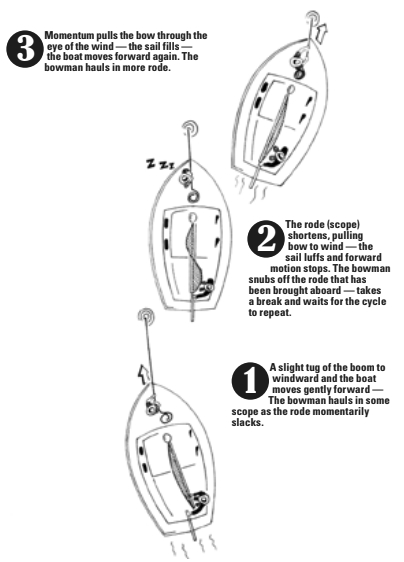
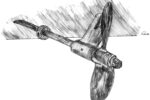
The bowman will use the moments when the boat briefly makes headway to take in the rode, pausing as the boat points, and then hauling in a bit more rode on the next cycle (1-3). When the bowman judges that the anchor is about to break free, he prepares to rapidly retrieve the remaining rode and bring the anchor aboard. The progress of the retrieval, especially the freeing of the anchor, must be relayed to the helmsman (4).
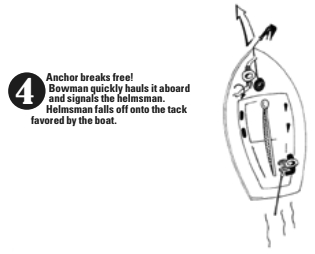
When signaled that the anchor has broken free, the helmsman gently falls off onto the tack favored by the current motion of the boat. The helmsman should steer and trim to produce only minimal speed until the bowman signals that the anchor is aboard. If the anchor fails to break free at the anticipated moment, the bowman must signal this to the helmsman, who will steer into the wind, taking off all headway until the hook is freed.
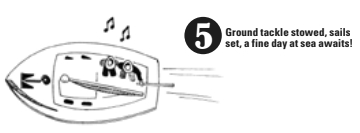
Once the anchor is safely aboard, the helmsman will steer the predetermined course out of the anchorage while the bowman stows and secures the ground tackle (5). After the bowman’s task is complete, the jib, and any other sails, may be hoisted and set as desired.
Mastering the knack of sailing off the anchor will bring about a great feeling of satisfaction. More importantly, it will increase your level of self-reliance and refine your skills. Like any sailing maneuver, the keys to success are to think through the process first, communicate clearly with the crew, and then be patient, careful, and deliberate in the execution of all steps.
Vern Hobbs and his wife, Sally, sail a 1974 35-foot Bristol cutter along Florida’s Atlantic coast and the Intracoastal waterway. Their day jobs pay the rent, but Vern’s work as a local artist specializing in maritime subjects finances the boat projects.
Thank you to Sailrite Enterprises, Inc., for providing free access to back issues of Good Old Boat through intellectual property rights. Sailrite.com