Whether flat-bottom or round-bilged, each hull has a purpose and a place on the water
Issue 21 : Nov/Dec 2001
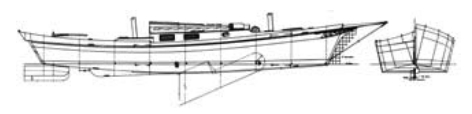
The basic hull forms for sailboats are the flat-bottom, the vee-bottom or deadrise hull, and the round-bilged hull. Each of these types has a place and a purpose, even in today’s plastic-filled waters.
Flat-bottom hulls
Small flat-bottom skiffs and punts have been used for many years. In the 19th century, large flat-bottom scows were built as working sailboats, some carrying cordwood and farm produce from Maine to Boston. In the west they lugged great, towering cargoes of hay from inland meadows down the rivers to San Francisco. Other sailing scows were used for commercial fishing. Larger examples were often two-masted, rigged as cat ketches or schooners.
The New Jersey garvey and the Casco Bay sloops of Maine are typical examples of flat-bottom fishing craft. They were built in sizes up to 45 feet or more, and several were set up as sailing houseboats for gunning clubs or individual owners. A sailing houseboat is still a practical vessel but today, with rare exceptions, the few flat-bottom cruising yachts in our waters will be bateaus of the sharpie or dory types.
The sharpie: The sharpie was developed in the 1830s and 40s for the Long Island Sound oyster fishery and, because of its low cost, ease of construction, and a reputation for speed and ability, the type spread to the Chesapeake, the Carolinas, Florida, the Great Lakes, and even the Pacific Northwest. The boats were noted for speed, and Howard Chapelle writes of a 40-footer that made 14 knots for several hours in ideal conditions. Indeed, the owner of one of my 32-foot Mystic sharpies reported clocking 10 knots over a measured mile while reaching in a spanking breeze. The larger Carolina sharpies, from 40 to 52 feet, were quite seaworthy, and Chapelle mentions that they often made coasting voyages between New York and the West Indies. In fact, sharpies were used in Florida as mailboats, and several larger sharpies were built by the French for use as gunboats on the coast of Africa.
Sharpies have been built with transom sterns, with round sterns, and as double enders, depending on the whims of the owner or builder, I imagine. The typical sharpie was of light displacement and had a relatively narrow beam of about 20 to 25 percent its length. The flare amidship was about 3.5 to 4 inches per foot of depth, and the freeboard was low. Sharpie cruisers are often designed with higher freeboard to obtain good sitting headroom. Bruce Kirby’s delightful Norwalk Islands designs are a fine example of a handy and handsome cruising sharpie.
Obviously, excessively high freeboard and high cabins can be unsafe on a narrow hull as the weight and windage adversely affect stability. As a result, it’s difficult to obtain standing headroom in a sharpie yacht under 42 feet or so, and this is one of the drawbacks of the type.
Other problems of the sharpie are the long centerboard trunk that splits the cabin in two. This obstacle can be eliminated by the use of two centerboards, of course, and designs with bilge boards or leeboards are quite practical as well. Also objectionable is the fact that the sharpie, like most flat-bottom boats, can pound severely in certain conditions. Still, the sharpie makes a fine inexpensive cruiser for those waters where the bottom is close to the top, and there are thousands of miles of wonderful cruising grounds open to any boat that can sail in less than 12 to 15 inches of water!
The dory: The dory hull is another flat-bottom type that can be made into a cruising auxiliary. The dory hull is proportionally deeper and beamier than a sharpie but has great flare to the topsides and an extremely narrow bottom ending in a very narrow or even pointed stern with a tombstone-shaped transom. The narrow bottom and pointed stern make the dory initially quite tender, so small rowing dories will heel alarmingly, almost rail down, with the slightest shift in weight. However, the heavily flared topsides give the boat great reserve stability, and Grand Banks fishing dories have a well-deserved reputation for seaworthiness.
Obviously, heavy ballast carried on a deep keel is essential for a sailing dory cruiser to offset her initial tenderness, and many such craft will also show a widened transom to further increase initial stability. Still, the dory will sail at a greater heel angle than the sharpie. This can be an advantage since she’ll present her chine, rather than her flat bottom, to the seas thus reducing the tendency to pound in a chop. With her heavier displacement and outside ballast, the dory will be slower than a sharpie but can also be self-righting from a severe knockdown. As a result, she is somewhat more suitable for offshore hops. One of my 22-foot Grand Banks dory ketches has sailed from the Pacific Northwest to Alaska and back several times.
One interesting design that merged the dory and sharpie hull forms was the Egret, designed by Commodore Ralph Munroe in the 1880s. He combined the lines of a sharpie with the flaring topsides of the dory, increased the beam (7 feet 6-inches on 27 feet 10 inches overall length) and rigged her as a gaff cat-ketch. She was inside-ballasted and reputed to be fast and able. Indeed, she carried the mail in all kinds of weather from Miami to Palm Beach, no small feat in Gulf Stream waters.
The essentials in the design of flat-bottom sailing yachts are a fine entrance, moderation in freeboard and upperworks to reduce weight and windage aloft, moderation in beam, and moderation in fore-and-aft rocker. Excesses in beam or rocker are very detrimental to speed.
Vee-bottom or deadrise hulls
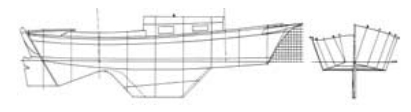
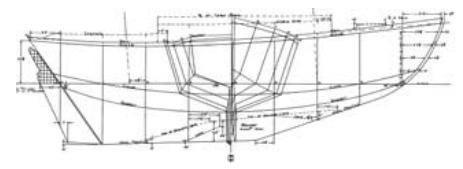
The vee bottom was little used in North America in the early 19th century, although some of the Revolutionary War gunboats built on Lake Champlain for Benedict Arnold’s flotilla had a shallow vee form. Then, in the late 1870s and early 1880s, several sharpie builders began to introduce a vee to the sections abaft midships in an attempt to improve performance and make the sharpie more yachtlike. Thomas Clapham, a noted builder on Long Island, N.Y., is usually credited with this innovation in sharpies. But the vee bottom was also being developed about the same time on Long Island Sound on beamier skipjacks, a type that was taken up by Chesapeake boatbuilders in the late 1880s and developed for the commercial fisheries in the bay. Within a few years the vee bottom began to be fitted to many workboat types in order to increase speed, seaworthiness, or carrying capacity. Even scows were fitted with vee bottoms and, schooner rigged, were used on the Gulf Coast for hauling produce to market and for commercial fishing.
Clapham first used the vee shape aft on his Nonpareil sharpies to reduce wetted surface when the yacht was upright, but it also added reserve stability as the yacht heeled. Later Clapham used a vee in the bow sections also, still retaining the flat bottom amidships but, eventually, he extended the form full length in a shallow vee, as well as experimenting with increased beam and outside ballast. The full-length vee allows the vessel to carry heavier displacement and ballast for improved seaworthiness and self-righting ability. Then it is only a short step from this to the deeper vee hulls that we see on some cruisers intended for offshore use today, particularly those craft of sheet plywood or metal construction.
Thomas Day, publisher of The Rudder magazine, sailed the yawl, Sea Bird, a 25-footer with a moderate vee bottom, across the Atlantic to the Mediterranean in 1911. This did much to promote the vee hull as a suitable yacht form for offshore voyaging. Interestingly, Sea Bird was built by L. Huntington, another Long Island builder of sharpie yachts. In 1913, off the coast of Japan, Captain John Voss and two companions survived a typhoon and a 360-degree rollover in another Sea Bird that also enhanced the offshore reputation of small vee-bottom yachts. Later Harry Pigeon circumnavigated aboard Islander, a slightly larger version of Sea Bird. This further increased the luster of the vee hull’s fame.
The shallow vee bottom is still seen today in many of our sailing dinghies and small racing classes. Indeed, one feature that Huntington developed for his sharpie yachts, the arc bottom, is still used on one of the world’s most popular racing classes, the ubiquitous Star-class sloop. This bottom is simply a shallow arc of a circle running athwartship and, like the vee bottom, is used to increase displacement and allow wider beam. L. Francis Herreshoff also used the arc bottom on his unique Meadowlark sharpie, and many of these fine shoalwater yachts are still cruising our waters.
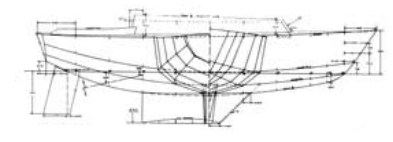
As the yachts became larger, the deadrise angle of the vee-bottom hull continued to increase, giving the vessel greater displacement and allowing it to carry added stores, have heavy outside ballast, and be self-righting in the most severe conditions. This deeper hull also provided improved accommodations with full headroom. Many such craft have made extended voyages, of course, and are every bit as able as their round-bilged sisters.
The deeper vee hull is rarely as fast as its round-bilge sister though. If performance is a major requirement, then the chine hull should be of light-to-moderate displacement, and the rocker of the chine and keel kept as flat as possible, not unlike the flat-bottom hull. She should also have moderate beam and, in effect, resemble a modified vee-bottom sharpie of the Nonpareil type. For offshore use, the deeper vee sailing hull is to be preferred for its qualities of motion comfort, a larger range of positive stability, and increased accommodations.

Multichine hulls
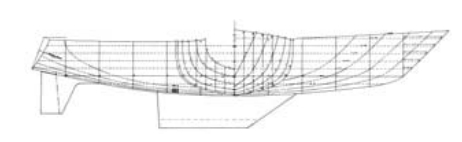
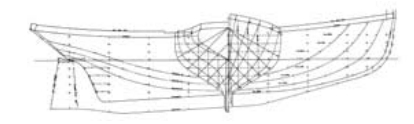
A number of deep-vee sailing yachts have been designed with two or more chines per side in order to more closely approach a round-bilge hull form in shape and performance. The extra chine(s) add to labor and, slightly, to material costs, but they reduce wetted surface and turbulence. So they do pay off in potential speed as well as resale value and aesthetics.
Radius-chine hulls
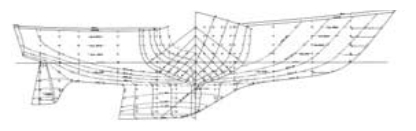
I was, perhaps, the first to use the radius chine on deep-vee metal hulls to more faithfully reproduce the true round-bilged hull form. The shape is simply a single chine, vee-bottom hull with a large radius at the “corner” where the topsides and bottom meet, rather than a sharp chine. The first of this type, the Goderich 35, had a radius of 2 feet at the transom increasing gradually to 4 feet at the stem and was sufficiently able to round Cape Horn in adverse conditions, continuing on to circumnavigate the globe. The radius chine does add to labor costs, but this is usually returned in slightly added performance and often returned several times over in increased resale value and general appearance.
Round-bilge hulls
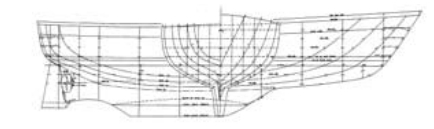
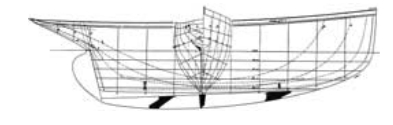
The round-bilge hull is the most common form seen in cruising sailing yachts and will be one of two different types: the U-section hull with its round bilges fairing into a flattish bottom with relatively little deadrise; and the Y-section with round bilges fairing into a vee’d hull, often with substantial deadrise.
The U-section was used for many years on dinghies and daysailers but today is also seen on the largest of finkeel cruisers and ocean racers. The older U-hull may have a fair amount of fore-and-aft rocker, but the trend with today’s light-displacement hulls is to widen the stern and flatten the rocker in order to straighten the buttock lines aft, increase the prismatic coefficient, and produce a yacht with higher potential performance in a stiff breeze.
One form of U-shaped hull that has never received the recognition it deserves is the Presto, another of Commodore Munroe’s developments. The first of the type was derived from the Egret, in all likelihood, but was of much heavier displacement, with wider beam, extreme flare, and much greater rocker to her keel. The Presto-type was noted for speed and seaworthiness, and Vincent Gilpin’s book, The Good Little Ship, long out of print, has a great deal of praise for and much information on the boats. It is well worth reading if you can find a copy. The large Indian dugout canoe, Tilikum, which Captain Voss sailed over four oceans, had a similar section shape but was narrower and with less rocker.
The fact that it is used on craft ranging from dinghies to ocean racers shows that the U-section is usefully employed on fast sailing yachts of all sizes. However, many yachtsmen still swear by the Y-section hull for its motion comfort; its ability to carry heavy loads of stores, gear, and liquids; and, when heavily ballasted, its ultimate safety in extreme conditions.
There are Y-sections and there are Y-sections, though, including the incredibly narrow “six-beam” British cutters of the 1880s as described in C.P. Kunhardt’s Small Yachts. Imagine, if you can, the Surf, a handsome cutter of 42 feet 10 inches overall, 35 feet 3 inches on the waterline, and only 7 feet 4 inches wide! She’d be legally trailerable if you could find a rig to tow her 34,000 pounds around. She carried 19,000 pounds of ballast, and she needed every ounce, as her skinny hull certainly had no form stability. It is reported that the Surf sailed at 35 to 40 degrees of heel in strong breezes, and I can believe it. But she certainly would be hard to capsize.
The wineglass hull is an offspring of the Y-section. When outside ballast first began to be used, most of the yachts were of Y-section but, as the keels were made deeper and the ballast heavier, the wineglass section developed. In it, the bottom lines are faired into the lines of the ballast keel by means of a softly rounded tuck. This reduces wetted area and turbulence at the tuck but may also reduce the effectiveness of the lateral plane if the rounding is carried to extremes. The wineglass section was used on many of the old six-beam cutters of the Gay ’90s and was de rigueur on the majority of keel yachts until the fin keel reappeared on the scene in the 1960s. Indeed, some of the early fin-keel yachts still showed considerable fairing in the tuck. Now, most yachts will have only a small radius fillet to fair the fin to the hull, and the wineglass section is rarely seen in new construction.
Today most new Y-section hulls are heavy displacement. For offshore cruisers, motor sailers, and the average production fin-keel cruiser, the U-section seems to be the rule.
Ted is one of North America’s best-known yacht designers, having worked on the America’s Cup boats American Eagle and Weatherly, as well as boats that won the Olympics, the Gold Cup, and dozens of celebrated ocean races. He also is the man who designed scores of good old boats . . . the ones still sailing after all these years.
Thank you to Sailrite Enterprises, Inc., for providing free access to back issues of Good Old Boat through intellectual property rights. Sailrite.com