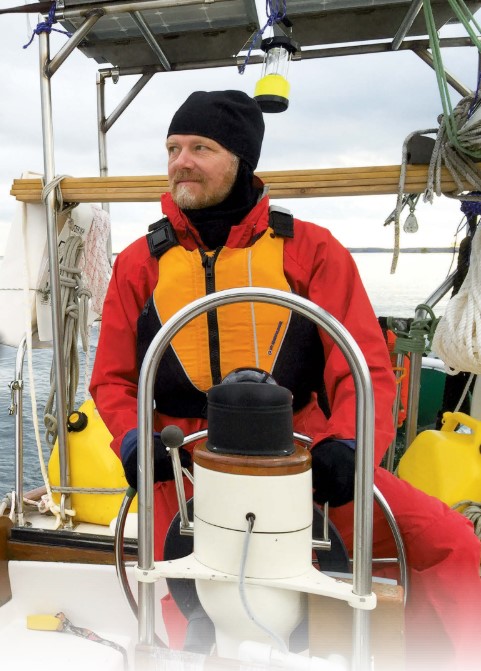
A departure delayed by foul ground and a lee shore
Issue 118: Jan/Feb 2018
Following years of laid-back dreaming, of soaking up from books, magazines, and YouTube the wisdom and experience of voyagers who’d gone before us, and of working hard to make Ariose, our Alberg 30, as seaworthy as we knew how, my partner, Tim Martens, and I cast off for our cruise from Canada to the Bahamas. Yet despite all of our hard work and acquired wisdom, we departed with little more than casual northern Ontario freshwater lake sailing under our keel. We knew our voyage would be an intensive immersion course. What we didn’t know was that the first learning opportunity would hit so soon and with such impact.
While the rest of the fleet — the sensible ones, some would say — had already either headed south or been hauled out, we were craning Ariose into Lake Ontario, feeling as though we were going against the current.
After a week dockside, we’d completed most of the essentials on our Pre-departure list. Some remaining items, like trying out our new VHF radio and getting comfortable with our tablet and its electronic chart application, we moved to our Immediate Under Way list. Many other nonessentials got shifted to our Someday list, the one we planned to tackle once we bored of palm-fringed beaches. As we stowed our mountains of gear, we felt particularly smug about our self-sufficiency. We had ample food provisions — enough for an Atlantic crossing should we overshoot the Bahamas, we joked — and a thorough inventory of spare parts. We were as ready as we were going to be for our maiden voyage.
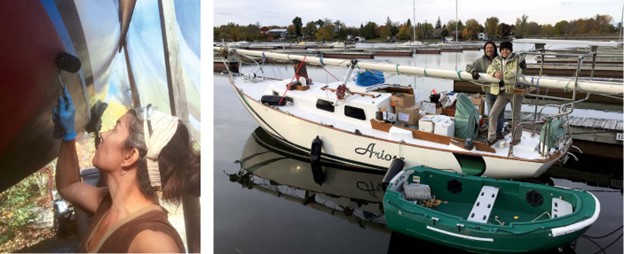
Early-November days offer only 10 hours of light. It would take all of that to motor from Kingston, Ontario, to the canal’s entrance in Oswego, New York, so we had planned to stop near the midpoint of the crossing at Main Duck Island, where we were assured we could dock in a protected inlet. Because we would be transiting the New York State Canal System, Ariose’s mast was secured on deck.
The lake was uncharacteristically calm, and this was our first experience being out of sight of land while on Ariose. What a rush we felt upon seeing Main Duck Island rising from the horizon exactly where it was supposed to be. It was a pleasing and confidence-building start to our journey.
We entered the island’s marked channel and approached cautiously, aware that lake levels were low. We slowed to a drift, and were puzzling over what our depth meter was telling us when we felt Ariose nudge to a stop on the soft bottom of the inlet, just shy of the dock. Folks in a shoal-draft boat hopped into their dinghy and helped tug us back into deeper water.
Grounded on day one of our adventure! This was a rite of passage, we thought, to be survived with lessons learned but no hardship. Surely we would enjoy smooth sailing from here on. We were wrong.
A questionable anchorage
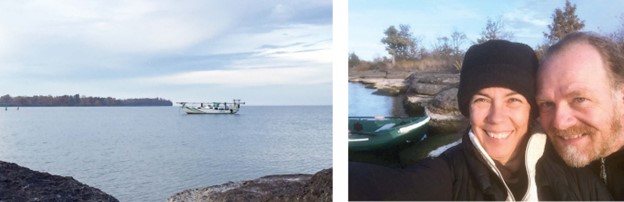
A quick look at the chart clearly showed that most of the island’s perimeter was inhospitable to anchoring. The sun would set shortly, so there was not enough time to make it to the mainland. We had no choice but to disregard the “don’t anchor at Main Duck” advice we’d been given. We chose a partially protected bay near the inlet’s marked entrance. A gentle offshore breeze was encouraging. The rocky shoreline wasn’t. We anchored. The water was clear and we were relieved to spot our plow lodged securely in a crevice. Then we paid out a generous amount of chain rode just to be sure.
Having expected to spend the night secured to a dock, we hadn’t taken note of the extended weather forecast, but we thought we remembered that the wind was forecast to change. Far from cell towers, we had no internet connection to check. But mindful that any change in the wind direction would cause us to swing, Tim rowed the dinghy in a circle around our anchor, using a makeshift lead line to be sure that we would have plenty of water under us. It appeared we would be fine.
After hanging out a bit to be sure we were holding, we rowed to land and explored the gorgeous dramatic shoreline of Main Duck Island. The calm water mirrored our serene mood. Here we were, finally off on our long-planned adventure, buoyed by the self-assurance that had grown with each accomplishment over the past few months, and confident that we were securely anchored for our first night.
Nevertheless, we stayed hyper-vigilant, and got up several times during the night to check on our position. I use the phrase “check on our position” rather loosely. We didn’t yet know how to use our GPS-based anchor-drag alarm, nor did we even know that our new electronic charting app had a track feature that would give us a clear visual of the boat’s movement. We just poked our heads out and relied on our eyes, our rather unreliable eyes.
By the wee hours of the morning, the wind was up and Ariose had begun to rock and roll. We repeatedly shined our spotlight toward shore and wondered whether we were any closer than the time before. When we thought we were, we attributed that to having swung around the anchor. The short bursts of scraping sounds? Must be the chain sliding along the bottom as we pivoted. What really concerned us was the 180-degree wind shift that left us anchored off a lee shore. We returned to bed with a growing unease.
Trouble
As the sky brightened, I got up, donned my foul weather gear, and headed out into the cold driving rain. I was surprised to see the boat that had helped us the previous day already under way. Rolling waves broke on the shore and our surroundings looked nothing like the calm bay we had anchored in the night before.
I called below to Tim, cozy in the V-berth, “Tim, I think we’re too close.” As the words left my mouth, I watched the shore close in on us. “Tim, we’re dragging!” The gut-wrenching crunch of keel on limestone jolted us into action. Half-clothed, Tim leapt into the cockpit and dove for the ignition, key in hand.
If there is a more disheartening sound in all the world than that made by the bottom of the boat you have lovingly restored grinding against rock, it’s the raspy metal-on-metal clunks of a cheap starter disintegrating. We had no motor. We could raise no sails. The gravity of our situation hit stone-solid.
We needed help. The vessel I’d watched leave was just rounding the island and would still be within VHF range. I grabbed the mic and stopped. My radio-operator lessons were fresh, and the sample script I had prepared for emergencies was close at hand, but I had never actually operated a radio and did not even know how to turn it on. “Familiarize selves with radio” was on our Immediate Under Way list that we’d not gotten to immediately. While being tossed in the cabin, I found the manual, my reading glasses, and the relevant instructions, and was able to issue the call.
There was no response.
Meanwhile, Tim had taken to our dinghy and was preparing to take out the kedge. I left the radio and met him at the bow. As Ariose bucked under me, I secured our secondary anchor to its chain and passed the anchor to Tim — much easier said than done.
As well as rowing against the wind and waves, Tim struggled against the weight of the chain pulling him back. With superhuman effort, he made progress and dropped the hook. I heaved hopefully on the rode to pull Ariose out, even a little bit, but succeeded only in hauling the anchor in. We tried again. No luck. We switched from chain to 200 feet of rope. Tim could now set the kedge out farther. Still no luck. Repeat. Again no luck. The anchor would not catch. Cursing didn’t help. Pleading didn’t, either. With each wave, Ariose rose up and crashed down, sometimes with little more than some scraping, but often with a hard jolt that sent a shuddering quake through her hull and up my vertebrae. I feared that Ariose would soon be destroyed.
The situation now felt more desperate than when I had issued the pan-pan earlier. Time for a mayday call. But I still wasn’t sure that I was using the radio correctly. After broadcasting my mayday message, I tried the automated digital selective calling (DSC) distress-call function. I did not get a response. Drenched and shaking from cold and adrenaline, I concentrated again on the pages of the instruction manual and realized that, before I could use the DSC distress function, I needed to enter our MMSI number. Entering the number took only minutes, but it felt like I spent hours scrolling through numbers to enter each of the nine digits the first time, and then again for confirmation.
Then it hit me. With our mast down for our canal transit, our mast-mounted antenna was only just above deck level and aimed horizontally. What kind of VHF range could we possibly have?
No help in sight
We had filed a float plan with my brother, instructing him to alert search and rescue if he hadn’t heard from us by noon Saturday. It was now about 8:30 a.m. Thursday, so it would be more than 48 hours before anyone would begin looking for us. Soaking wet. Exhausted. Cold. Discouraged. Even as our spirits plummeted, we realized that, although we might lose Ariose, we would be fine. That was what was important.
Help wasn’t coming. It was time to demonstrate the self-sufficiency that we were so proud of. We needed to replace the starter motor. Tim dug through our overstuffed lockers and found the spare and the tools he’d need to do the job. I wasn’t hopeful. It takes a gymnast to work on our Alberg 30’s engine in optimal conditions, and here we were heaving and crashing. Yet doing something — anything — felt better than doing nothing. Tim got to work.
I admit that Tim’s stubborn streak has at times irked me. Now I regarded his perseverance with newfound admiration as he contorted himself into the engine compartment, patiently retrieving errant tools and bolts from the dark icy water in the bilge.
At about that time our VHF crackled to life. It was the Coast Guard, transmitting about our situation! But . . . wait, the coordinates they broadcast weren’t ours. Could there be another sailboat in distress out here? My hopes sank. Moments later, they broadcast a correction. It was us! We needed only to make it through a few more hours before help would arrive.
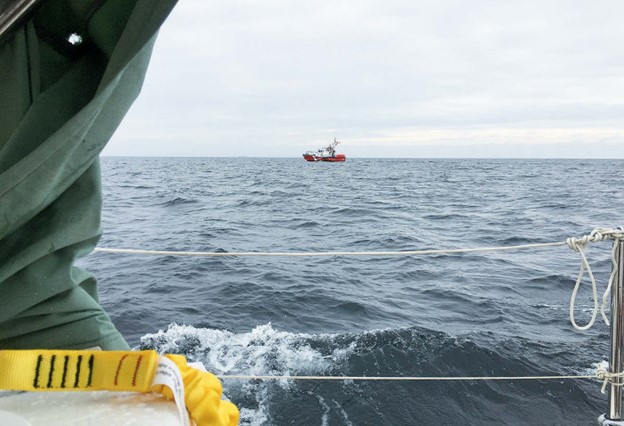
Yet only moments later, a C-130 Hercules buzzed us at low altitude and then circled. A helicopter arrived shortly after and dropped three search-and-rescue responders on shore. We felt as though we were on a movie set, and were mortified by what seemed like an over-response. After all, it was only our boat at risk, not our lives. We rowed ashore to save the three guys from having to wade out to us. They were calm and comforting and even showed a sense of humor as they assessed the situation. They reassured us that we had done the right thing in issuing the distress call, and alleviated our embarrassment by letting us know that, fortuitously, a training operation had been under way when our call came in. With aircraft already in the air, it was easy to switch to an actual rescue mission. They informed us that a Coast Guard vessel was now on its way to tow us off. Our tension eased. We returned to Ariose and Tim got back to work on exchanging the starters.
The rescue vessel arrived and, with a bit of effort, pulled us into deeper water, where we dropped anchor to take stock of our situation. It felt glorious to be afloat again. We pumped out the water that Ariose had collected from rain and waves, and continued to check our bilge, relieved to find that it remained dry. Just as I was weighing anchor so we could get the tow under way, Tim popped out of the companionway and proudly announced that the replacement starter was in. Really? How the heck did he pull that off? He turned the key and the rumble of Ariose’s Yanmar engine was music to our ears.
For five solemn hours we motored to Kingston and back to the marina we had departed from 24 hours before.
Repairs and reflection
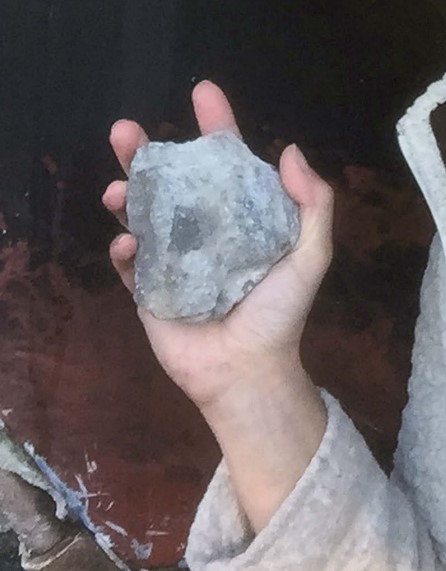
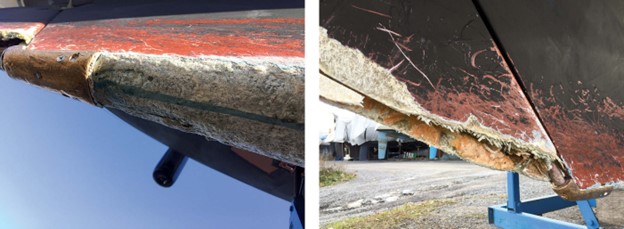
The next day, we held our breath as Ariose was craned out, hoping beyond hope that there would be little more than cosmetic damage. We had a local fiberglass-repair expert present to offer advice, but it was obvious even to our inexperienced eyes that Ariose’s injuries were substantial. Her rudder had split and its bottom edge was smashed. Her keel was ground down along its full length, with a few holes in its seam. A fist-sized chunk of limestone embedded in the rudder became the first souvenir of our voyage. A couple of hours pounding on rock had taken its toll, but our well-built 1969 Alberg had held her own. This story might have had a different ending with a lesser boat.
Although it now seemed likely that we would have to pause our adventure until the next year, we were determined to exhaust all possibilities before admitting defeat. Winter was fast approaching and the canals we needed to transit to get south would be closed in two weeks. Our next few days were a whirlwind of obtaining quotes on repairs, dealing with the insurance claim, sourcing transport trucks, figuring out customs requirements, and on and on.
We were not on our own, however. Collins Bay Marina, although closed, made us feel welcome and even kept the restrooms open for us. Their hot showers were a wonderful extravagance. The local yacht club graciously offered us its clubhouse, which we adopted as our warm, dry mission-control headquarters. We were offered assistance by so many. Unbelievably, a fellow Alberg owner who had a derelict boat he used for parts responded to an online ad we’d placed. By the next morning, not only had he delivered a replacement rudder, but he had leveraged his relationship with a local boatyard to coax it into tackling the work. By noon that same day, Ariose was hauled to its workshop with a commitment that her repair would be top priority. It was. Eight days later, she was as good as new.
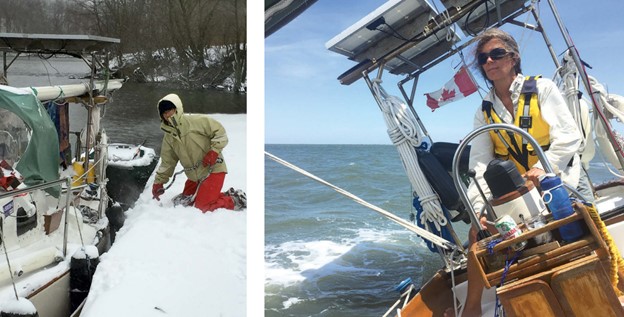
The New York Canal Corporation assured us that, if we were to sneak in by the closing date, they would ensure we got through. And that’s exactly what we did. We were the last recreational vessel admitted in 2016, gratefully enduring late-November snow and ice while making the transit that led to an amazing nine months of sailing. You can imagine how sweet the Bahamian sun and aquamarine waters felt when we finally arrived. Sure, our maiden cruising adventure offered us other learning opportunities along the way — many, in fact — but none with the hard-hitting impact of those first-day-out lessons. And for that, we are grateful.
The takeaway
While we clearly made several mistakes related to this experience, we also did many things right. First, we didn’t give up. We tried one thing after another without succumbing to defeat. We were also generally well prepared in terms of equipment, including a spare starter motor and secondary anchor with rode. Before departure, we filed a float plan with my brother and, after dropping the hook, Tim surveyed the anchorage to make sure there was room to swing. After our initial shock, we kept our heads and communicated well with each other throughout. Finally, as soon as we realized we needed it, we sought help. But all the things we did right were not enough to eclipse our missteps.
First, it was penny wise and pound foolish to equip Ariose with a cheap knockoff starter motor. We paid the price. We never should have departed prior to calibrating our depth sounder, pre-programming and learning to use the VHF, making our automatic bilge pumps operational, and practicing with the anchor alarm on our GPS. We should have taken better note of the weather forecast before leaving, and not relied on memory. And knowing we’d need all 10 hours of light to motor to Oswego, New York, why didn’t we leave earlier and give ourselves a buffer? Had we done so, we’d not have been pressed by darkness to anchor where we did when we couldn’t reach the dock we’d planned to tie to. Finally, when the wind changed and we realized we were anchored off a lee shore, we should have weighed anchor and departed no later than first light.
Shirley Jones took a break from her career in the mental health field to focus on making more of her dreams become reality. She and her partner, Tim Martens, spent two summers fixing up Ariose, their Alberg 30, before heading south for a winter in the sun. When not aboard Ariose, they live off-grid in a cozy straw-bale cabin near North Bay, Ontario.
Thank you to Sailrite Enterprises, Inc., for providing free access to back issues of Good Old Boat through intellectual property rights. Sailrite.com