Issue 24 : May/June 2002
After repainting the hull on our Yankee Seahorse 24, the rubrail, when compared with the new paint, suddenly looked worse than ever. We tried the Tyco catalog but couldn’t find a workable insert for our aluminum channel rail. Replacing the aluminum channel rail was not only expensive and time-consuming, but the stuff on today’s market is not as “beefy” as the original channel rail on our boat.
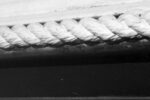
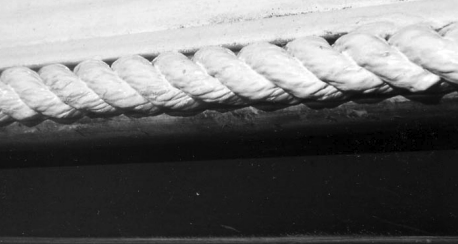
After much thought we decided to use 5⁄8-inch three-strand nylon rope for an insert. The rope fit into the groove in the rail with very little room to spare.
Finding glue and cleaning up the rubrail aluminum were the next steps.
I have compressed air in my shop, so we used a wire brush, elbow grease, and 100 psi air pressure to get the junk out of the channel groove. I then used 80-grit sandpaper to get into the “C” sections of the rubrail. After much prep work, we were ready to look for glue. Searching the marine catalogs gave us 3M’s 5200 and lots of other high-priced glues. I was looking at Lowe’s one day to see if they had any marine glues when I stumbled on a glue that was new to me. It was a polyurethane construction glue at $3 for a standard caulking tube size.
I bought a tube to test with. We cut off 2 feet of 5⁄8-inch rope and glued one foot to a piece of 1⁄2-inch plywood. We clamped the plywood in my big vice. Later, when the rope came loose after much effort, the wood was still with it. The rope-to-wood joint held, and the plywood lamination failed.
The only downside is that the glue comes in brown only. We planned on painting the rope, so any brown spots around the edges of the rail did not matter. We used Pettit’s Easypoxy on the hull and tested some on our rope. It didn’t flake off and seemed OK. This was our choice for painting the 5⁄8-inch rope.
The glue is PL Premium Polyurethane Construction Adhesive. It’s water- and weatherproof. It’s made by OSI Sealants Inc. My son, Mike, and I blew out the channel one more time, cleaned it with acetone, and began the gluing process. We made sure the aluminum was dry. We used duct tape every 6 inches and glue from the caulking gun. We used a rubber mallet to gently tap the rope and glue home. We pulled the rope tight as we went along and taped it every 6 inches.
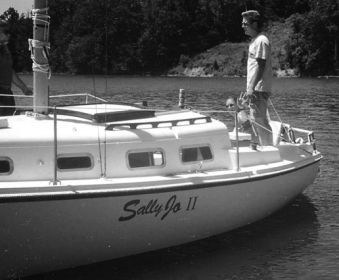
We let the glue cure for two days before removing our duct tape “clamps.” The results were great! The bond was strong and good-looking. The cost was low. All it took was glue, duct tape, 50 feet of 5⁄8-inch rope, and a lot of prep work. We gave the rope two coats of Pettit’s Easypoxy paint, which is holding up very well so far.
Thank you to Sailrite Enterprises, Inc., for providing free access to back issues of Good Old Boat through intellectual property rights. Sailrite.com