Issue 24 : May/June 2002
“Are you nuts?” “Go for it!” “Don’t you have enough problems?” “Life’s too short. Do it while you can.” The contradictory voices I heard from other people were no different from the voices I heard in my own head. Buy a sailboat? Part of me knew it was a loony idea. Might as well think about a flight to the moon. Even if I could afford it, how could I justify spending money on something so . . . well, frivolous?
After all, I was still looking at ponying up the ransom for my son’s college education. The car was going to need replacing before too long. And unless I got around to having the house painted sometime soon, my neighbors were likely to start hauling me into court for lowering their property values.
Besides, even if I could manage the financial burden, did I need all the hassles that I kept hearing went with boat ownership? The cleaning and repair, the painting in spring, storage for the winter, and on and on . . . an endless list. No, it was a stupid idea. Didn’t make any sense at all. And yet . . .
And yet here I was, in the middle of my second season of sailing classes, and I couldn’t clear my head of the image of myself at the tiller of my own boat, couldn’t stop turning it over in my mind, trying to figure out some way to make it possible.
Baiting the hook
They were clever, those folks at the Great Hudson Sailing Center. I saw it all clearly in retrospect. The classes were only the bait. The owners knew from the beginning that once they got a sucker out on the water a few times, they could bet their fiberglass bottoms that pretty soon he’d want to be sailing his own boat. Why else would the center’s brochure include that seemingly incidental but oh-so-calculated come-on at the bottom of the page, the one in tiny type that whispered so seductively: “Graduates of the course will receive a 10- percent discount on the purchase of any boat.”
My first thought was: “Hey, good deal!”
My second thought was: “Ten percent off a bucket of money still leaves a bucket of money.”
But that cunning little come-on had worked its magic. A few lessons, and I was hooked. I could not stop scheming and daydreaming about how I might/could maybe/possibly someday find myself flying along on a fair breeze in my very own sweet sloop.
“What about that one there?” I asked my instructor, Diego Carr, as we glided along one Sunday morning on Haverstraw Bay, a wide stretch of the Hudson River some 25 miles north of New York City. I had my eye on a pretty little sailboat that was heeling nicely in the breeze off our port side. It had a small cabin amidships, a nice lift to the bow, graceful lines. And at 22 feet or so, it looked about the right size for me: big enough to be comfortable but not so big that I couldn’t sail it singlehanded. As nonchalantly as I could, not wanting to sound too avid, too greedy, I asked: “How much would something like that go for?”
Affordable or not?
No harm in asking, right? Just out of curiosity. It wasn’t as if I was actually ignoring the family budget and looming expenses. But how would I know whether I could afford a boat at all if I didn’t get some idea of what they cost?
“That one?” Diego shrugged. “Depends.”
“Hmm,” I said carefully, wondering why he was being so vague. Was it bad manners to ask the price of a boat? Was it a case of, “If you have to ask you can’t afford it?” Or was he being deliberately coy, like a car salesman who refuses to be pinned down . . . a negotiating tactic perhaps? But I persisted. I needed to know whether my pipedream was even remotely within the realm of possibility. “Well, what would be, you know, sort of . . . ballpark?”
Another shrug. “Hard to say. So many factors come into it: The age of the boat. What condition she’s in. How many extras are included. How eager the owner is to sell. Stuff like that.”
“Well, say, how about a boat like that if it were new?”
“New? Maybe 18, 20 thousand. You could go to 25 or higher if you wanted all the bells and whistles.”
I groaned inwardly. Even stripped down, such a thing was out of my grasp.
“But forget buying a new one,” he went on. “Why waste your money? There are all kinds of old boats you can get cheap.”
“But then aren’t you just buying someone else’s problems? I mean, why would someone sell a boat if it didn’t have problems?”
“Oh, people sell for all kinds of reasons. They want something bigger. Or their family situation changes. It could be anything. Maybe they’re just tired of sailing.”
Incomprehensible
Tired of sailing? How could anyone get tired of sailing? Right now, right here on the widest stretch of the Hudson River, in this glorious sunshine with this wonderful breeze, it seemed incomprehensible that anyone would ever want to give up something as fine as this.
“What you want to do,” Diego continued, “is hang around the marinas, check out the “for sale” signs, talk to people. When you see something you like, make a ridiculous offer. You never know. The owner might just be so desperate to sell that he’ll make a deal.”
A chord thrummed in my brain. Make a ridiculous offer. Hmm.
Still, given all I knew, did I really want to take on the burdens of time and money that a boat entailed? Did I want to make that leap? Did I really need a boat?
Mulling aloud, I found myself caught between yearning and practicality, plagued by indecision, daunted by responsibility. “I’d love to have a boat, but do I really want all the problems and the expense? It’s fine for a guy like you. You’re single; your kids are grown. I just don’t see fitting it into my life. You know? I mean, do I really need a boat?”
Diego, as always, set me straight. “Look,” he said, “nobody needs a boat. You need a house. You need a car. You need food on the table, clothes on your back, all that. Boats are a luxury, man. There’s no way around it. They’re expensive. They’re no end of trouble.”
Know the realities
I jerked my head back as if I’d been slapped. “Thanks,” I said. “I needed that.”
He shrugged. “Hey, I’m not saying don’t get one. I’m just saying, if you want one, you should know the realities. You get a boat for only one reason: because you want one. If you’re worried about being practical, forget boats. There’s nothing practical about them.”
Simple words. But they struck me with the force of revelation. It all came down to a simple equation. I could keep on sailing other people’s boats. I could rent or crew and let it go at that. But if I did want a boat of my own — and I did!
Oh, how I did! — then it was time I quit being so wishy-washy and made it happen. I’d deal with the consequences later.
It was quite simple: get the mind in gear, and the rest will follow.
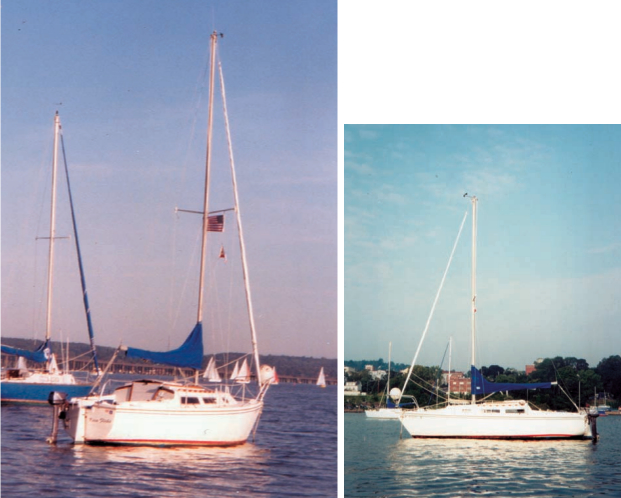
Today, many lessons and many decisions later, I sail the Hudson in a 25-year-old Catalina 25. Its age made it affordable. Its length made it just right both for daysailing and for exploring more distant cruising grounds. Right now, in fact, I am studying the charts and laying my plans for my longest adventure yet: a cruise from Nyack, New York, downeast to Maine.
Not for a minute have I regretted my decision to buy a boat. What has come home to me again and again is that where boats are concerned, everything becomes a matter of balance. I have learned that with boats, as with so much of life, the challenge is to find the point of equilibrium between opposites: wind and water, sails and keel, need and desire, responsibility and pure pleasure.
I also know now that at least part of what Diego told me was dead wrong. Some of us do need boats.
Thank you to Sailrite Enterprises, Inc., for providing free access to back issues of Good Old Boat through intellectual property rights. Sailrite.com