Three modified full-keel 31-footers

Issue 33 : Nov/Dec 2003
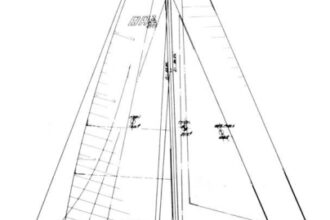
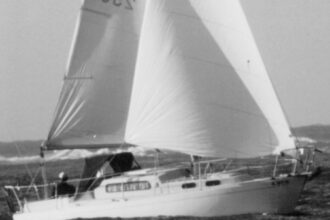
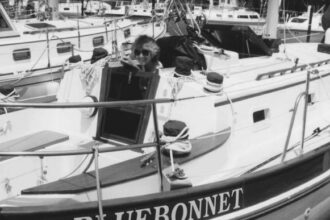
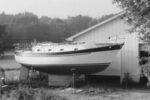
The Eldredge-McInnis-designed perky little Eastward Ho 24 has always been one of my very favorite designs in her size range, a superb little cruiser, so it was a pleasure to be asked to review her larger sister, the Eastward Ho 31. I had some difficulty getting information on other full-keel yachts in this size and of the same era for comparisons. After finding the Carl Alberg-designed Cape Dory 31, I finally settled on my own Douglas 31, which was also built as the Hullmaster 31 and the Cape Carib 31. After working up the figures, I was amazed to see how much alike these three yachts actually are.
The Douglas is the smallest and the lightest, the Eastward Ho the largest, and the Alberg design the heaviest. However, the differences are surprisingly minor. The probable reason for this is that Carl Alberg and I were trying to come up with a coastal racer/cruiser that fit the CCA (Cruising Club of America) rule of the late 1960s. McInnis, on the other hand, seems to have worked at designing a coastal cruiser that compared favorably with the general dimensions of the other yachts of the times, but with the emphasis on comfort rather than racing. Indeed, the Eastward Ho seems to have the roomiest interior of the three.
By today’s standards, all three of these yachts are narrow, heavy, and short on the waterline. Their lateral plane is of the modified full-keel type, and their sloop rigs are of quite low aspect ratio, so very typical of CCA yachts of the late 1960s. The comparison figures are interesting and worthy of study.
As befits her shallower draft, the ends of the Eastward Ho’s keel are less cut away than those of the other boats. I did not try to calculate the actual square footage, but visually it appears that the lateral plane areas of the three are reasonably close. That being the case, I’d expect the Douglas and Alberg to make somewhat less leeway especially to weather, due to their deeper draft and the slightly higher aspect ratio of their lateral plane. The Eastward Ho might well have a steadier helm on a run due to her longer keel. Her more shallow draft will let her explore a few gunkholes forbidden to the two deeper yachts.
The displacement/length ratios of the three yachts are all on the heavy side, as one would expect from these older designs, but the Eastward Ho, with her 24-foot waterline, still has the lightest ratio by a substantial amount. Given that, and with the longest waterline of the three, she should give the others a challenge on a reach, especially in a good breeze where her smaller sail area would not be any great handicap.
There is little to choose from in motion comfort or capsize screening factor between the three yachts and, in my opinion, any one of these boats is quite capable of cruising blue water. One Douglas 31 survived an Atlantic hurricane at sea some years back and, more recently, a Cape Carib 31 was written up in a British yachting journal for getting through a serious tropical storm in a China Sea passage with no major problem. I would expect no less from the Eastward Ho or the Cape Dory. They will take you there, and they will bring you back in safety and with as much comfort as any yacht their size can offer.
The sailor looking for an able cruising yacht at a reasonable cost would do well to give serious thought to an Eastward Ho 31 or one of the other two yachts. Modern light and beamy cruisers will have more interior volume and perhaps a “private” aft cabin tucked under the cockpit. With their tall rigs, long waterlines, and fin keels, they will undoubtedly be faster as well. But, when the weather turns sour and the sea starts to growl, an older, narrower, and heavier full-keel yacht is not a bad place to be. And, besides, with their long ends and handsome, traditional sheerlines, you’ll always get an appreciative glance in any harbor that you poke your nose into.
Thank you to Sailrite Enterprises, Inc., for providing free access to back issues of Good Old Boat through intellectual property rights. Sailrite.com