She’s just a sweet, 31-foot boat that suits the Sandifers’ plan

Issue 33 : Nov/Dec 2003
Bill and Genie Sandifer say it’s the boats they’ve owned over the years that have kept their marriage strong. They value the time they spend together on the water. And they develop a strong commitment to each boat they own. How strong? They have an agreement: if either of them walks out on the relationship, the other one gets the boat. Children? That part is negotiable. But don’t take the boat. After 40-some years, this marriage is going to last.
Genie can’t remember when there wasn’t a boat in her life. Her father had the boating bug, so her family grew up in and around boats. Vacations were usually spent on the water. Bill discovered boats at age 12. “Before that, I was into trains,” he says. His mother figured his interest in boats was just the next in a series of fads. “I was given a choice of going to camp or getting a boat,” he recalls. “I figured a boat would last longer.”
It was an Old Town skiff. Bill had to row it for a year before a 7-hp motor was added. So he spent much of his time rowing and then putt-putting around in New York’s Oyster Bay, an experience similar in many ways to that of Richard Bode, who wrote the classic, First You Have to Row a Little Boat.
As teenagers, Bill and Genie didn’t meet on the water but Bill, who was advised to meet her father before they could go out together, arrived for that momentous meeting by sea. By this time he was messing about in a 15-foot White, a lapstrake boat similar to a Lyman. Apparently he made a good impression on the older yachtsman.
Nothing fazed her
Bill’s test of Genie involved her ability to keep smiling while aboard in the worst of weather. Nothing fazed the daughter of a boater. She knew boating occurred in all kinds of weather. She passed the test. During this time Bill built a Sailfish that he and Genie sailed on Long Island Sound in some serious weather, including one day when her father, with his 38-foot powerboat, couldn’t get out of the harbor.
The day after Bill was commissioned in the U.S. Navy as an ensign, he and Genie were married. He served on two LSTs (Landing Ship Tanks), which he says, grinning, stands for Large Slow Target. One quick sea story must be inserted here: While bringing LST #1177, the USS Lorraine County, home from the Cuban Missile Crisis, Bill’s formation of ships ran into a frightful storm south of Cape Hatteras. While his ship was pounding into large head seas, a ramp fell on the vehicles in the hold, crushing some of the jeeps and their fuel tanks. A fire broke out. The commanding officer brought the ship about to prevent the headwinds from sweeping the fire into the ammunition-laden trucks behind the jeeps. But coming about put the ship momentarily broadside to 65-foot seas. While the designed point of no return for the Lorraine County was 65 degrees, she was heeled to 70 degrees during the turn. The superstructure developed a crack 2 1⁄2 feet wide. Running downwind with the seas, the crew of 250 plus 750 Marines made it safely to Charleston for repairs. Genie was lucky Bill made it home from that one.
Various progressions
A progression of children, boats, jobs, boats, locations, and boats followed his enlistment. “When Bill got out of the Navy,” Genie notes, “we had $1,500. So being sensible people, we bought a boat.” They recognized that this would be seen as “nuts” and they already had their first daughter, Megan. So they named the boat Nutmeg. This was a Marconi-rigged catboat made of knotty pine. The knots popped out, causing geysers, near-sinkings, and no end of stress. As it turned out, they had been nuts for buying it.
They sold it soon afterward and bought a Crosby Striper bass boat for cruising Long Island and Block Island sounds. By this time Megan had been followed by Beth. Two more, Chip and Jenny, completed the family. In fact, Bill (ever the do-it-yourselfer) delivered Jenny himself when they couldn’t get to the hospital in time. His signature is on her birth certificate as the attending physician.
They invested in a home on the East Coast in the mid-1980s and bought a business building cruising tugs, called Tugboats. The marine industry declined, taking their fortunes with it, and the family started over. Bill became a project manager for oil rigs off the Texas coast near Brownsville. The family boat at that point was an Aquasport.
The time that followed was punctuated by the first boat they named the Genie B, a 16-foot O’Day Daysailer, and jobs first with Charlie Morgan, then with Don Arnow of Cigarette boat fame, and later with Ingalls Shipbuilding. Their job-related moves took them away from and brought them back to the Gulf Coast of Mississippi, where they live today. The farthest move was to Singapore for several years where Bill’s expertise with oil rigs was in demand.
Children growing up
Before this move, they bought a Pearson Ensign, another Genie B, which they sailed out of Pass Christian, Mississippi. The children were growing up by now, and Genie stayed behind while Jenny completed her senior year of high school. It was during this time that Genie became a sailor in her own right.
Sailing skills are not necessarily innate in the daughter of a powerboater. She had been crew and moral support for Bill and helpmate during his many fix-it projects. But she had not singlehanded their boats. With Bill in Singapore, she spent many a lunch hour with a bag lunch, enjoying the marina ambience from the cockpit of the Ensign. Her epiphany came when she took the Genie B out without him. Now Genie is as comfortable as Bill is behind the wheel or with a hand on the tiller.
The Ensign was sold with regret when Genie joined Bill in Singapore. Both Sandifers remember it fondly as a “sweet-sailing boat.” While in Singapore they sailed, of course. “Most people go to Singapore and buy Oriental carpets,” Genie recalls of their time abroad. “We bought a boat.” This Genie B was a Cheoy Lee Offshore 26 in need of work. They also sailed and repaired someone else’s Cape Carib ketch for a period of time. With these and other boats that went before, Bill was developing a knack for fixing boats — minor repairs and major structural modifications. “I’m always looking to save a boat,” Bill says. “I often rescue boats.”
They did not bring that Cheoy Lee Offshore home with them, but they did bring a boatless Farymann diesel engine back.
“We had no use for it,” Genie says.
“But it was a good deal,” Bill points out.
More progressions
Once home again, the couple bought an unloved O’Day Daysailer and reglassed it. A Pearson Ariel was next, and finally their current boat, an Eastward Ho 31, designed by Walter McInnis of Eldredge-McInnis fame. (The firm of Eldredge-McInnis primarily built fast rumrunners and faster chase boats during Prohibition. Now in his 70s, Alan McInnis, son of co-founder Walter McInnis, is still running the company.)
Repairs on the Pearson Ariel, a 26-footer, became nearly legendary with Good Old Boat charter subscribers as Bill wrote about work he did, beginning with issue Number 2, September 1998. Projects on this boat included recoring the deck, bringing the Atomic 4 back to life, rebuilding the rudder, replacing the interior including the galley, replacing the ports, redoing the chainplates, and fixing leaks. “The best part of the boat was the bottom,” Bill says, grinning.
The Ariel had been raced, so it was well outfitted with sails. He sold many of the extra sails and wound up with a small profit on the purchase of the boat. He wrote of this and also of his philosophy that you must keep sailing and enjoying a boat you are bringing back. “From the day we bought it, we used it and fixed things as we went along,” Bill says. “Genie wants her boats to run, and I’ve got to tiptoe around that on weekdays. On weekends it’s got to run.” How do you gut and rebuild the interior while maintaining the boat as a sailing boat? Bill took one section apart at a time.
It could be said that one boat led to another. The Pearson Ensign, for example, was a wonderful boat, but they soon realized the limitations of a boat they couldn’t sleep aboard . . . they wanted a head . . . a self-bailing cockpit. The Ariel was the answer to these limitations. It was an improvement but, they both laugh, they thought it would be nice if that head were an enclosed head . . . if the bunk were a double bunk . . . if there were a table below . . . if it were powered by a diesel.

Sold quickly
Bill doesn’t mind. He likes messing about in boats. Any boats. All boats. And the Ariel was generally fi nished. It was sold to the first person who came to look at it. Bill and Genie were boatless for a time until he found the Eastward Ho. When he found it, he was looking for a deal on an Allied Seawind and had located one on the East Coast.
Although Bill is a surveyor, his work schedule didn’t offer time for a trip north. He hired a local surveyor who told him the Seawind was overpriced and in bad condition. But he pointed Bill toward the Eastward Ho. Bill had never heard of an Eastward Ho but has since learned that there is also an Eastward Ho 24, which is quite popular. (See Mail Buoy, Page 90.) He has become the informal contact for other Eastward Ho owners on the Good Old Boat association webpage.
Of this boat Bill recalls, “Genie went below and said, ‘This is the boat.’ It had big windows, 6-foot 6-inch headroom, an open plan. It’s a distinctive-looking boat. I don’t want a No. 1 Clorox box, No. 2 Clorox box.” The Sandifers are also pleased with the engine, a Westerbeke 491 (now called a Westerbeke 30). Its reliability has won high praise with Genie. A 25-hp, 4-cylinder diesel, its block is a marinized English Ford tractor engine.
“Jack Westerbeke marinized all kinds of engines,” Bill says. “If I were to repower now. I’d use a Kubota engine. There’s a Kubota dealer in every town, and parts are cheap and available.” He notes that the Eastward Ho’s access to her engine is nearly impossible. The Ariel, although smaller, has much better engine access.
A sensible boat
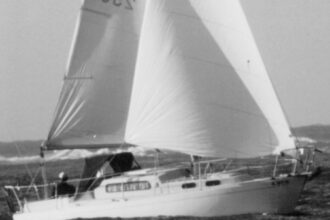
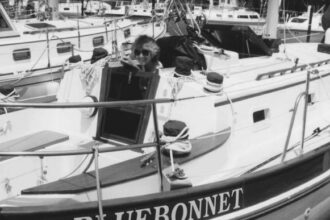
Bill’s rendering of the latest Genie B is a work in progress. She’s a sensible boat, sensibly maintained and modified, not one that would be referred to as Bristol fashion or a gold plater. On the pier where she’s docked, she’s known to be the boat that gets the most use. Bill calls her “more of a motorsailer than a sailboat,” although Ted Brewer would probably disagree (see “Dissecting the Motorsailer,” Good Old Boat, January 2003). She carries a full sailing rig and a hull designed for good performance at displacement speeds. Bill says before he’d take this boat offshore he’d add a positive hold-down for the engine access cover in the cockpit floor and heavy-weather covers for the overlarge windows.
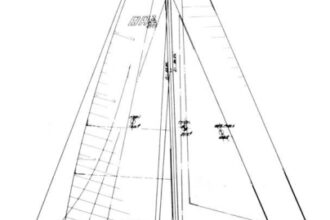
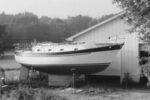
The Eastward Ho, as interpreted by the Sandifers, is not a boat of superlatives. It is a boat of compromises, as all the really good designs are: not the fastest or the slowest, not the biggest or the smallest, not designed to cheat the racing rules, just a sweet, well-maintained, 31-foot, full-keeled boat that suits the plan that Bill and Genie have for her.
The Sandifers have been sailing this Genie B for four years. But Genie says with a twinkle in her eyes, that it would sure be nice if this boat had a permanently made-up bunk . . . a bigger head . . . a shower . . . refrigeration. Clearly, they are not yet sailing their last boat.
They have a framed Hagar the Horrible cartoon hanging in a prominent location in their home. In this cartoon someone tells Hagar, “They say a man is lucky if he has just one serious, all-consuming love affair in his lifetime.” There is a pause as Hagar becomes lost in thought counting each of his serious affairs . . . with boats he has owned. He’s up to 12 in the last panel. Bill Sandifer’s own list is similarly long and each boat has been all-consuming. Lucky for him there’s been just one Genie through the years sharing his passion. In fact, it’s the boats that have kept the marriage strong.
Thank you to Sailrite Enterprises, Inc., for providing free access to back issues of Good Old Boat through intellectual property rights. Sailrite.com