Sailing an obscure board boat had big-boat consequences
Issue 127: July/Aug 2019
When writer Nathaniel Philbrick felt stranded in mid-life, he dug out the hull of his old Sunfish, the boat on which he won the North American championship 15 years earlier, and embarked on an odyssey that took him across most of the ponds of Nantucket.
At the same age, I responded to wander-lust by going cruising on a big boat. But my humble sailing beginnings were as a small-boat sailor, and Philbrick’s story, told in his memoir, Second Wind, sent me on an odyssey of memory.
My time spent at the Eagle Island Girl Scout Camp on Saranac Lake in upstate New York looms large in my formative sailing years. The Girl Scouts did such a good job enticing me to sail that by the age of 12 I was seriously hooked on boats. When I was still too young to sail the Blue Jays alone, I’d volunteer to scrape dry rot out of their wooden hulls just so I could spend time in them on their moorings.
The Eagle Island fleet also included knock-around board sailboats that I could take out on my own. These craft represented freedom. While our camp counselors sat on the dock, we campers would mess around on the board boats in packs, spreading our sailing wings.
The wind could really blow on Saranac, so we used the boats to learn skills like capsize procedures; on hot days we’d slip off the over-turning boat like frogs, shove foam cushions under the masthead and gather up the sail and boom, giggling and hanging our puny weight on the centerboard to right the boat.
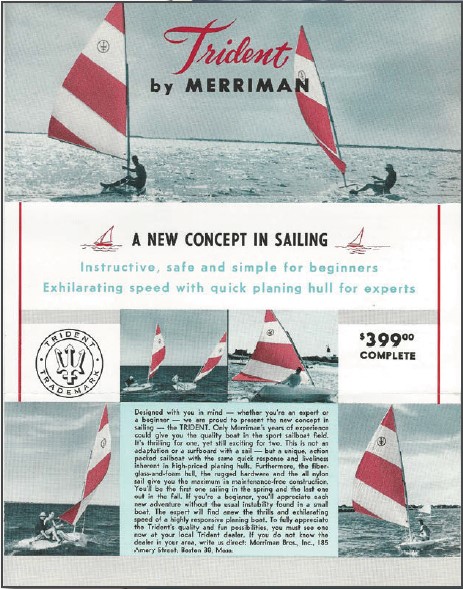
In a moment of nostalgia, I tried to remember the make of those board boats, but couldn’t. I unearthed an old album with fading snapshots from my camp days. Some of them showed the boats, but no identifiable markings were visible. I did notice they had a distinct blunt bow with a concave underbody, almost like a catamaran. Searching online, I found the “Board Boat Shorty Pen Sailboat Guide,” which lists dozens of board boats, and matched the blunt catamaran bow and “wing sprit Marconi rig” with something called a Trident. There were a few grainy pictures of the Trident hull, sketchy dimensions, and a listed manufacturing run in the late 1950s.
My further research followed a bunch of twisted paths before I found in Popular Boating magazine a Trident advertisement and a reference to a fleet of Tridents at Cape Cod Sailing Center in the 1960s. I might not have found anything except that the Trident occupied a unique turning point in boat design and construction.
The Trident’s designer, Dick Fisher, went into business with Merriman Brothers, longtime makers of yacht hardware (hence the trident symbol on the sail) to produce the boat. Whereas Alcort’s Sunfish and Sailfish were wooden, Fisher used a new product, polyurethane foam, and treated it as a synthetic balsa that could be sandwiched between layers of laminate and gelcoat to make a light-weight boat that was also strong and rigid. By then, Alcort had filled the niche market for board boats, and Fisher soon moved on, using his new production concept to help create the Boston Whaler.
Tridents were phased out of Eagle Island Girl Scout Camp’s fleet not long after I aged out of camp. I imagine at least several are still around, moldering in garages or under backyard tarps. As a hull sailor, I harbor a lingering distrust of board boats, but I think I’ve rekindled a childhood fondness for the unconventional Trident.
Ann Hoffner and her husband, photographer Tom Bailey, spent 10 years cruising on their Peterson 44, Oddly Enough. They sold the boat in Borneo, returned to the US, and bought a Cape Dory 25 in Maine. Ann is a longtime contributor to sailing magazines, most often writing articles about weather events on passage and places she’s been.
Thank you to Sailrite Enterprises, Inc., for providing free access to back issues of Good Old Boat through intellectual property rights. Sailrite.com