Banishing wet balsa, one stanchion at a time
Issue 119: March/April 2018
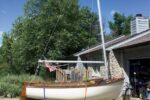
When we bought our 1977 Pearson 365 sloop several years ago, the surveyor noted elevated moisture readings around just about every piece of deck hardware, including the lifeline stanchions. He said he could guarantee that every boat this age would have at least similar problems, but that the moisture was sufficiently local for most repairs to be made within the perimeter of the stanchion base. This was good news. I could handle localized deck repairs, but I had no desire to undertake a major repair that would mean removing large areas of the top skin of the deck. Beyond the effort that would entail, it would be difficult to ensure a seamless and attractive end result.
That moisture had not spread much beyond the bolt holes seemed to confirm the results of a much-publicized test that Everett Pearson conducted decades ago. He submerged a balsa-core panel, with holes in it, off his dock in Narragansett Bay for a year. When he pulled up his sample, he measured the extent to which moisture had migrated — something like half an inch.
Although the result of this informal test was promising, it did not justify Pearson Yacht’s fastening hardware through the balsa-cored deck. A solid non-hydroscopic material incorporated in the laminate underneath deck hardware not only prevents damage from water seeping in around fasteners, it also better withstands compression loads when bolts are tightened. Today, non-hydroscopic material options for new construction include glass-filled putty, resin, or a fiberglass board like Coosa or Airex PXc.
In researching the repair of the core beneath our stanchions, I visited the Gougeon Brothers’ forums on the use of their WEST System epoxies. One customer and contributor to the company’s Epoxyworks newsletter said that, on examining wet balsa core on his boat, he was surprised how stiff it still was. I was soon to discover the same.
To fill the cavity under the stanchion base, I chose WEST System G/flex toughened epoxy, which Gougeon Brothers’ technical director, Jeff Wright, assured me would work well. He wrote, “The only downside of using G/flex instead of 105 Resin and 20X Hardener is that G/flex has a lower compression strength, although it is more than likely stronger in compression than the original balsa-cored laminate. G/flex does have the advantage of being tougher, and since it does not appear you will be applying fiberglass over the repair, this will make the repair more durable when the stanchion is loaded and the deck flexes.”
One surveyor I consulted before starting the repair suggested possibly using two-part high-density foam to fill the cavity. While expanding foam certainly would fill the void, my experience rebuilding a foam-filled rudder made me well aware of its ability to deform the fiberglass skins. Also, a quality foam repair would require applying a thin layer of fiberglass fabric over the area, which would have to be scarfed in to make it flush with the surrounding deck. There is precious little area to achieve anywhere close to the usually recommended 12:1 ratio of length versus depth for the scarf.
Step by step
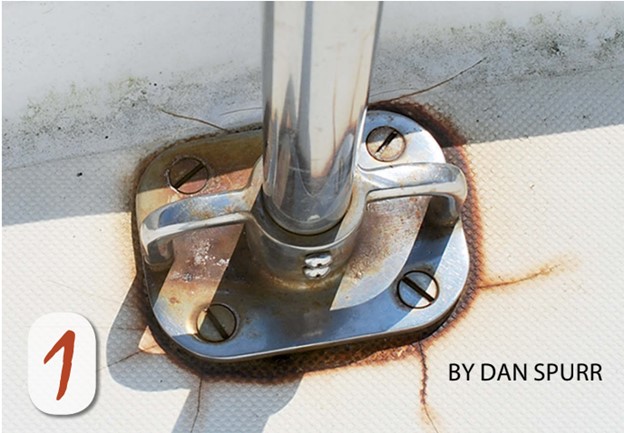
1 Stainless steel isn’t really stainless, especially in a saltwater environment. The hairline cracks in the gelcoat are probably a result of people pulling on the stanchion when climbing aboard.
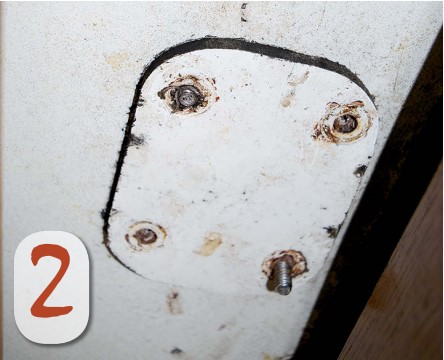
2 Though Pearson Yachts erred by drilling through the end-grain balsa core, it did install thick fiberglass backing plates under the deck to help distribute loads.
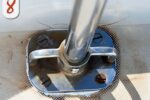
3 Removing the stanchion base exposed the funky remains of bedding compound and accumulated dirt.
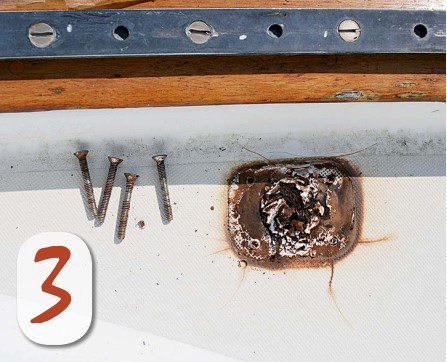
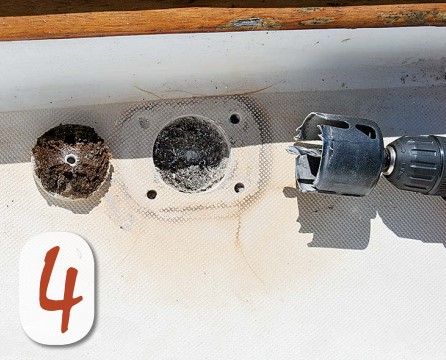
4 A 2-1⁄4-inch hole saw removed the top skin of the deck; the pilot bit did not go all the way through the bottom skin. The balsa adhered to the plug was moist but not dripping wet.
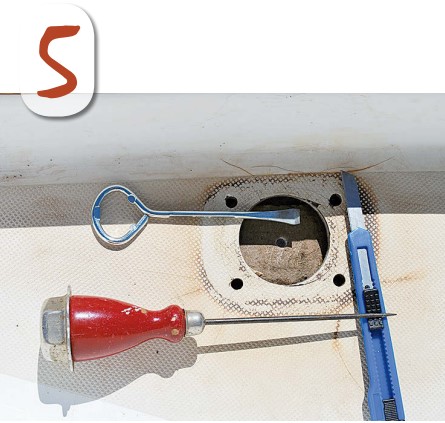
5 I used a variety of tools to scrape out the affected balsa: a paint-can opener, a sharp retractable knife, and a pick. The wet core did not extend outside the bolt holes by more than 1⁄2 inch.
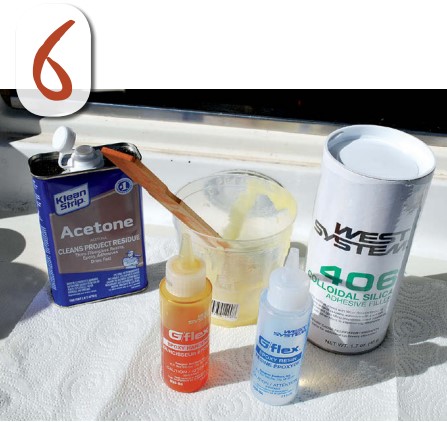
6 Rather than use the WEST System’s standard 105 epoxy system, I selected its “toughened” G/flex, which is already thickened to better adhere to vertical surfaces. The mixing ratio is 1:1 and reaches full cure in 24 hours. I added some 406 Colloidal Silica for a little additional thickening, but not too much, as I wanted the mixture to flow sideways into the cavity.
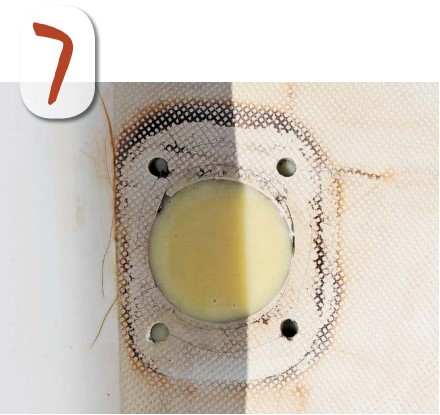
7 The mixture has a 45-minute work time at 72°F. I filled the cavity until it was flush with the surface. The epoxy is plenty tough enough and impervious to water.
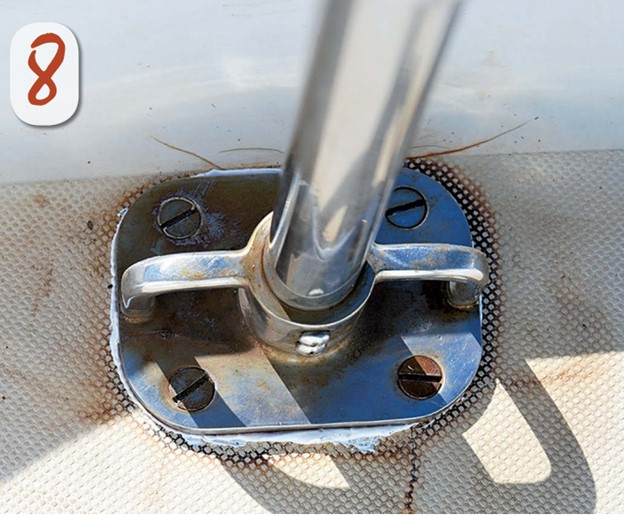
8 I used BoatLife Life Seal caulk to bed the stanchion base in the bolt holes and around the perimeter, using enough so it started to ooze out the sides when I tightened the bolts. To finish the job, I need to polish the metal, remove the deck stains, and fill the hairline gelcoat cracks.
Dan Spurr is a contributing editor with Good Old Boat and an editor at large with Professional Boatbuilder. He is the author of seven books on boats and sailing and was formerly senior editor at Cruising World and the editor of Practical Sailor.
Thank you to Sailrite Enterprises, Inc., for providing free access to back issues of Good Old Boat through intellectual property rights. Sailrite.com