Ready to buy a boat and sail away? Try this first.
Issue 132: May/June 2020
I blame YouTube. I blame those sailing channels filled with bikini-clad sailors living carefree lives in tropical paradises. They so blithely fail to show the realistic, day-to-day maintenance chores that are part and parcel of sailing and sailboat ownership. I can’t imagine the shocking reality that awaits the audience of landlubbers who buy boats so they can follow in the naked, sun-kissed footsteps of their YouTube heroes.
Every one of them would be purged of their starry-eyed misperceptions if they could spend just a week aboard one of these YouTube boats to experience the behind-the-scenes reality. Maybe after they unclog the head, clean up the exploded can of tuna in the food locker, service the winch (while dropping a critical part overboard), clean the bottom, and fix the deck leak (after spending two years just finding it) will they be of right mind to decide if they still want to buy a boat and sail away.
Of course, that’s not going to happen, but I have a more realistic litmus test for the prospective sailboat purchaser: Change the oil in your car, at home, but follow my instructions so that you get a sense of what it can be like to do the same chore aboard.
Preparation
Good preparation is the key to success. You wouldn’t just throw a whole loaf of scrumptious Spam right into a scalding hot pan, right? You’d first prepare. You’d get a knife and slice the loaf. You’d make sure the spatula was clean and handy. So it goes with my Boat Buyer Oil-Change Litmus Test; there are a few things you’ll need to do to prepare.
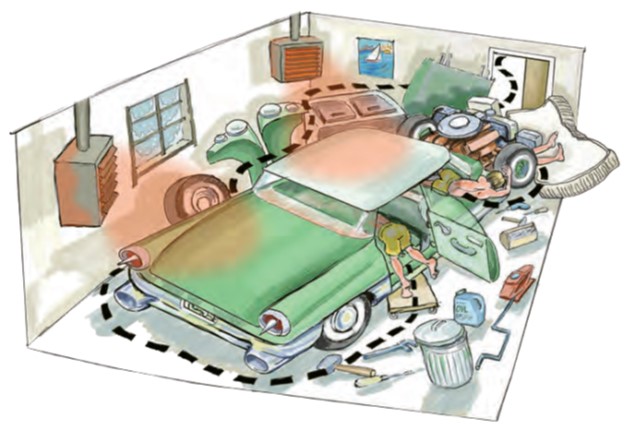
Step 1: Make room for your car in the garage. No need to clear it out completely, just enough room for the car is fine—in fact, the more cluttered and crowded the garage, the better. Pull the car in until the front bumper is touching the back wall and then turn it off (making sure the engine is warm) and shut the garage door.
Step 2: If it’s not already very hot and humid in your garage, you’re going to need to make it so. Maybe bring in some space heaters and humidifiers. When you can’t spend 10 minutes in your garage without dripping in sweat and feeling a bad case of heat rash coming on, you’re almost ready. Now strip down to your swim trunks or skivvies and bare feet. That’s how you’re going to change the oil, because you’re afloat in a tropical paradise, remember?
Step 3: Drag the bed from the guest bedroom into the garage and jam it against the passenger side wheel well. Slide your chest freezer to the identical location on the driver’s side.
Step 4: Move the recliner from your living room to the garage and dump the contents of your toolbox underneath the cushion.
Step 5: Remove the hood from your car and lay it across the top of the recliner (this step simulates the removal of the companionway steps).
Step 6: Now do the reverse of the previous step so you can get to the tools you need underneath the cushion, the cushion you covered with the hood (it’s okay to swear loudly at this point). Carry the needed tools across the garage and set them on the clean sheets of the guest bed.
Step 7: Stub your toe on something.
Step 8: Get in your car and crawl from the back seat to the front seat.
The Oil Change
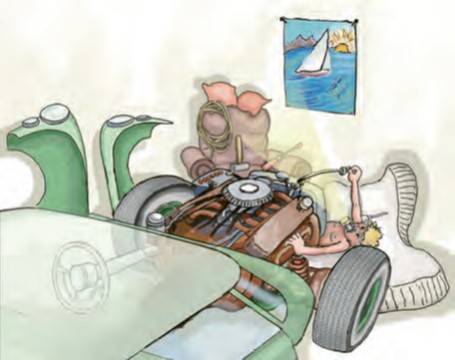
Step 9: Reach forward out the passenger-side window and strain to remove the dipstick from the engine. As you pull it out, note the drops of dirty oil you’re hopeless at preventing from flicking all over the guest bed.
Step 10: Crawl out of the car, balance yourself on the front bumper, and insert your longest drinking straw into the dipstick hole.
Step 11: Suck hard. Spit the mouthful of dirty oil into your mother-in-law’s heirloom iced tea pitcher. If this doesn’t prime the oil-extraction pump, repeat. Drain the oil into an empty gallon milk jug, whose lid you will conveniently forget you failed to install until you later tip the jug—which you left on the front seat of the car—to complete the oil removal.
Step 12: Once the oil is removed, climb onto the guest bed. While lying on your back with a flashlight in your teeth, reach behind the passenger side front tire and remove the wheel well guard. Force your arm through the maze of suspension components and feel around blindly for the oil filter. When you find it, remove your bloody arm, climb off the guest bed, and retrieve the oil filter wrench that you forgot beneath the recliner cushion.
 Step 13: Repeat Step 12 with oil filter wrench in hand.
Step 14: Loosen the filter with the wrench. Continue unscrewing the filter with your bare hand until your hand is covered in scalding hot oil. Don’t drop the filter. As you try to remove the filter by pulling your arm back through the fender well, drop the filter (it’s okay to swear loudly at this point).
Step 15: Being careful not to leave any oily footprints, trudge into your house and retrieve a new oil filter from under the dining room table and a gallon of oil from a kitchen cabinet.
Step 16: Open the new oil and pour some into the new oil filter until it overflows and spills onto the garage floor. Check the oil’s lubricity by stepping in the spill.
Step 17: Crawl across guest bed with the full oil filter and again reach around the front tire and through the suspension. Blindly search for where the oil filter is mounted. When found, carefully cross-thread the new oil filter to ensure future leaks.
Step 18: Laying across the windshield, pour the rest of the gallon of new oil into the engine (do not use a funnel). As soon as you realize that a gallon equals four quarts and that your engine takes five quarts, swear loudly before returning to the kitchen for more.
Step 19: Clean up.
I’m confident that having followed the above steps, you—YouTube viewer—are far more informed about the boat owner’s life and ready to make that boat-buying decision with a clear head. At the very least, you’re ready to shut off that computer and go sailing.
Ken Ferrari and his wife, Vicky, are full-time cruisers living aboard their 1981 Morgan 382, HuskaBean. In addition to a stem-to-stern refit of their boat, they have logged over 20,000 nautical miles while cruising the U.S. East Coast, the Bahamas, and the eastern Caribbean, and have recently completed a west-to-east crossing of the north Atlantic Ocean.
Thank you to Sailrite Enterprises, Inc., for providing free access to back issues of Good Old Boat through intellectual property rights. Sailrite.com