Banish the hazing, crazing rays of summer
Issue 111: Nov/Dec 2016
Under the relentless glare of UV, crisp sails turn to fragile rags, shiny paint dulls, and clear plastic windows become hazy and crazed. Compounding and polishing can remove surface haze from plastics but they can’t reverse crazing damage deep within. Crazing is especially bad because it can weaken the plastic until it cannot be trusted to take a heavy blow, necessitating major surgery to remove and replace glued-in windows. Waxes promise protection, but the protection is slight and ephemeral, and cleaning the windows to remove dust and bird bombs removes the wax.
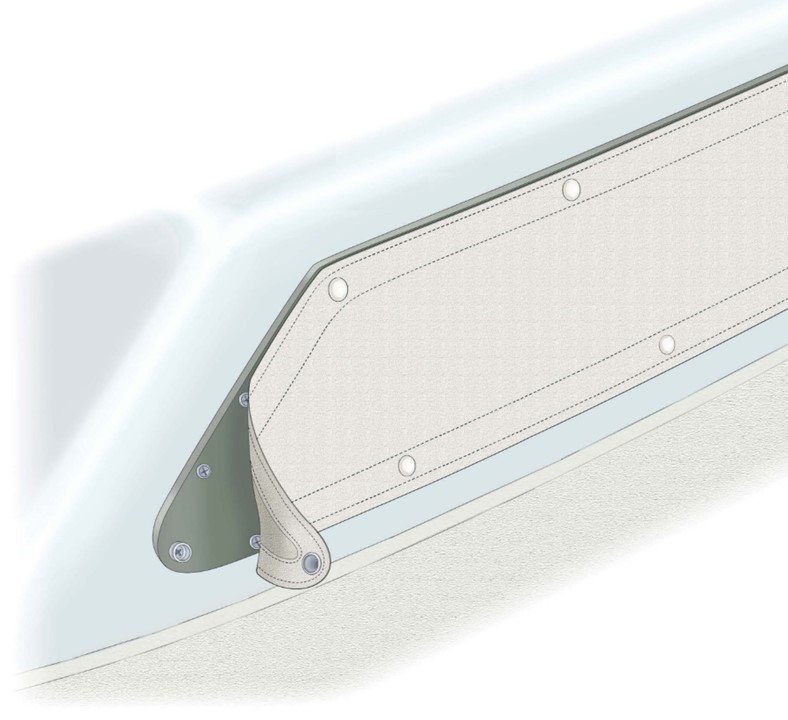
The best protection for acrylic or polycarbonate windows is to cover them. Fixed plastic windows, like those on our PDQ 32 catamaran, are typically attached by a ring of screws on the perimeter. By replacing the corner screws and a few in between with male snaps (5⁄8-inch with a #8 wood-screw thread), I created attachment points for covers without drilling any new holes. These male snap screws are shorter than the screws they replaced, but I did not remove many, and the window is actually secured by the adhesive, not the screws.
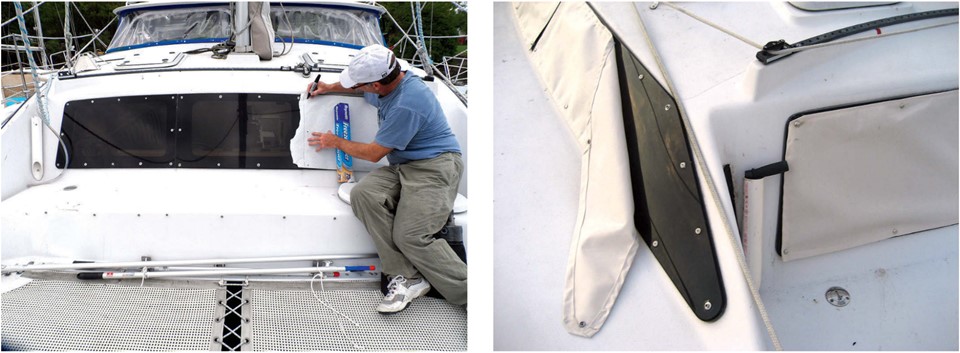
I made patterns for my covers using freezer paper. It comes in a convenient roll, is reasonably strong, and doesn’t stretch. I marked the fastener locations by feeling through the paper, pressing to make an impression, and marking with a Sharpie. I marked the perimeter of the window the same way, by feeling and making an impression. I labeled each pattern and wrote “this side out” to avoid confusion.
Because I was making my covers from Sunbrella, I increased every dimension by 1⁄4-inch per foot to allow for shrinkage. To measure this, I marked a single centrally-located fastener on the pattern with an “X” and increased the dimensions from that point. The covers were a little baggy at first, but shrank over time to a nice fit.
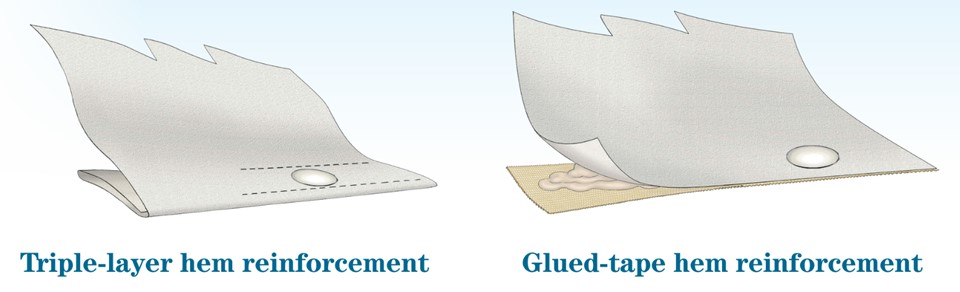
I allowed an additional 3 inches around the perimeter for the edge hem. To make the hem, I doubled the cloth under, slitting it as needed to make the corners lie reasonably flat. The resulting three layers of Sunbrella are required to hold the pound-in female part of the snap. I sewed the hems with Tenera thread as it lasts as long as the fabric, which is at least 15 years for a simple window cover. On the top inside corner of each cover, I used a Sharpie to write its location; they all look alike when they are on deck and I’m trying to decide which is which.
An alternative to sewing is to cut the fabric to the patterned size with a hot knife (or flame the edges), allowing for shrinkage. The thickness around the borders can be built up with 1 1⁄2-inch-wide strips cut from the same fabric, or with webbing, glued flat along the edges with polyurethane adhesive sealant (Locktite PL S30 is an economical choice). This will seal the edges and provide the snaps enough material to bite into. I have used this shortcut under grommets for years, for repairs and in places where sewing would be awkward.
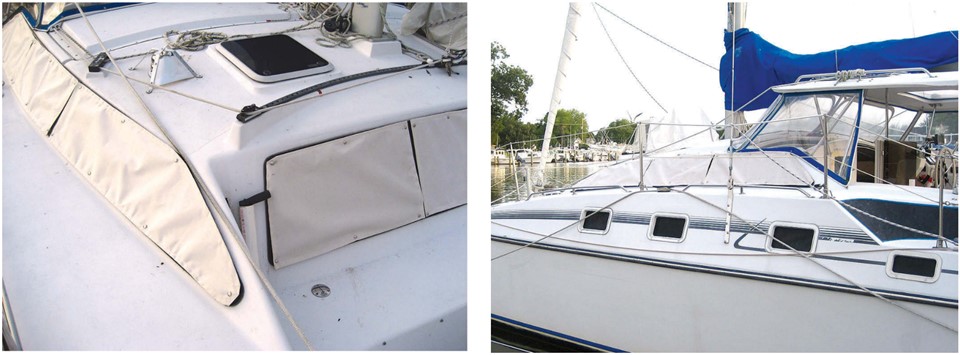
I’ve used these covers for 5 years. They have stood up well and have not caused chafe on the windows. By blocking the sun, they dramatically reduce heat gain and air-conditioning loads in the summer, help with heating in the winter, and add privacy when desired. I lubricate the snaps regularly with grease to lessen stress on the snaps when I remove the covers, reducing the chance of pulling out a snap. I almost never have to clean the windows as the covers bear the brunt of atmospheric fallout and bird bombs. I could take the covers home for laundering, but I just scrub them in place.
Drew Frye cruises Chesapeake Bay and the mid-Atlantic coast aboard his 34-foot catamaran Shoal Survivor, searching for out-of-the-way corners known only by locals. A chemical engineer by training, 40-year climber and 30-year sailor by inclination, he brings a broad mix of experiences to solving boating problems and writing about his solutions.
Thank you to Sailrite Enterprises, Inc., for providing free access to back issues of Good Old Boat through intellectual property rights. Sailrite.com