Issue 9 : Nov/Dec 1999
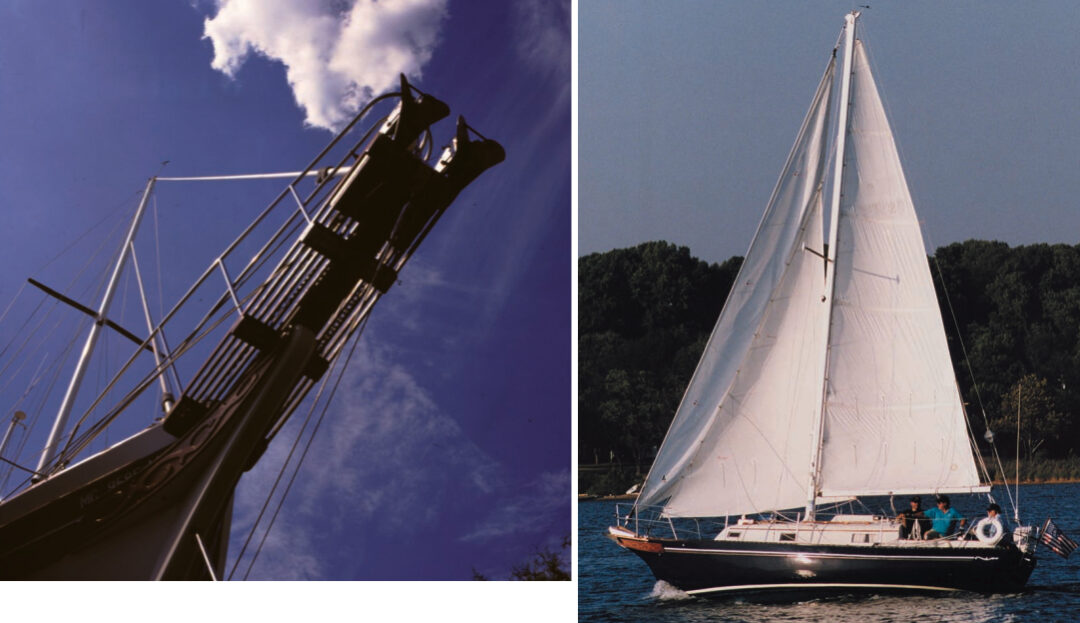
I first saw a Bayfield early in the ’80s, on the hard, at a marina on Lake Huron’s Saginaw Bay. It was a 25, sitting next to an elderly wooden Tahiti ketch. Here was a study in contrast. The little fiberglass Bayfield 25 bravely trying to look classic, while a tattered wooden classic, complete with galvanized rigging, was gamely trying to look seaworthy. Each succeeded in its own way. I wonder what John Hanna would have thought of H. (“Ted”) Gozzard’s Bayfield line? From the small 23, with which Ted began the company, to the stately Bayfield 40 (but excluding the 36, which wasn’t designed by Ted), these boats have what can only be called a family resemblance. In fact, if you’ve seen one, you won’t mistake it for anything else. They all have an overhanging bow, a full keel, inboard engine, and a low-aspect-ratio rig. But Tahiti ketches they ain’t.
Ted Gozzard took pains to give these boats what he felt was a traditional look. Each one has a certain sheerline, a similar curve to the over-hanging bow, a rake to the transom, a ratio of cabin-to-topside that defines the esthetic quality of the design and says to the modern eye: “Traditional.”
We know what traditional really is, and as boat buyers we have most emphatically rejected it. Our boats are no longer made from wood (at least most of them aren’t). They no longer have the narrow look of a plank on edge. We want that interior space. The topsides are high because we want headroom. And gaffs no longer hang from the top of the mast. The mast just continues to go up, and up, and up. Yet Ted Gozzard, in designing the Bayfields, tricked us into thinking that his modern fiberglass boat was traditional.
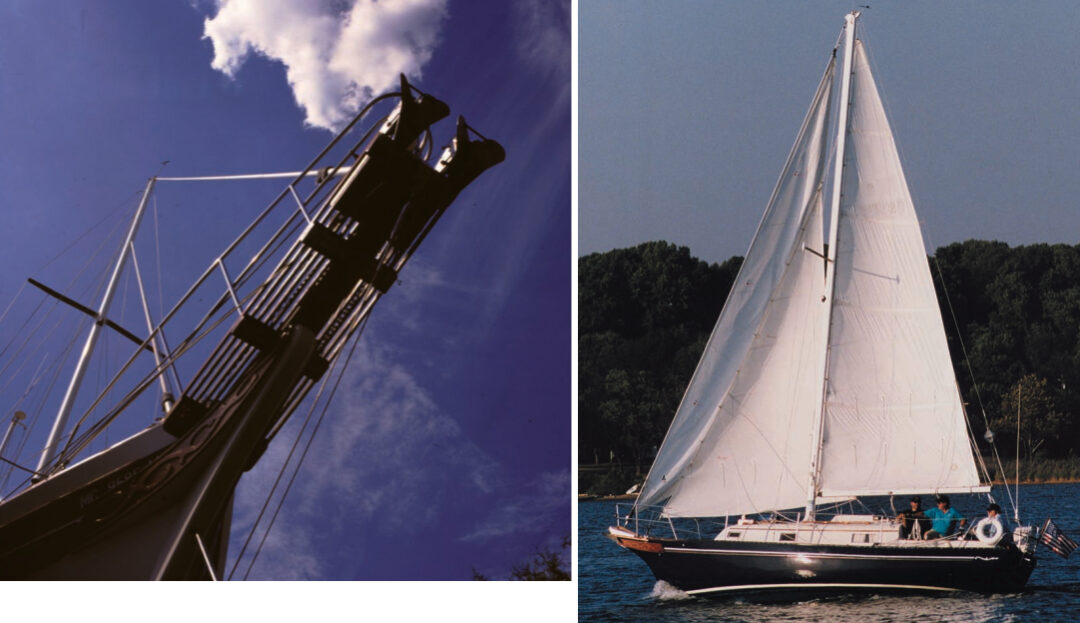
First and foremost is the bowsprit — but not the traditional bowsprit, in which a spar is rigged out from the bow of the boat and copious rigging holds it in place. Rather, it’s an extension of the molded hull with a platform built on it. With a sturdy stainless steel railing around you, you can walk out on the “bowsprit” and pretend you’re on a clipper bringing the tea back from China at a record pace. Traditional.
Then there’s the full keel with a moderate cutaway forefoot. This gives the boat a solid look and feel. My first sight of one was out of the water, and she did look solid. Upon examination, she was solid, too. The ballast is inside. Kept low. These boats are not tender. They don’t skitter around. Traditional.
By keeping the sailplan low and moderate in size, the stateliness of the design is emphasized. It says to the eye, “This is a dignified boat, a boat that will behave itself . . . above all, a boat that will take care of you.”
Wetted suface
When you combine all of that with teak trim, the trademark trailboards at the bow, and a contrasting sheer stripe on the fiberglass hull, the illusion is complete. Here, in the most modern of materials — stainless steel, fiberglass, and Dacron — is a very “traditional” craft. Ted Gozzard deserves a medal. Or maybe an Oscar.
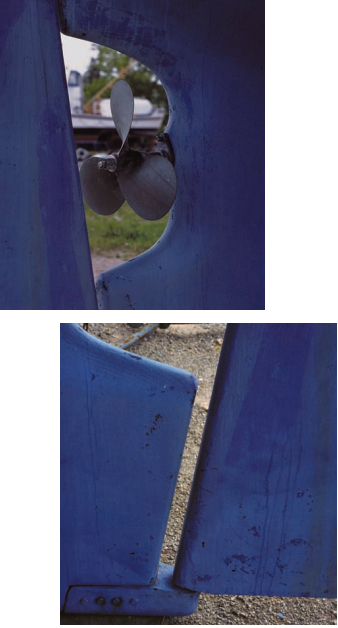
Owners love them despite the fact that Bayfields are not fast. They all have a lot of wetted surface. That’s a full keel under there, so there’s a lot of drag. Add to that a fair amount of beam for the length (the 25 with its 19-foot-8-inch waterline has an 8-foot beam), and you have lots of skin to push through the water. Include a three-bladed prop in an aperture with a fairly square rudder, and the drag grows.
There’s the low-aspect ratio of cutter rigs (depending on the boat). Cutters have smaller sails, which are easier to handle. Cutter rigs also offer visibility under the sail. Sloop rigs depend on big deck-sweeping genoas for power. The main is merely a tab that helps the genny along. Cutters are different. They have bigger mains, and the jibs are cut high: a Yankee, for example. You can see under a Yankee. Try looking through one of those deck-sweeping genoas sometime. But you pay in loss of power. These sailplans do not overpower their boats. If you want to race, you might want something other than a Bayfield.
If you want to cruise, though, a Bayfield is for you. And comfort is the reason their owners love them so. Take that same large wetted surface, inside ballast, relatively small sailplan, modern materials, and good design, and you have a boat to settle back on with a sigh. A boat in which to put your feet up and relax. Stable, slow (but not too slow), stately, steady, roomy, a boat to trust. It even looks like a boat to trust. It’s traditional.
Sapphire
I knew this much about Bayfields when I contacted Doug and Carol Kelly, in Millersburg, Mich., somewhere “up north.” For those who live in the Detroit area as I do, there is a distinct meaning to “up north” in Michigan. It is the place where the woods begin, where the white pine trees are — many of them — and where you find lakes. Great Lakes. Lakes that sometimes take more than a day to cross in my sailboat. Doug began sailing with a friend and his cousin in 1955 in an X-boat on the St. Croix River near St. Paul, Minn.
Later, after he and Carol were married, they bought a plywood Corsair, a Midget Ocean Racing Club (MORC) design, for $2,300. Carol was teaching, and Doug was an engineer. They learned serious sailing together on Lake Michigan. At one time they even asked themselves, “Do you think anybody has ever crossed Lake Michigan on a sailboat?” That day finally came for them one Memorial Day weekend. It was a trip to remember. They had two dogs and two couples on that little sailboat in a storm at night. Both women were pregnant and seasick. Still, that trip marked the beginning for them. Next, they began chartering sailboats and venturing to popular places like Mackinac Island.
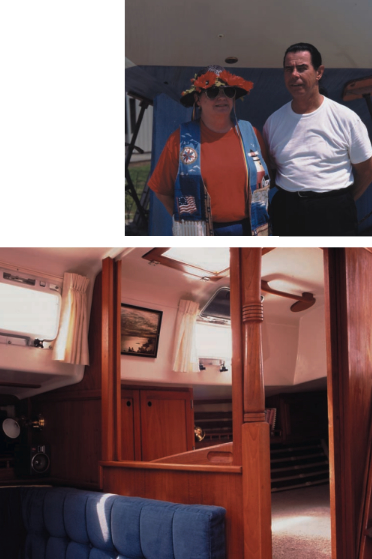
Eventually they wanted more comfort, so they bought a Seafarer 38 and sailed it from 1979 to 1982. It had a modified bathtub that worked well for confining the kids when they were little. But Doug discovered this boat was really a 34-footer with a 31- foot waterline. He felt the designers had just extended it and put on more superstructure. He said the bow sections would “oil can,” popping in and out. He felt the designer had taken the 34 design and scaled it up, without modifying the scantlings. He and Carol also thought it was tender, so tender that they kept the tanks full as extra ballast to make it manageable.
Not long after that, they went to the Metropolitan Beach Boat Show, a large in-the-water show near Detroit. They saw a boat that looked very much like the Seafarer. It was a Bayfield 40. They really liked its rakish look. They went back three days in a row and finally bought hull #12.
The Bayfield factory put too much ballast in the keel of this particular model — 8,500 pounds of lead, right at the bottom of the keel. Later, the company eliminated 800 pounds. But Doug and Carol opted for the older one with the full 8,500 pounds. Consequently, their boat is “stiffer than the dickens,” according to Doug. It carries 1,000 square feet of sail, and does very well in a blow, he says.
Doug and Carol spend one or two months cruising Sapphire, their Bayfield 40, each summer. They believe the North Channel of Lake Huron is the best cruising ground in the world. Carol says they’ve been as far east as the islands in Lake Erie, as well as all over Lake Huron and Georgian Bay. “There isn’t a harbor we haven’t been in,” she says. They have been as far south as Grand Haven in Lake Michigan. They had intentions of going all the way around Lake Michigan one summer, but it was a blazing hot summer “and it just wasn’t fun,” Carol says.
One summer they cruised Wisconsin’s Green Bay, and they have been in Lake Superior a couple of times. “Many times we were the only boat in the anchorage there,” Doug recalls.
And how does the Bayfield perform? “She sails very, very well,” Doug says. “You can lock up the wheel, trim the sails, and sail on course with no attention. It will do that for hours and hours and hours unless there are gusts. The wind goes around, and the boat just follows it.” He has an autopilot, an old Autohelm 5000, “but sometimes I don’t use it. Our guests think I do. The boat has that big, long keel. It has a cutaway forefoot, but even so, sometimes it’s a job to get it around on a tack. You have to turn on the engine.”
Jib and jigger
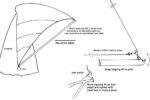
Doug and Carol say when the mizzen is up, it will turn the boat about 45 degrees off the wind and hold it there. The boat will drift backward at about half a knot. This can be very handy in an emergency situation or when they want to heave to. They can also put up either the jib or staysail with the mizzen and still be balanced. The boat sails well “jib and jigger” in about 30 knots of wind.
Doug says, “Many skippers think of the main as the controlling sail and the jib as the power sail. In higher winds they will take down the jib and sail with reefed main alone. We do it the other way around. We use the jib or the staysail. Any time we heel more than about 15 degrees, it gets too hard. We take the main down early.”
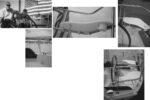
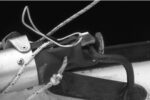
There have been some problems with the boat in the time Doug and Carol have owned her. A memorable one was when they grounded near Little Current in the North Channel. There is a cap that holds the bottom bearing of the rudder. It has four stainless-steel, half-inch-thick bolts. Whatever they hit in the grounding sheared all the nuts off one side. These bolts should have been recessed to reduce drag and vulnerability (see photo on next page).
During that incident, Doug reached down to hit the starter on the engine and found how things can pile up on you at sea. When he turned the key to the start position, the ignition switch stuck. The starter continued spinning after the engine started, burning up the starter motor windings in the process. The first thing Doug knew, smoke was coming out of the bilge. He shut off the engine and worked the boat out of the shallows under sail, bumping and banging all the way.
The interior of the Bayfield 40 is unusual. Doug thinks Gozzard did a superb job of laying it out, although he has not done any other boats like it. The entire forepeak is the head and shower stall. “You can go in there and get seriously cleaned up,” he says (see layout on Page 51).
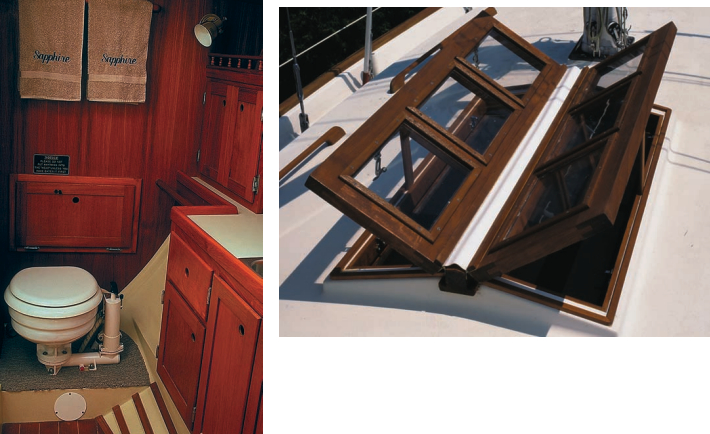
As you go down the companionway there’s a stateroom on either side. There’s a table there as well. A galley doesn’t have to be right aft, and it isn’t in this boat. It has a very open feel. Cutouts with sliding panels contribute to this open feeling, (shown at left).
The boat has a Westerbeke 50 diesel that Doug thinks is outstanding. He made the boat into what he considers a real performer by installing a 20-inch prop, instead of the original 18-inch-diameter one, and upping the pitch from 12 to 13 inches. He got almost a knot-and-a-half more speed. “It doesn’t strain the engine,” he maintains. “And you pick up 50 percent more blade area.”
Extra alternator
One of the big modifications the Kellys made was adding a propshaft alternator. Doug took a 35-amp Oldsmobile alternator and put it on the propshaft. Now, when they sail, the spinning propshaft cranks out about 10 amps. Doug put an 8-inch pulley on the propshaft and a 2-inch pulley on the alternator. There is a manual switch to turn it on. When the boat slows down to where the alternator is not charging, a buzzer sounds, and the alternator can be turned off.
“An Adler-Barbour refrigerator chews up between 74 and 100 amp-hours per day,” Doug says. “You have got to replace that. A propshaft alternator really helps. The wind generator doesn’t work very well. I also have a 150-amp alternator on the engine. With eight batteries, each one providing 105 amp hours, I could weld.” With this setup, Doug claims they can go about four days and not even be down 50 percent.
The engine battery is set up like a car’s and is dedicated just to the engine. It’s a separate unit from the house bank. Doug says, “I have my big battery bank — which cuts down on this cutting back-and-forth — connected to a Heart Interface Link 2000. That’s a 20-amp battery charger as well as a 2000-watt inverter. We usually have both our computers on board. It’s nice to be able to plug into 110 volts when you want it.”
It’s taken the Kellys 15 years to get things exactly how they want them. You can shower while under sail on Sapphire because they moved the water heater up near the shower. They also made storage modifications, like cutting out the bottom panel under the dresser. That provides a large storage area below.
“Every time we meet another Bayfield owner, we get one or two ideas,” Doug says. One in particular was Siemens solar panels. They now have two 3-foot by 2-foot solar panels. These have sufficient output to run the refrigerator. They can be placed across a set of davits, safely out of the way. Putting the television antenna on top of the mizzen is another good idea they picked up from Bayfield owners.
It has taken time to sort out the ground tackle, too. “I didn’t like the Danforth anchor,” Doug says. “I went to the CQR. They’re heavy, but they don’t seem to set very well.” Next, he says, he tried a Delta and liked how it worked. But with chain, it was far too heavy for Carol to handle.
So he made two aluminum Deltas. “I heavied up the aluminum, eyeballed it, and welded it up.” Doug says they work like a charm. But there’s another difference. “When they made the Delta, they put a big chunk of steel in the point of it, to get the thing to roll over right. It didn’t make any sense to me to make an aluminum anchor and put a big chunk of steel in the tip. You can do the same thing with a float. So I attached a float to the other side. Now it drops with the tip down, and it anchors instantly.” Carol can lift this anchor and swish it off in the water by herself. It weighs 9 1/2 pounds and has 3 pounds of chain on it. “It’ll hold a 40-foot boat in 30 knots,” Doug claims.
Minor problems
Bayfields have beautiful six-unit skylights. They all leak, according to Doug. The silicone sealer pulls away from the glass in cold weather. The next spring, the windows leak. “There’s an easy way to fix that,” Doug says. “I took a router, cut a little round channel around the bottom and inserted ‘O-ring spaghetti.’ This is the same stuff that goes in screen doors. It worked like a charm.”
There have been some other minor problems, too. The boat developed some small blisters along and below the waterline. They sanded them out and used VC tar and VC-17.
Until two years ago, the boat was kept in the water except for two days a year when the bottom was painted. Lately, they have noticed little toerail leaks. Sometimes it leaks inside the liner, and sometimes on the outside.
Cupboards can pop open when the contents hit the latch from the inside. They installed thumb latches on the outside to prevent that.
All the Bayfields have their original trailboards stripped off by the first big wave they hit because the factory let the trailboards stick down a little past the fiberglass, according to Doug. “The water hits that overhang and just takes it right off,” he says. Even when they made them the right size, the trailboards would still come off, because the bow would come down so hard that when it hit the water, the pressure would go in the crack and split them out. “All you have to do is run a solid bead of silicone along the bottom and then put the trailboard on so the water can’t get in,” Doug says, “and it solves the problem.” He has the patterns and forms for making trailboards. They’re also available from Gozzard’s shop in Goderich, Ontario (see sidebar for more information).
The Kellys feel that the best feature of the boat is its comfort and the compliments they get. “Bayfields have been all over the world,” Carol says. “We know of two or three of them that have turned turtle and sailed on.” What better recommendation could you get?
Ken Miller has been cruising for more than 17 years. Beginning with a 19-foot Mirage with two holes in the bottom, Ken progressed through several boats to his present 34-foot Tartan. Each was in poor shape when he bought it and was restored to safe running condition for cruising.
Thank you to Sailrite Enterprises, Inc., for providing free access to back issues of Good Old Boat through intellectual property rights. Sailrite.com