“Cows Week West” celebrates good old boats
Issue 19 : Jul/Aug 2001
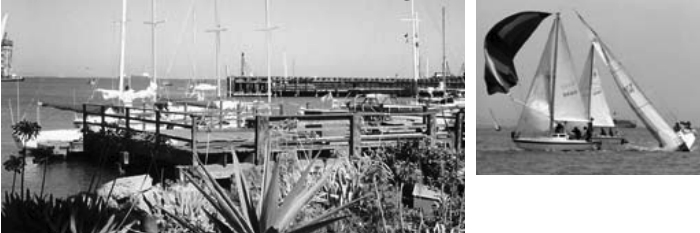
Californians have long been informally acknowledged as the nation’s trendsetters, and so it is only fitting that a full-scale celebration of good old boats should begin on the Left Coast. What began as a grumble in a bar in 1984 became the Plastic Classic — a regatta and concours d’élégance — the following year, and it continued to gain momentum in the ensuing years. This year’s Plastic Classic on July 21 will draw San Francisco Bay sailors and others from neighboring states who will compete among their peers for racing and “beauty” honors.
But first a trip back in time to the Golden Gate Yacht Club bar, where a pair of sailors were lamenting the lack of respect for older boats — not woodies, but rather the sandwiched group that was designed prior to 1970 and built of fiberglass. These boats were no longer being invited to the officially sponsored racing events and the corresponding award banquets and parties. In 1984, the new racing fleets included the lighter-weight racers such as J24s, Moore 24s, and the Santa Cruz 27s.
Left out were John Super, an Islander Bahama sailor, and Don Waldear, a Gladiator sailor. John recalls, “We could think of several fleets of boats which were dead or dying. These fleets weren’t being invited to the regattas anymore. So an idea was born.” The two sailors agreed to start their own event, which became increasingly fantastic with each beer. It would be a regatta: one-designs, PHRF, spinnaker, non-spinnaker. It would include cruising boats, with awards for other achievements. It would use a celebrity to draw attention to the event. It would celebrate good old boats . . . a certain kind of good old boats . . . why not call them plastic classic boats?
Not too long after the hangover wore off, Don sold his Gladiator, but John went forward with gusto. He has maintained that initial momentum for 16 years of Plastic Classic events with a 17th soon to become history as well. That first event in 1985 set the tone for the decades that followed.
Carol Doda — a local topless go-go dancer who in 1964 did much to enhance her self-image as well as the future of plastic surgery — presided at the awards event. Prizes and hugs were handed out freely. Adult beverages flowed. The band played golden oldies. Protests were discouraged. Racing rules were informal. There was an Olympic awards theme with medals hung around the necks of winners who proudly stood on a multi-tiered beer case platform.
Over the years, members of the Bay View Boat Club, a laid-back organization, hosted the events and provided increasingly outlandish decorations for a platform situated 200 yards offshore. Known as Mark T, a small barge serves as the weather mark and, according to John, forms one side of the starting line. It also provides one side of the finish line for the course which must be rounded twice in order to complete the 10- to 12-mile race.
This mark has been decorated for years with cast-off plywood farm figures, primarily cows, relics salvaged from an area county fair. Painted in bright colors and wearing sunglasses (this is California, remember), these bovine statues have given the regatta a new subtitle: Cows Week West. Bawdy activities on this barge/mark involving varying levels of dress and undress, distract serious sailors, encourage the rest, and in general make light of the race.
If all this seems a bit informal to the “real” racers among us, it should be pointed out that this event was a giant leap forward from sailboat racing as it had been previously defined by members of the Bay View Boat Club. Prior to hosting the Plastic Classic, these folks held beer can races that had no starting or finishing gun. Members sailed around a mark and back to the bar. First one back bought the beer for the rest.
These days, the race is a U.S. Sailing-sanctioned event. As few as two boats of the same design can get their own start, but generally fleets of as many as seven to 10 sister ships participate. Typical Plastic Classic participants — designed before 1970 and built of fiberglass — include Pearsons (Electras, Vanguards, Tritons, Ariels), Columbias (the 26 and the Challenger), Cals (20 and 34), Islander Bahamas, Gladiators, Rhodes 19s, Santana 22s, International Folkboats, Coronado 25s, Alberg 30s, Excaliburs, Quarter Tonners, Newport 30s, Chris-Craft Cherokees, and Thunderbirds. Thunderbirds? Fiberglass? While a plywood design, these boats qualify for the race and concours events because they’re finished with glass cloth and resin.
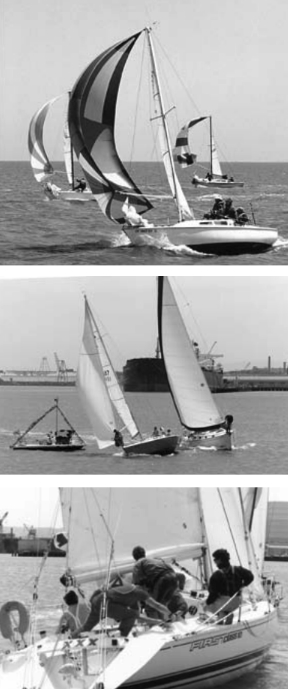
Race events include starts for boats of the same design and two PHRF divisions (spinnaker and non-spinnaker). A trophy is awarded for the fastest boat of the day on PHRF-corrected time, and honors go to the top first through third places (depending upon the total number of boats racing) in the individual fleets.
Concours events include trophies for prettiest overall and for the boat owned by the same owner for the longest time. First-, second-, and third-place honors also go to the boats with the nicest interiors, the simplest single-handers, and the most “stock” boats (also known to some as the “Gee-you-haven’t-spent-a-dime-on-your-boat-in-20-years award”). If you think the concours events are more straightforward than the wacky racing rules, consider this: these boats are judged by a team of wooden-boat owners (ostensibly so they will be impartial). And this: sailors whose boats are on display for judging “thoughtfully” leave wine-and-cheese snacks for the judges, who are likely to be overworked and in need of refreshment.
As the founder and powerhouse behind the organizational details, John Super is the guy who maintains the event’s party atmosphere and who makes the rules. With the passage of time, of course, many of those boats previously racing as the “modern yachts,” which once excluded the plastic classic boats, have now also been excluded as “older boats.” They have certainly become good old boats by this magazine’s definition of 10 years old and older. Will they be allowed to compete in the Plastic Classic events, we wondered?
“Once they’ve suffered enough, we might open the events to Hunters and others,” John says with a grin. “They’re the guys who wouldn’t let us into their regattas.”
Thank you to Sailrite Enterprises, Inc., for providing free access to back issues of Good Old Boat through intellectual property rights. Sailrite.com