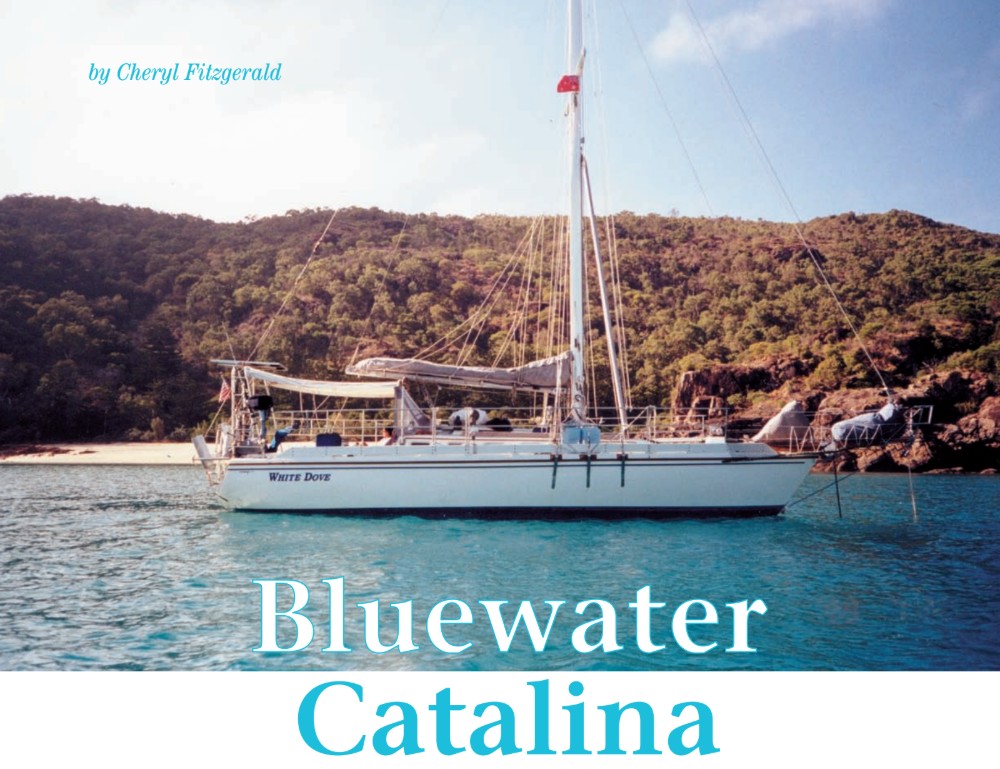
How a couple converted White Dove, a 36-foot coastal cruiser, for offshore work
Issue 27: Nov/Dec 2002
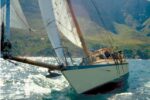
CAN A 1989 CATALINA 36 be sufficiently modified to become a bluewater cruiser? After five years of grueling boat projects, we set sail in October 1998 to put White Dove to the test.
Jerry and I left California on White Dove in October, 1998, and sailed to Mexico, through the South Pacific islands including Tonga, and on to New Zealand. From there we visited Fiji and cruised up the east coast of Australia, then headed across the South Indian Ocean to South Africa with short stops in Mauritius and Reunion Islands. Our passage continued around the Cape of Good Hope, up the South Atlantic with a brief rest in St. Helena, and on to Trinidad. Then we island-hopped through the Caribbean and Bahamas. We completed our voyage in July, 2001, in Florida, where we lived aboard for another year.
To feel secure crossing oceans, we replaced wire lifelines with 1-inch stainless-steel tubing around the boat except for a short distance leading to the bow pulpit. We secured 33-inch-high double rails to tubing stanchion bases and 1⁄4-inch stainless-steel plates. We incorporated a heavily reinforced radar arch made of 1 1⁄2-inch tubing into this system to provide support for two solar panels, a permanent awning, and a wind generator. This arch has been worth every penny (and it took quite a few), since it provided us with the safety and security we needed, even during the roughest weather.
We added 8-inch bulwarks with a clearance of 1 inch off the deck, attached to custom stainless-steel brackets, some of which also served as rail-stanchion bases. Made from three layers of clear spruce and laminated together with resorcinol glue, these were coated with epoxy and two layers of glass, and then painted. They serve as an integral part of our rail system.
This was our most challenging modification, but the bulwarks prevented many items from being washed overboard and also created good attachment points for our web-strap/snatch-block setup through which we could run the jib sheets.
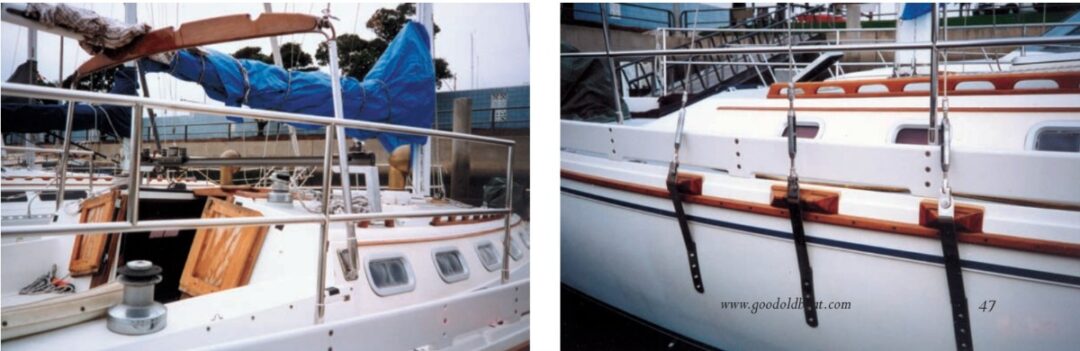
Attachment point
We constructed a boom gallows over the companionway, which also served as the forward attachment point for our sail awning. We raised the cabintop handrails 1 inch for an easier reach, and they also served as footholds. One more interesting addition: we welded a ladder-like structure to the boom. With a width of 23 inches, it provided good handholds, a nest for the mainsail to rest in, and additional strength for the boom.
One of the most important investments for a boat is a reliable, user-friendly anchoring system. Our horizontal Lighthouse anchor windlass is mounted on a pedestal far back on the foredeck. Overall it has served us well. Due to its easy operation, we don’t hesitate to re-anchor if we’re in doubt. The only complaint my husband, Jerry, has is that all horizontal
windlasses have a tendency for the chain to jump off the gypsy under sudden, severe loads. For the price we paid, we could have bought two vertical windlasses.
We built a large chain locker by forfeiting a small portion of the V-berth and constructing two additional bulkheads. Anchor rode falls directly to the bilge, allowing a better balance for carrying 250 feet of chain and 400 feet of nylon rope, keeping the load lower down and aft. The real bonus is that the chain freefalls into the locker and neatly stacks itself.
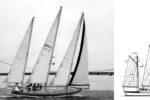
We made several modifications to the rigging. We moved newly designed chainplates outboard and through-bolted them to the hull for better support of the mast, and we attached longer spreaders to accommodate the shrouds. A longer, 14-foot boom provides more sail area lower down. And by adding a 6-foot spruce bowsprit to move the headstay forward and installing an inner stay, we converted White Dove into a cutter. The variety of sail options available has enhanced our sail performance.
Two thoughts
All of these items have proved effective, but in retrospect two thoughts are worth mentioning: first, a metal wishbone bowsprit might be more practical for walking out to handle headsails, and second, twin headsails, one placed just ahead of the other, would be a useful addition for running two headstays. We’ve covered many miles of downwind sailing.
We added running backstays to increase mast support when beating with the staysail. These proved to be a hazard and a hassle. We wonder now whether permanent stays behind the lower aft stays would have been better.
Many people were puzzled when we removed the wheel and converted to a tiller (most folks do the opposite). But we wanted to reduce the amount of friction on the windvane. Besides, a tiller can use a simpler, less expensive, autopilot. This gave us the luxury of owning three (believe me, you’ll use all of them). Most important, we had no steering cables to break.
However, we encountered a different type of steering disorder . . . our rudder sheared off! (See the July 2001 issue of Sail magazine for that story.) In New Zealand we fabricated a new rudder, using 2205L stainless steel for the shaft. This held up well for the remainder of our journey, but we also carried an emergency rudder that could be attached quickly. The best option for any spade-ruddered yacht is to install a Hydrovane or Autohelm windvane to act as a steering windvane and a second rudder. A compromise would be to convert the spade rudder to a half-skeg by creating a third attachment point.
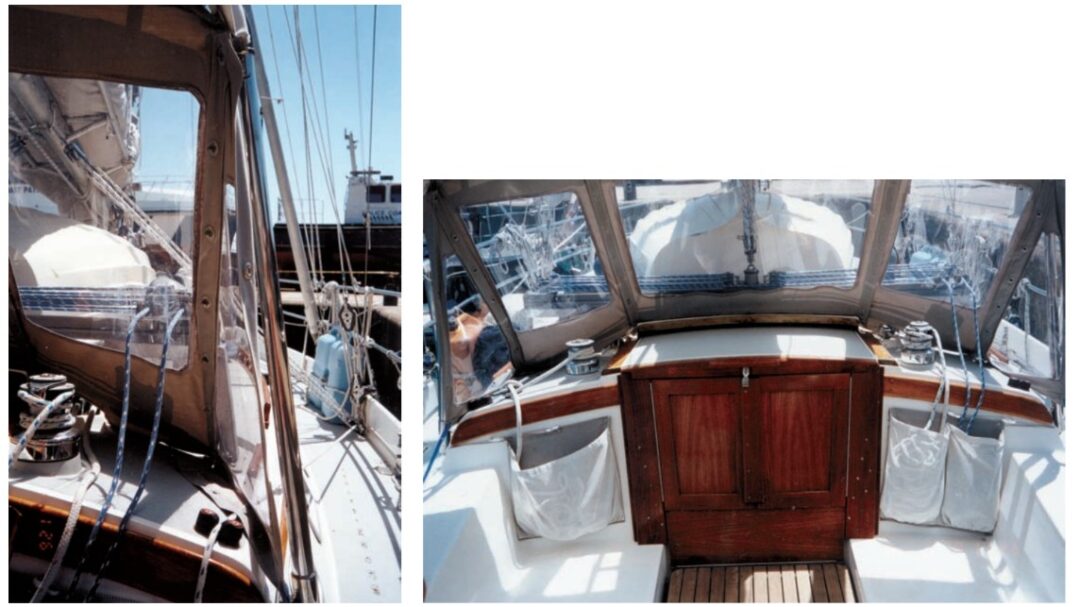
Traveler changes
On deck, we moved the traveler aft to accommodate our hard dinghy and installed a Catalina 42 track and traveler car with a 6-to-1 purchase, placing both control lines to starboard. To secure the boom, preventer lines with a 4-to-1 purchase, port and starboard, run from a mid-boom attachment to deck attachments behind the lower afts, out to the rails. The lines lead back to cabintop corners and are secured in large jamb cleats. This is convenient and effective for safely controlling the boom.
We constructed heavy teak doors for the companionway, retaining the dropboard slats. This was much more practical for going in and out, and it added strength and security in heavy weather.
One of our most ambitious alterations was glassing in the cabin sides, which came with stock, non-opening ports (except four) and installing 12 Lewmar Atlantic opening ports. We also replaced our small center hatch with a 24-inch-square hatch. These conversions have proved very valuable. Sufficient ventilation is a key factor to comfort in a tropical climate, but don’t forget to add several fans, good for circulating the air during rain squalls and on windless days.
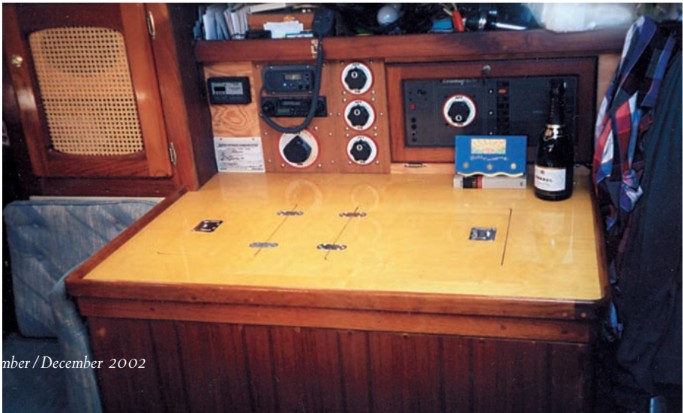
One last item of importance is refrigeration. We replaced the chart table with a new refrigerator/freezer and removed the unused nav seat. The new refrigerator top can still be used as a chart table. The original refrigeration locker gave us additional dry storage. Four inches of insulation surround the new box, and we installed a Technautics coldplate system. This worked flawlessly, even in the tropics, for three years, but went out on us during our longest crossing: up the South Atlantic from South Africa to Trinidad.
We ultimately discovered the problem to be the Aero-Quip line connectors. The valves became contaminated and restricted the flow of refrigerant. Nauti-Kol in Trinidad was able to fix our unit and recommends not using this type of valve.
Worth it?
Would we do it again? Should we have bought a boat (at twice the price) closer to our needs? No matter what the boat, Jerry still would have found an infinite number of projects to improve and restructure existing systems. Overall, our modifications greatly improved the functional effectiveness of our Catalina’s performance as a bluewater cruiser.
Taking on the many challenging projects to transform a Catalina 36 is not something most sailors are willing to do. But, this ambitious venture worked for us and gave us a safe, comfortable bluewater cruising boat to enjoy while sailing the many oceans of the world. We were rewarded with the enrichment and creation of magnificent memories and the fulfillment of a lifelong dream.
Thank you to Sailrite Enterprises, Inc., for providing free access to back issues of Good Old Boat through intellectual property rights. Sailrite.com