What you need under power, sail, and at anchor
Issue 53 : Mar/Apr 2007
When it comes to lights for sailing at night, small and medium-sized sailboats have options since several light combinations are allowed when under sail. In addition, the moment we start our engines we must also be able to show the lights of a motorboat. The regulations are exacting and complicated. As a result, there are many choices to be made when it’s time to replace your boat’s deck lights. Most humble sailors wish simply to be seen at night from as far away as possible without emptying their wallets or batteries.
Since the time that sailors abandoned oil lamps in favor of electric lights, there have not really been any significant technological changes . . . until the last year or two. Let’s discuss the rules and the available technologies for boats of less than 20 meters (65 feet 7 inches) in overall length. I’ll paraphrase the rules to put them into clear context, but you should have a copy of the Navigation Rules on board to read at your leisure. You must carry a copy aboard if your boat is more than 12 meters (39 feet 4 inches) in length.
The rules are the same for all sail-boats between 7 meters and 20 meters, except that for boats less than 12 meters the white lights have a 2-mile instead of a 3-mile visibility requirement. Sailboats of less than 7 meters (23 feet) are not required to have fixed lights. However, without them, sailors must instead carry a white light they can show “in sufficient time to prevent collision.” A power-driven vessel of less than 7 meters, whose speed does not exceed 7 knots, may, in lieu of sidelights, a stern light, and a masthead light, exhibit an all-round white light.
For all the colored lights we discuss, the visibility required for boats of less than 12 meters is 1 mile. For boats of less than 20 meters, the minimum visibility for colored lamps is 2 miles. For incandescent bulbs to have a 2-mile visibility they typically have to have a 25-watt rating for colored lamps and 10 watts for white lights.
Anchor lights
Almost every sailboat needs to be lit for three scenarios: sailing, motoring, and at anchor. Lighting a boat at anchor is the simplest. The minimum requirement is that you “exhibit an all-round white light where it can best be seen.” Many sailboats use a light at the top of the mast for this purpose.
Motoring
Whether we want to admit it or not, any sailboat with a motor running turns into a powerboat. The logic is that if the motor is running you have the ability to maneuver like a powered vessel. Motorboat lights are fairly straightforward, although the terminology can get a bit confusing.
Boats in our size range need at least three or four lights when motoring: a white stern light, two sidelights, and a masthead light. Here is where the terminology in the rules gets a bit complicated. What the rules call “side-lights” are the red and green lights most smallboat sailors call “bow lights.” The red and green sidelights can be, and frequently are, combined into a single lamp at the bow.
The “masthead” light is actually not usually at the head of the mast but rather about halfway up. It also is not an all-round light since it shows white light over the same arc as the red and green sidelights.
Under sail
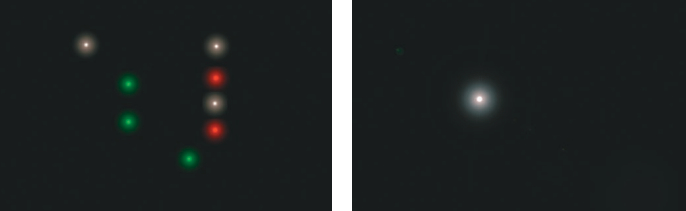
If we are sailing, we have options. This is handy but complicated. The most common arrangement is to show the red and green sidelights and stern light, just as a motorboat does, and to turn off the forward-facing white masthead light.
Boats less than 20 meters in length are allowed to combine the three lights “in one lantern carried at or near the top of the mast where it can best be seen.” This is most commonly known as the “masthead tricolor,” or simply as the “tricolor.”
One last rule allows a pair of allround lights, red over green, at the top of the mast in addition to the normal deck-level lights. This is rarely seen, but may become more common (see sidebar on Page 53).
Light logic
Why so complicated? It certainly seems needlessly so when approached from the standpoint of buying equipment and wiring your boat. In reality, however, the rules are about as simple as they can be and still convey all of the information needed to navigate around other boats at night while avoiding unnecessary complications.
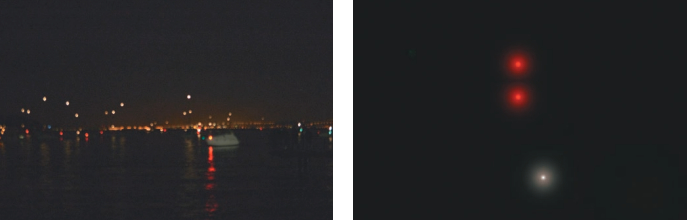
For example, while sailing at night you see a single white light ahead. You have no idea if you are looking at a vessel under oars, a powerboat, a sailing vessel, or even if it is anchored or under way. However, you have all the information you need to follow the rules of the road. Avoid it. The light might belong to an anchored boat or it might be the stern light of a vessel you are overtaking. No matter who is sailing and who is motoring, you must maneuver so as to avoid this boat.
In another instance, you are sailing when you see a red light ahead and to your right with a white light above it. You are looking at the forward, port side of a motorboat. When the skipper of that boat looks at you, he sees just your green light. You know he is a motorboat. He knows you are a sailboat. It should be clear to both that the motorboat should give way.
Are the situations always so clear? What if you see only two red lights: one above the other? You should be looking at a vessel that is “not under command,” one that is unable to maneuver and will have the right of way over almost all other vessels. Unfortunately, you might also be looking at the port bow of a sailboat skippered by someone who thinks “more is better” and has turned on his sidelights and his tricolor light. This just demonstrates the importance of knowing the rules and following them to avoid causing dangerous confusion.
Lights under power
If your sailboat has an auxiliary engine, you must have sidelights, a stern light, and a white “masthead” light. You will also need a white all-round light as an anchor light. Is it worth the additional expense for a tricolor? The answer is the classic answer to so many questions: “It depends.”
On the high seas, a combined tricolor light at the top of the mast will give better visibility than sidelights that are close to deck level. With a tricolor, you get the lights up high, away from the waves and any potential blanketing by your sails or other rigging.
The situation is not so clear in coastal cruising. From the high bridge of a large ship, a light at the top of a sailboat’s mast might be lost in the background of city lights. To someone who is looking down from above, the deck level lights may stand out against the dark water more clearly.
I prefer to have both deck-level lights and a tricolor. This gives my boat a built-in backup system so I won’t have to be out there changing a light bulb in the middle of the night to avoid getting run down.
One of the ongoing arguments that flares up (so to speak) whenever cruising sailors discuss lights, is the subject of strobes. Strobe lights are allowed on boats only as distress signals, and then, only under the Inland Rules. However, many sailors feel that these lights are more visible and, therefore, more likely to attract attention. The rationale for not allowing them is to prevent even the remote possibility that a ship’s navigation light be mistaken for an aid to navigation.
Two types of lights dominate the market these days, incandescent bulbs and light-emitting diodes (LEDs). Incandescent bulbs are more common, simpler, and easier to troubleshoot. LEDs are more expensive but use less power and, if properly designed, last almost forever. This seems like the same trade-off we face when selecting other equipment for our boats: more money gives better performance. Technology changes quickly, and the relative costs have changed dramatically in the last year or two.
As an example, consider the cost calculations and decisions we made recently when upgrading the lighting and internal mast wiring on our boat.
Our plan
For all the reasons listed above, we decided to go with both deck-level sidelights and, at the top of the mast, a tricolor light for sailing and an all-round white light as an anchor light. For the top of the mast, LED lights attracted me. They had allure because of their low power requirement and because their long life would reduce the need to get to the top of the mast to change light bulbs. The cost of the fixtures I had seen seemed to price them beyond what I was willing to spend. However, my calculations changed as I started to investigate. Because the wiring, switches, and fixtures in our mast were all 30 years old, it was time for the whole system to be replaced. As I started to investigate the parts needed for a replacement system, I discovered that LEDs had other advantages I had not considered.
Starting with the fixture itself, a combined anchor and tricolor using incandescent bulbs suitable for a boat of up to 20 meters, costs about $180. A similar LED fixture from Orca Green Marine costs $239 ($269 if you add the photo sensor to automatically turn the anchor light on at dusk and off at dawn). There are many more companies in this field than there were just two years ago. Competition is intense and prices are likely to come down further, but for now it looks like you save money if you install the incandescent light, right? Not so fast.
The incandescent bulb draws 25 watts (2 amps) while the LED fixture draws only 6 watts (0.5 amps), so you can use smaller-gauge, cheaper wire. Additionally, you can use two-conductor wire for the LED but you will need three conductors for the incandescent fixture.
In our case, from the distribution panel, up the mast, and back again, totaled 130 feet for the total length of the circuit. Limiting the voltage drop to below 3 percent for this extensive run at 2 amps needs 10-AWG wire. At an LED’s draw of 0.5 amps, you can use 16- or 18-AWG wire. Sixty-five feet of 3-conductor 10-AWG marine cable will cost about $170. The same wire in 2-conductor 16-AWG costs only $70. Aha! It’s going to be cheaper to install the LED light. But wait, we’re not done yet.
Anchor-light draw
While lying at anchor in some beautiful tropical lagoon, you probably will generate much of your power with solar panels or a wind generator. If your 25-watt incandescent anchor light is on for 10 hours a night, you will need to generate 20 amp-hours of electrical energy per day to keep your batteries charged. Replace your anchor light with an LED light that draws 6 watts, and you will need to supply only 5 amp-hours a day.
How do you get away with only two conductors with the LED combined tricolor and anchor light? Just like regular diodes, LEDs allow current to flow only one way. When current flow is in one direction, the tricolor lights, and when flow is in the other direction, the anchor light is on. An inexpensive double-pole, double-throw switch is needed to implement this arrangement. These switches are available from the manufacturer of the fixtures, if you cannot find a local source.
Our installation
We installed an LED fixture that combined a tricolor and a photocell-controlled anchor light. We did not install a strobe because we felt the times when it would be used did not justify the extra complexity and expense.
We had working wiring and fixtures for our deck-level lights so we decided to keep them for the time being. LED fixtures are becoming more affordable for this application as well, but they still have a way to go. Prices are coming down so fast that the situation may be different by the time you read this. Right now the cost advantage is still with conventional fixtures for this application, mostly because of the shorter lengths of wire needed. Other advantages of LEDs are also not as critical here. Bulb life is not the big deal it is when the bulb that must be changed is at the top of the mast. Also, power draw is not as significant because much of the time when we are using these lights we have the engine running and we have power to spare.
We chose what we believe to be the most efficient, economical, and reliable combination of lights for our boat. Our documented length is 39.4 feet overall, therefore we are technically allowed to use lights with a visibility range of 2 miles. But we did not even consider this as an alternative. Being seen is what navigation and anchor lights are all about. The small cost and power saving associated with smaller lights is not worth the risk, no matter what size boat you have.
Once you have installed the right lights on your boat, use them correctly by lighting the correct lamps under the conditions calling for them. It seems like a small thing, but understanding the lights around you at night pays big benefits in staying safe in busy waters.
Thank you to Sailrite Enterprises, Inc., for providing free access to back issues of Good Old Boat through intellectual property rights. Sailrite.com