After 10 years of cruising, a Yankee family still lives its dream
Issue 26 : Sept/Oct 2002
Our dream to live the cruising lifestyle started, oddly enough, high in the Rocky Mountains. We were a young couple with no boat, no money, and virtually no sailing experience. That didn’t stop us. We knew we could eventually obtain those things. So we started with more important things — the qualities we knew would help us make our sailaway dream a reality — qualities such as independence and an adventuresome spirit and perhaps the most important quality of all, a belief in ourselves and our dream.
So how did we go about finally getting sailing skills, money, and a boat? Educating ourselves about cruising and sailing was fun, fairly inexpensive, and involved a simple contribution of our time. Reading was a great way for us to start out. Boat. shows added to our growing knowledge. On-the-water experience was slowly gained when we bought a 1976 Balboa 26 to sail on Colorado’s Lake Dillon in the summer and Utah’s Lake Powell in the winter. We also knew that we didn’t need to know it all before we started cruising, thank goodness, because we’re still out there learning after more than 10 years of liveaboard life.
- The money: We never had much of that and probably never will. But we learned that we can substitute hard work for cold cash. We also know that despite what magazines, manufacturers, and retailers tell us, we don’t need it all. In fact we’ve learned how little we actually do need.
- The boat: With our budget, we knew we would need to find a good, old boat. We would pay in blood, sweat, and tears as well as with our hard-earned money.
Getting closer
A few years after the conception of our dream we moved a little closer to sea level with the hope of finding and moving aboard our dream boat. We were now a family of four, as our two daughters had arrived several years before. Wisconsin was our home state and seemed a great place for the next phase of our dream. We started looking for an older fiberglass sailboat. We thought a center cockpit would be safest with two young children aboard, and we wanted an aft cabin to provide some privacy.
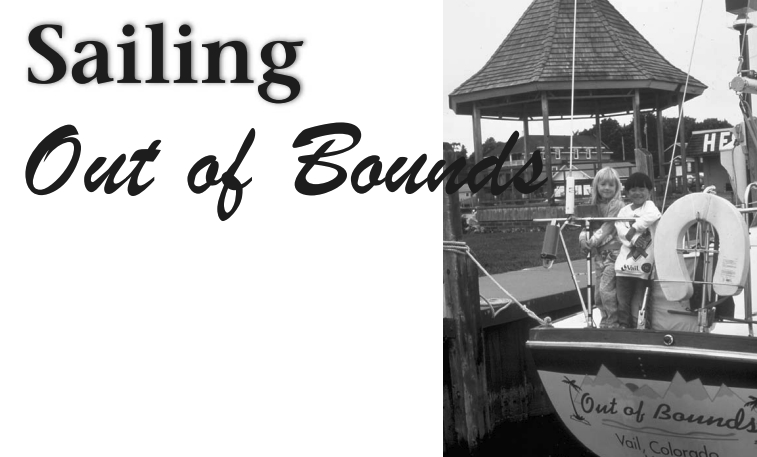
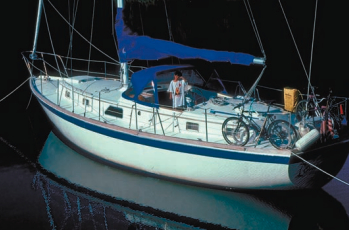
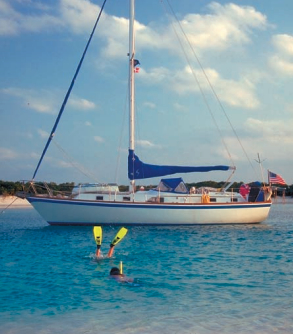
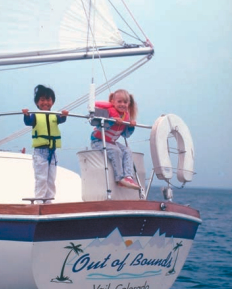
In 1990, we found our boat, a 1974 Gulfstar 41 sloop we named Out of Bounds. She was a strong, well-built boat that needed lots of cosmetic work and a few upgrades. But the price was right. At the end of April, my husband, Tom, and I sailed her from her slip at the Grosse Point Yacht Club, near Detroit, to her new home on Lake Michigan’s Green Bay.
We spent a week sailing her home and moved aboard immediately. Ours was the first boat in the water at our marina that spring. Tom headed off to work, and I began my first day of liveaboard life, a day I had dreamed about for years. Unfortunately, about an hour after Tom left we had a freak spring snowstorm that left about six inches of heavy wet snow behind. We had an electric heater that valiantly tried to keep up with the falling temperatures. But every time the wind blew, our shorepower cord (which had a slight defect, I think) fell out of the boat’s receptacle. I would have to decide — should I open the hatch and let all the cold air in so I can plug the power back in? Or should I wait until the temperature in the cabin drops and I have to go out and plug it back in?
Listing pier
Once when I was outside plugging the cord in, I noticed that the finger pier we were attached to was now listing at a 45-degree angle. I wondered how long the pier would stay attached before our boat and the pier drifted off down the river. I was fairly certain I wasn’t yet ready to try moving the boat single-handedly to another slip — especially in a blizzard. I tried calling the marina on the VHF, but they weren’t officially open yet, and no one responded. I would have to go for help. But I couldn’t leave our two three-year old daughters alone on a boat that might break loose.
I bundled up the girls in their snowsuits and got them in the cockpit. We couldn’t get off the boat and onto the finger pier because we’d slide into the water. So I walked one daughter to the bow. I jumped off the bow onto the main dock and had my daughter jump into my arms. I walked her to dry land and instructed her to stay put. I went back for daughter number two. In decreasing visibility, we walked across our private island home, crossed a footbridge and found help at the marina office.
Back at home again with our boat now secured to a concrete bulkhead, I put the girls down for their naps. The wind had stopped, the storm had passed, and the sun came out. The May temperatures quickly rose into the 40s, and the snow began to melt. The boat began to leak. I reached into my hanging locker to get another sweatshirt and found I had to wring out the sleeve. I sat down in the main saloon and watched a river of water coming down the mast. Yet all I could think was: I’m living aboard a sailboat. This is the most wonderful life anyone could imagine. And I meant it. I’ve never forgotten that wonderful feeling.
More storage
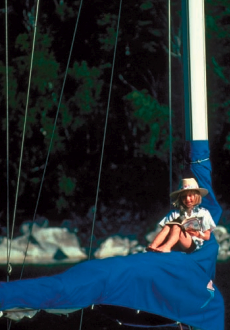
Our first upgrades to Out of Bounds came that following winter while she was hauled out. We tore out the forward head and shelves and added drawers to increase storage. A diesel heater was installed to provide heat, and the old alcohol stove was replaced by a three-burner propane stove and oven. I get nauseous just priming an alcohol stove. After 10 years of daily use, our Force 10 propane stove is still cooking up great meals and has never given us any problems.
I primed the aluminum mast and painted it white, which improved the looks belowdecks. We added a mast boot to keep the water out. We soon learned everything there was to learn about the fine art of caulking.
We had new cushions made for the main saloon. The old cushions had no “cush” left and had been upholstered in the lovely 1970s color scheme of olive green and orange (by then quite faded). One mistake I made here was in the color choice of the new fabric. Everything I read about living aboard suggested using light-colored fabric to avoid a dark and dreary living area. My first inclination was to go with a darker fabric that would hide dirt and stains — we did have two toddlers, and spills were inevitable. But I didn’t want that claustrophobic feeling the books warned me about, so I choose a beige fabric. I soon discovered I should have gone with my gut instinct. Over the next few years the cushions began showing a bit of engine grease from Tom’s wayward finger, a pink Kool-Aid stain, and many other signs of an active family of four living aboard.
Cruising kitty
Spring arrived, and we launched Out of Bounds. Our immediate goal was not to sail off to the far corners of the globe. We spent the next couple of years attached to our shoreside commitments, mainly a paying job that was building up a cruising kitty and paying for the boat.
But every weekend from May through September, we were out cruising. We explored Green Bay, enjoying the Door County anchorages. We spent a month cruising Lake Huron’s North Channel every summer. These years offered great lessons in living aboard. We learned how our boat systems worked as well as how to maintain and repair them when necessary. We learned how to anchor in a variety of bottom types and weather conditions. We practiced anchoring and hoisting anchor under sail. We learned how to dock in currents. We increased our knowledge of navigation.
In 1993, we made our next big move. We spent six months sailing up Lake Michigan through the North Channel and Georgian Bay, transited the Trent-Severn Waterway, crossed Lake Ontario, joined the Erie Canal, sailed down the Hudson river out into the Atlantic, down the Chesapeake, and into the Intracoastal Waterway, which took us to our new home in North Carolina.
For a Yankee family, this state was full of surprises, all of them a sailor’s delight. We sailed up creeks, yes creeks — some of which are navigable for many miles. Rivers host regattas and can be sailed for 10, 20, even 30 miles or more. Pamlico Sound, one of the largest enclosed bodies of water on the East Coast — second only to Chesapeake Bay — often holds so little water that I swore it would be easier to walk across than find enough water to sail in.
And then there was the ocean, beckoning some days with her gently rolling waves and brisk salty breezes and warning us away on others with ferociously growling breakers and storm-force winds. Waters teemed with creatures previously unknown to us. Shorelines here were draped in Spanish moss and overhung with live oaks. Uncrowded anchorages abounded.
Wild horses
We choose to live at anchor. One of our favorite anchorages was in Taylor Creek in Beaufort, N.C. Along the southern shore of the creek is Carrot Island, home to about 30 wild horses. Our daughters quickly made the island their backyard and “adopted” the wild horses. Dolphins were frequent visitors to our anchorage and once entertained us with our own private dolphin show. For hours we watched the 20 or so bottlenose dolphins, some accompanied by their young, as they leaped, splashed, and showed off for us.
In July of 1996, our idyllic North Carolina anchorage was rocked by the first of seven hurricanes that Out of Bounds would endure over the next few years. She was unharmed during our first-ever hurricane, big bad Bertha, although boats all around her were sunk or thrown against the shore.
But we weren’t so lucky when Hurricane Fran hit us in September of that year. Despite our best preparations, Fran pushed our boat into about three feet of water. Since we draw five feet, we returned to find her at a rather disconcerting angle and showing off a bit more bottom than seemed appropriate. Furious Fran had left her with a variety of deep scratches in her gelcoat and a bent shaft. Fortunately we were insured, as the cost to “refloat” Out of Bounds (at the usual cost in our area of $100/foot) meant we had a bill of $4,100 before we were even hauled out.
Once hauled out, we decided that would be a great time to do many of the major projects we had been hoping to do. First on the list was painting her topsides and deck. This meant taking off — screw by screw and bolt by bolt — every piece of hardware and gear on the boat: rubrail (which we replaced), winches, ports (which we also replaced), teak handrails, cleats, hatches, and so on. I’ll let the numbers paint a better picture. It would have cost us $13,000 to have the boatyard repaint topsides and deck. But by doing all the work ourselves, including sanding and priming and letting the yard spray on the two-part polyurethane paint, we reduced our costs for material and yard labor to about $1,000. But the $12,000 in savings was hard earned.
Boatyard delays
This was time-consuming work, and we were often delayed. First we had to wait three weeks for the insurance adjuster to arrive. (“Don’t touch anything, I need to see the damage.”) It was understandable considering the massive destruction done by Hurricane Fran. The weather rarely seemed to cooperate — perhaps because we needed perfect weather — which, naturally, we had while waiting for the insurance adjuster. Too cool, too hot, too windy, wind from the wrong direction, just rained, might rain, pouring rain.
Worst of all were our own delays (spending an hour looking for the right tool, forgetting to recharge the cordless drill, thinking we had another box of stainless-steel screws when we really didn’t, and the hardware store was closed.) Since Tom was working fulltime, we realized we were going to be in the boatyard for a long stay. And being in the boatyard tended to make our to-do list grow bigger, rather than smaller. Now was the time to “just do it,” we decided. We ended up living in the boatyard for a year.
Six years had passed since we first had the cushions reupholstered. With a family living aboard full time it was that time again. This time I chose a dark blue fabric and have been happy with my choice ever since. We are fortunate that Out of Bounds has plenty of ports and hatches that let in a great deal of light. We also have very little dark wood below, so even with the dark fabric (brightened with some throw pillows) she has never appeared dark or dreary below.
One day, while the cushions were out being reupholstered, I found myself staring at the white plywood back to our settee, which was normally hidden by a cushion. What was behind it? A small hole drilled in the wood revealed empty space. Empty space! On a cruising boat that’s like hitting the jackpot. Tom enlarged the hole and installed a shelf the length of our six-foot couch. That empty space is now my “pantry” and is accessible by moving the cushion.
More work
Tom also did a variety of other projects in the boatyard. He built bookshelves, a stern storage box for our propane tanks, an anchor platform with anchor mounts and rollers, and replaced our inflatable’s floorboards. Our old heavy-duty Singer sewing machine was running fine on an endless supply of 110 volts, and we kept busy with various projects — repairing an awning, sewing a new mainsail cover, making winch covers, and so forth.
Tom, with the help of a diesel mechanic, rebuilt our Perkins 4.107 diesel. We finished up by coating the bottom with enough antifouling paint to last a couple years in tropical waters.
When we relaunched in the fall of 1997, Out of Bounds looked great. We headed south to the Bahamas. Since then we have done a few other upgrades as time and money allowed. We’ve added some equipment such as an SSB radio with a modem that allows us to send and receive email. We replaced the ancient roller furling gear and the headsail.
We also added a solar panel and a wind generator. Once we had plenty of electricity (well, actually, there never seems to be enough), Tom built a refrigerator/freezer. After 10 years of liveaboard life without refrigeration, this was a great addition.
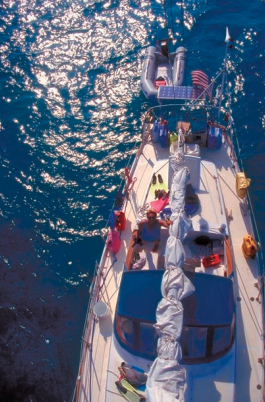
Mostly we’ve continued to cruise. Our latest adventures have taken us back to the Bahamas and on to Cuba, Mexico, Belize, and the Rio Dulce of Guatemala.
Our sailaway dream began the moment we moved aboard Out of Bounds. For us, living aboard and cruising is a lifestyle. It’s not a vacation or something we do on weekends. And we didn’t wait until that elusive day when we could afford a new boat equipped with all the latest gadgets to begin living our dream. Instead we found an affordable boat, and we did without many conveniences that most people take for granted.
Better beer
But now, believe me, that frosty beer from the fridge tastes all the better when we sit in the cockpit watching the sun go down off the second longest barrier reef in the world after a great day of diving.
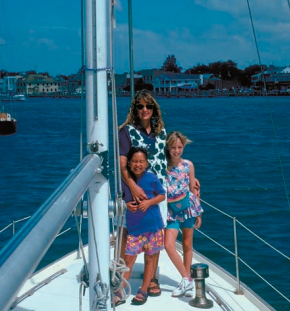
The cruising lifestyle has given us the opportunity to spend time together as a family — time for our kids to really know us and time for us to truly know our children. Homeschooling our daughters has brought a wonderful joy to our lives. I can’t imagine a better way to raise a family.
As I think back on our years of cruising, I realize that it wasn’t money or sailing skills or even owning a boat that made our dream a reality. It was the qualities of independence, an adventuresome spirit, and the belief in ourselves and our dream. And we’ve always known that whether we’re living in a marina tied to shoreside commitments or dropping the anchor inside a coral atoll, we’re living our dream of sailing Out of Bounds.
Thank you to Sailrite Enterprises, Inc., for providing free access to back issues of Good Old Boat through intellectual property rights. Sailrite.com