Mate narrow Grade 43 chain with heavy-duty shackles
Issue 60 : May/Jun 2008
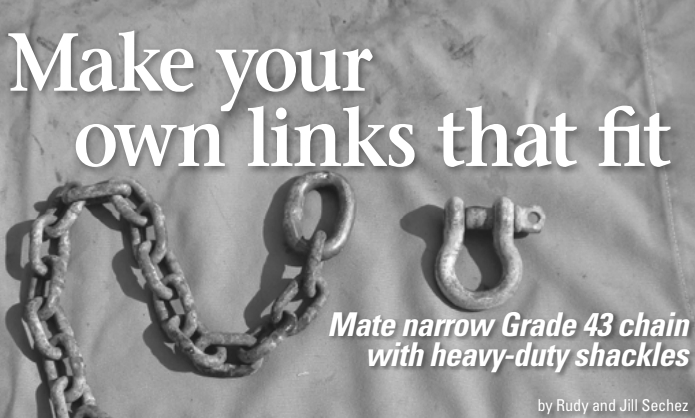
Eleven years ago, as we were completing our first cruising boat in our backyard, our thoughts turned to the ground tackle that we would be using. We wanted to use 5⁄16-inch high-test, Grade 43 (also called Schedule 40) chain, since it is lighter and cheaper than equal strength proof-coil chain. The major drawback with this Grade 43 chain is that its links are too narrow to accommodate shackles that are strong enough to match the chain’s strength.
How incongruous, we thought, to use chain with a working load of 3,900 pounds, an anchor that will be able to hold the boat in extreme conditions, and then join the two together with an under-strength shackle. To match this chain’s 3,900-pound working load, a 1⁄2-inch shackle is needed, but this shackle’s 5⁄8-inch pin is too fat for the chain’s 1⁄2-inch width. After taking four years to build this boat, we did not want to trust its safety to understrength shackles.
We began looking for a solution to this dilemma. Frank Luke, the manufacturer of the 3-piece, fisherman anchors, gave us the solution. He suggested that we install oversized links in the ends of the chain. He said this would allow the use of large enough — thus strong enough — shackles. He noted that we could do this locally, as any welder would be capable of making these links.
We implemented Frank’s idea and these oversized links allowed our 36-foot, 28,000-pound wooden cutter to be safely anchored through three 120-knot hurricanes, two 80-knot hurricanes, and many storms.
Installed again
We were so satisfied with the job these oversized links did for us that we installed them on the 34-foot, 28,000-pound troller that we built next. Like our previous sailboat, this boat has already held us safely at anchor through a 120-knot hurricane. Because we stayed aboard for these storms, we have had a firsthand look at the necessity of using gear hefty enough for the conditions. If these oversized links can handle conditions this severe, we are more than comfortable using them when lesser demands are placed on them. We’re believers in the old Maine proverb that says: “Nothing too strong ever broke.”
To have oversized links fabricated, take the chain (and a matching strength shackle) to a welder and, using the largest diameter stainless-steel rod that will fit through an end link in the chain, have the welder form, then insert and weld shut oversized links in the ends of the chain. Make sure the oversized links are large enough to accommodate the shackle’s pin. Even better, have the link made long enough to also accommodate one of the shackle’s eyes; this will allow more flexibility when coupling the shackle to the chain and other components in the system.
For 5⁄16-inch Grade 43 chain, using 1⁄2-inch rod, a link with an inside diameter of 3⁄4 inch by 13⁄4 inch is large enough for a 1⁄2-inch shackle, while not being overly long or too wide.
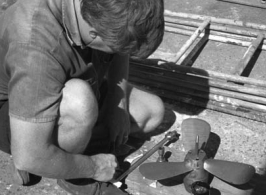
Oversized links are surprisingly easy to make. If you wish to make them yourself, for 5⁄16-inch chain, weld two 3⁄4-inch by 2-inch pieces of round rod on end to a piece of scrap metal, 1⁄4 inch apart. Bend the rod around this form while you are heating it. Bevel the ends of the rod before welding them together to get a strong weld. If in doubt, make the links longer but never narrower.
Plain steel too
In addition to stainless steel, galvanized rod or plain steel rod can also be used for oversized links and, if necessary, painted to control rust until the entire chain needs to go for re-galvanizing.
The first time we used galvanized rod to make oversized links, we found that the rod was slightly too fat to fit through the chain’s link, due to the layer of galvanizing. A welder told us to stand the link on end and hit it with a sledge hammer once or twice, just enough to widen the link that one-hundredth of an inch needed for clearance. We have since used this technique many times and, even after several hurricanes, have not seen any detrimental effects on the chain from being widened in this manner.
These do-it-yourself oversized links usually do not turn out looking very pretty, but they work.
Special high-strength fittings are available that are sized to fit and match Grade 43 chain in strength. We have used them, but we find that they are limited in choice; are often indistinguishable from their weaker, look-alike cousins; are often expensive; are seldom galvanized; and often will not mate with the other components in our ground tackle, particularly the anchors that we use in heavy weather, just when we need them the most.
For us, the slight cost ($30 to $40) to install oversized links is insignificant when compared to the liabilities that we associate with these special fittings. Therefore, we prefer the oversized links.
Occasionally, we receive a request to install oversized links in proof-coil chain. Galvanized shackles and the other galvanized fittings are designed to fit proof-coil chain and match its strength. As such, proof-coil chain would derive no additional benefit from installing oversized links. However, oversized links can be beneficial in any of the different sizes of Grade 43 chain; the only difference is the size of the rod that is used to make them.
Keep them greased
Always grease the threads on shackles to keep from requiring a hacksaw or a couple of pipe wrenches to take them apart after the threads rust.
The first time we loaded our chain in our boat, we were chagrined to discover that we failed to consider the size of the deck pipes that would be needed to let the chain pass through the deck. As we had installed a pair of oversized links at the 100-foot mark in our chain, this was an important oversight.
If the oversized links are not made too fat, the large oval (2 1⁄2-inch x 3 3⁄4- inch ID) and the large round (4-inch) deck pipes, it turns out, are adequate for 5⁄16-inch chain, its oversized links, and the accompanying 1⁄2-inch shackle. We do find the round deck pipe allows the oversized links and 1⁄2-inch shackle combination to pass with less interference than does the oval pipe.
This can be an important factor when anchoring or weighing anchor in less-than-calm conditions, but either type deck pipe is better than none. These large deck pipes are so beneficial that we do not hesitate, when necessary, to alter our boat or its equipment to install them. When adequately sized deck pipes are not available off-the-shelf, they can be fabricated by a welder using stainless-steel, bronze, or aluminum pipe, tubing, and plate. Those with the desire can also make them out of fiberglass and resin. An internal diameter on these deck pipes that is too big will be less trouble than one that is too small.
Oversized links have worked for us, having allowed the use of galvanized shackles, swivels, and other fittings large enough that their strength matches the chain’s strength. Additionally, these fittings are reasonably priced, readily available and large enough to be mixed and matched with the rest of the components in our ground tackle, allowing us to assemble the gear according to the varying conditions found when anchoring.
Rudy and Jill Sechez have lived aboard and cruised for 10 years, beginning with a 36-foot wooden cutter they built, and currently with a 34-foot sail-assist troller yacht they designed and built. They finance their cruising by working when funds run low . . . mostly on boat-repair projects. They write for pleasure.
Thank you to Sailrite Enterprises, Inc., for providing free access to back issues of Good Old Boat through intellectual property rights. Sailrite.com