Boat ownership triggers the gene for self-reliance
Issue 123: Nov/Dec 2018
Acknowledging a bit of hyperbole, I think that Kenneth Grahame’s Water Rat was right: “. . . there is nothing — absolutely nothing — half so much worth doing as simply messing about in boats.” But what’s the attraction of messing about in boats?
We live in a world far removed from our agrarian ancestors. We’re often reminded that they grew and raised and harvested what they ate, but not so often reminded that they lived in a world that required them to fix, by themselves, things that broke. Being a problem solver, being handy with tools, and having a broad knowledge base — these were valued traits and necessary to survive.
Oh, how far we’ve come.
In today’s world of specialization, it no longer makes sense (at least not financially) to even change the oil in our cars ourselves. Today, when an appliance breaks, that’s often when it gets replaced, not repaired. And if it does get repaired, it gets repaired by someone else. Need a new roof? Call a roofer. Pipe leaks? Call a plumber.
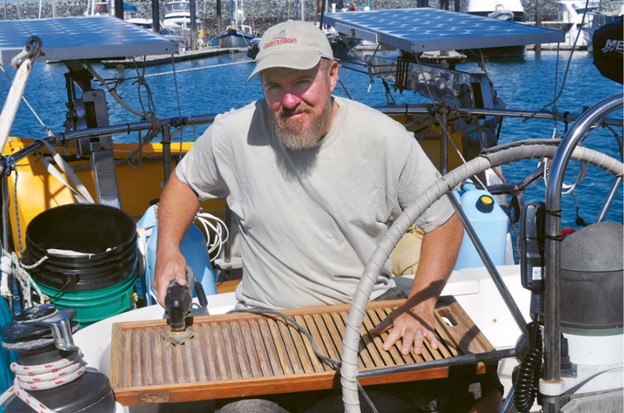
But boats take us back, no matter who we are. Only in the most rarefied circles do boat owners not tend to the basics of maintenance and repair. Sure, there are boatyards, and all of us need to rely on their expertise and resources from time to time, but for most of the things that demand a boat owner’s attention, it doesn’t make sense to do anything else but roll up the sleeves and take care of them. We may bring our Chevy, Ford, Honda, or Toyota to Jiffy Lube every 4,000 miles or so, but when the fluids need changing in our Atomic, Perkins, Universal, Westerbeke, or Yanmar auxiliary, we get out the wrenches and get to work.
And we know this going in; there are no surprises. When most of us buy a home, we don’t then buy a library of books and begin educating ourselves on drywall taping, tree-trimming, framing, and AC repair. But within weeks of buying a new-to-us 20-year-old sailboat, we’ve acquired every book ever written by Calder, Casey, Leonard, and others. And armed with the knowledge contained within those covers — knowledge that may never serve us beyond our boating lives — we do unthinkable things, like tackle projects well outside our comfort zones. We learn to be careful when we mate dissimilar metals, and we buy our first tub of LanoCote. When the first electrical gremlins stir, we get a multimeter, tinned wire, and a set of 12-volt connectors and learn about amps, ohms, and volts. Soon we own a respirator and we’re mixing epoxy.
But so what?
In lives where we often don’t make even our own coffee, a boat can be a bastion of the arts of self-sufficiency and self-reliance that are increasingly difficult to acquire. Boats are outlets in that sense, even when we’re not fixing them, but using them. We may no longer crank our car windows up, but to crank on a winch to raise or trim a large sail, and to then feel the boat surge ahead as a result . . . that’s pretty neat. And that same winch turned and clicked smoothly not because you called the Maytag repairman to service it, but because last year you bought a pair of snap-ring pliers and, under Don Casey’s gentle guidance, tore down that winch yourself and applied fresh grease and new pawl springs. What could be half so much worth doing as that?
Thank you to Sailrite Enterprises, Inc., for providing free access to back issues of Good Old Boat through intellectual property rights. Sailrite.com