The pretty pricey princess of production fiberglass sailboats
Issue 68 : Sept/Oct 2009
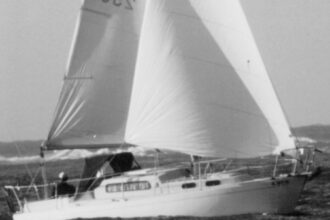
Say “B 40” in any yacht club bar and everyone, with perhaps the exception of an unrepentent powerboater, will know you’re referring to the William Tripp-designed Hinckley Bermuda 40, which may be the best-known production sailboat ever made. It certainly has the distinction of having the longest production run for an auxiliary sailboat in U.S. boatbuilding history. Over more than three decades, from 1959 until 1992, the Hinckley Company built 203 Bermuda 40s.
In his book, The World’s Best Sailboats, Ferenc Máté flatly states that the Bermuda 40 is “. . . without question the greatest fiberglass sailboat of all time.” My own experience sailing Hinckleys — both the Bermuda 40 and the Sou’wester 42 — leads me to agree. A tour of the Henry R Hinckley & Company boatyard in Southwest Harbor, Maine, some years ago dispelled any lingering questions I might have had about Hinckley quality. Hinckley does its best, and its best is top-notch.
The review boat
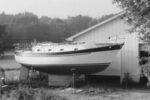
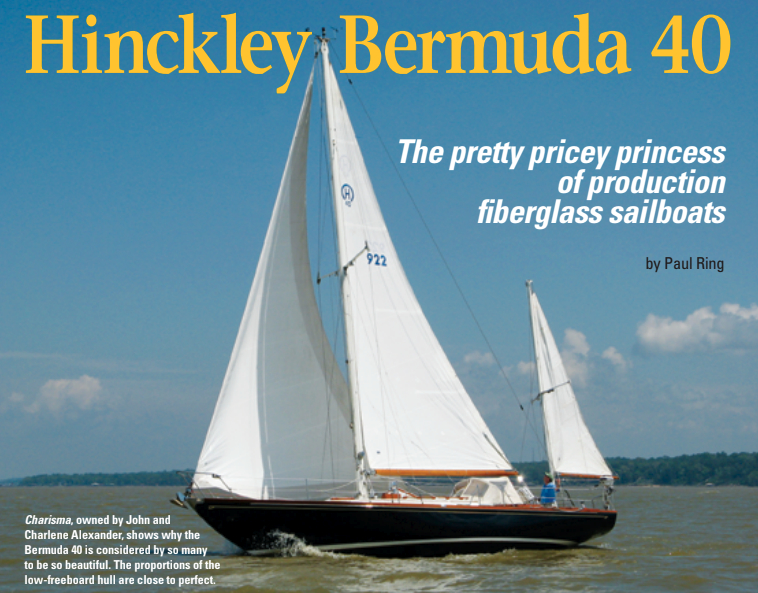
John and Charlene Alexander own Charisma, Bermuda 40 hull #17, built in 1961. Although elderly, she’s as beautiful now as she was when new. When they bought her in September 1993, however, Charisma’s faded blue hull wore the accumulated scrapes and scratches of 32 years, her interior was a little threadbare, and some of her systems were tired.
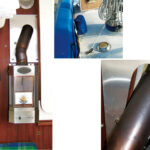
For 12 years, John daysailed and cruised along the northern Gulf Coast while gradually repairing and replacing the items in most urgent need. His ultimate goal was to restore Charisma cosmetically and mechanically to her original glory. After a false start with a local freelance worker, John looked into the restoration services provided by the Hinckley Company and sent Charisma home in 2005 for a complete exterior refinishing. She also received a new engine, electrical and electronic systems, and a water heater. More than a year later, Charisma was returned to her owners in pristine condition.
With advice and help from his friend and fellow B 40 owner, Will Blackburn, John continued where the Hinckley people left off. Items such as floorboards and ceiling strips that could be removed he took home to his garage for refinishing. The remainder of the interior he refinished in place, completely and beauti-
fully, then had all the cushions re-covered in a beautiful deep red fabric. The outcome is that John and Charlene now own a brand-new 1961 Hinckley Bermuda 40.
Design
The Bermuda 40 is nearly a clone of Bill Tripp’s earlier Block Island 40, built by American Marine in Rhode Island during the 1950s and ’60s. One subtle difference is that the BI 40 has a stepped coachroof, whereas the B 40’s is flat. Another is in the transoms: the BI 40’s transom slopes forward toward the waterline in the style of the era while the B 40’s is quite close to vertical.
The B 40’s shoal draft (4 feet 1 inch with the board up) contributes greatly to its appeal in many areas of the country. However, shoal draft means the designer must give up the ultimate stability obtained from hanging lead on the end of a deep keel. Instead, he must gain righting moment from form stability, which derives from the shape and dimensions of the hull, an essential part of which is greater beam. Although the B 40’s 11-foot 9-inch beam is not great by today’s standards, it is substantial and keeps her on her feet. The design is influenced by the Cruising Club of America (CCA) Rule that favored relatively short waterlines and long overhangs. A sweeping sheerline connects the bow to Bill Tripp’s trademark counter transom, which is radiused and nearly vertical.
The full keel, with its slightly cutaway forefoot, houses the centerboard entirely and keeps it out of the accommodation space belowdecks. The rudder is attached to the end of the keel and is protected by it.
With its short waterline, broad bilges, shallow draft, and centerboard, the B 40 does not go to weather with more modern designs, nor will it tack as nimbly. Crack off the wind a bit, however, and performance greatly improves. The full keel and centerboard make it easy to balance on reaches — a boon for the helmsman or autopilot.
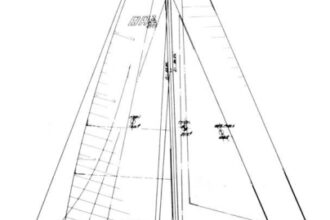
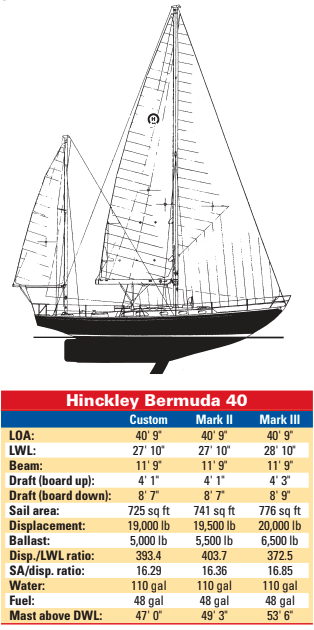
Over the years, Hinckley offered three sequential versions of the B 40, although the hull shape never changed. The original is called the Bermuda 40 Custom. It was followed by the Mark II and Mark III versions. The Custom and Mark II versions were built with a yawl rig only; a sloop rig was added as an option with the Mark III.
The principal differences among the three versions were in the rig. In the late 1960s, the height of the mainmast was increased a bit over 2 feet, adding 16 square feet to the sail area. Under the water, the bronze centerboard was given a more sophisticated airfoil shape. Boats with these changes were designated as the Mark II.
In 1972, Hinckley introduced the Mark III, in which the mainmast was moved aft by 2 feet and its height was increased by another 4 feet 3 inches. The mainsail was given a higher aspect ratio and the overall sail area increased by 35 square feet. To balance this, the ballast was increased by 1,000 pounds, immersing the hull an additional 2 inches and adding 1 foot to the waterline. These changes had the intended result of making the Mark III the best performer of the three versions.
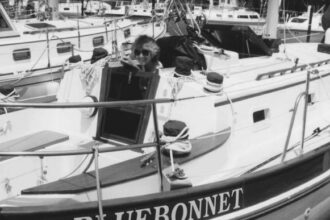
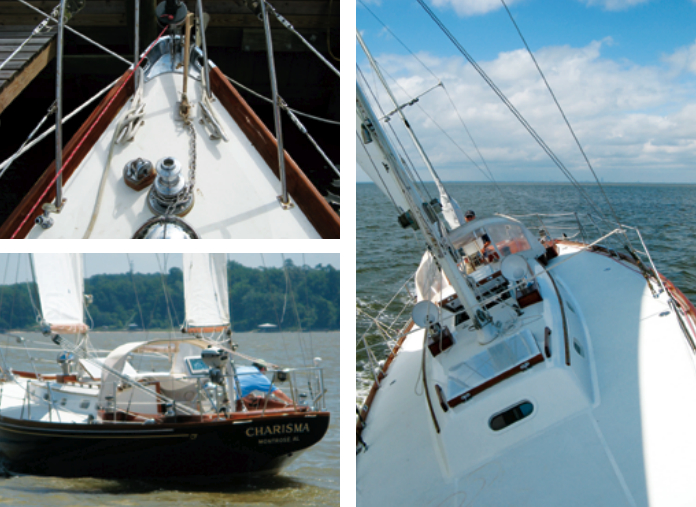
Wide sidedecks, a large uncluttered foredeck, and a long and low coachroof make movement on deck easy and visibility from the helm excellent. The cockpit seats are long and wide enough for sleeping under the stars; however, the rather straight-backed coamings can become uncomfortable. Openings in the coaming boards provide stowage for winch handles and other small items and two good-sized cockpit lockers accommodate bulkier items, such as fenders and docklines.
To invoke Ferenc Máté again, this time from Volume II of The World’s Best Sailboats, he describes the Bill Tripp-designed Bermuda 40 as “. . . arguably one of the most aesthetically balanced sailboats ever drawn . . .” Yacht surveyor Jack Horner, writing for BoatU.S. Magazine, says of the Bermuda 40, “I don’t recall a time when my sense of style, balance, and proper proportion of sailing yachts has not been influenced by the work of the late Bill Tripp. The Bermuda 40 is the quintessential example of Tripp’s masterful eye for near-perfect balance.”
Construction
Sailing with a friend on a return from the Abacos to Pensacola, and later during a two-week delivery, I had the opportunity to examine Hinckley quality carefully. I have concluded that one might have chosen to do one thing or another somewhat differently but it would be difficult to do anything better. Construction of the B 40 in fact did evolve over the years as the company found different and better ways to do things, such as switching from building the decks of solid fiberglass to coring them, first with balsa and finally with PVC foam in the last few boats. But certain things never changed, such as the solid fiberglass hull and the well-engineered hull-to-deck joint with its 6-inch overlap.
Hinckley makes an unusually large percentage of parts in its own shops, including such custom metal castings as the stemhead fitting. Ballast is lead, fitted externally, and the centerboard is bronze, operated by a worm gear because a wire pendant would be more prone to breaking. The attention paid to detail during the construction process is the reason Hinckley sailboats (and their value) have held up so well.
Accommodations
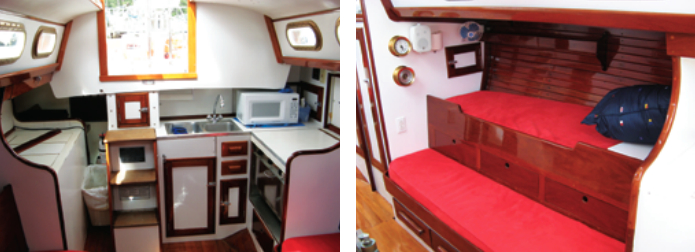
Stepping through the companionway into the interior of this solidly built yacht feels like stepping back in time, for the Bermuda 40’s Herreshoff-style finish in painted wood panels surrounded by varnished trim retains the look and feel of her wooden predecessors. There is no fiberglass to be seen.
Upon entering the saloon, you find the galley and nav station laid out athwartships, with the propane stove and oven to port. To starboard, the chart table covers a very large icebox. When he showed me the boat, John was in the process of reducing the volume of Charisma’s icebox by adding insulation inside it and installing a new box and refrigeration. The galley is adequate, although counter space is limited. Employing the icebox top as a chart table is an inconvenient compromise, as there is the potential for conflict between the needs of the cook and the navigator.
Immediately forward of the galley and directly opposite each other are two settees that slide out to convert sitting space into comfortable berths. Stepped above the settees are pilot berths. Not often seen in yachts these days, pilot berths make excellent sea berths. They also make good bunks for a couple of children, leaving the settees uncluttered for lounging and sitting at the table for meals.
The drop-leaf dining table is fixed to a pedestal between the settees. When the starboard leaf is in use, it restricts access fore and aft. When both its leaves are open, the table fully occupies the space between the settees.
The head, just forward of the mast, is spacious and includes a shower and good stowage. Cedar-lined clothes closets occupy the space opposite, to starboard.
The forward cabin has a spacious V-berth. It’s fitted sufficiently aft to have plenty of toe room at its foot, leaving lots of room forward in the narrow point at the bow for a rope locker and a large battery box. A small dresser and good storage lockers are fitted against the port bulkhead.
Although the basic layout is pretty much the same from boat to boat, because each B 40 was made to order, interior details differ.
Performance
B 40s were raced extensively by their early owners and enjoyed considerable success. These days, the B 40’s design is considered to be dated, particularly in terms of windward ability. Off the wind, however, her performance improves significantly. The less-than-stellar performance to windward is reflected in the average PHRF ratings assigned: 168 for the Custom, 162 for the Mark II, and 150 for the Mark III, both sloop and yawl. However, the Bermuda 40 is a very capable offshore passagemaker.
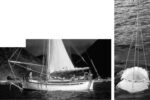
I found Charisma to be a joy to sail. The weather was unsettled with a northeast wind ranging from 10 to 15 knots. While flying main and jib only, I jotted down these performance notes: reaching, 6.3 to 6.6 knots; broad reaching, 5.4 knots; to windward, 5.3 to 5.6 knots. From tack to tack, our course-over-ground vector shifted through 105 degrees, with the board up! Charisma was exceptionally well-mannered and balanced, and she tracked well. Previous experience has shown me the B 40 is a great boat to be aboard for a long ride.
Performance under power depends on the boat’s age or what was installed when it was repowered. Early boats had gasoline engines. By now, I should imagine nearly all of these have been replaced with diesels. Around 1970, a diesel became standard on the B 40; the Westerbeke 4-107 was the most popular. Horsepower ranged from 35 to 50, depending on how it was rated, but this was plenty for the boat.
Backing a B 40 — as is true for all boats with a full keel and attached rudder — can be an adventure. Watching John back into his slip, I noted that finesse can overcome most of the difficulty: position the boat to allow for prop walk when beginning; when correction is needed, put the helm over and give the engine a quick shot forward to move the stern over; back again until prop walk makes necessary another short burst forward with the helm over; repeat as necessary.
Conclusions
The earliest Hinckley Bermuda 40s are 50 years old. While it took the magic of the Hinckley Company’s continuing comprehensive support to restore Charisma to her present beauty, that she was a worthwhile candidate for restoration is due to the quality of her original construction. There’s no denying that a Hinckley mystique attaches to all its boats; the quality is also undeniable. In 33 years, Hinckley built only 203 Bermuda 40s but, because they are treasured and carefully maintained by their owners, most of them are still sailing.
Hinckleys are expensive and the B 40 is no exception; however, the long production run translates into a wide range of prices. BUC Research’s Used Boat Price Guide lists a 1961 B 40 in excellent condition for $91,440 to $100,440. A 1976 Mark II in BUC condition (having average equipment and requiring no additional work) ranges in price from $126,500 to $139,000. A 1992 Mark III sloop in similar condition ranges $271,500 to $298,000. While expensive, if purchased at a fair price, a used B 40 represents real value that will depreciate very slowly compared to lesser boats . . . and almost all others are.
Paul Ring is a contributing editor with Good Old Boat. He has sailed, repaired, modified, restored, and built boats for 42 years. Paul sails his Nonsuch 260 with first mate, Barbara Brown, on Mobile Bay.
Thank you to Sailrite Enterprises, Inc., for providing free access to back issues of Good Old Boat through intellectual property rights. Sailrite.com