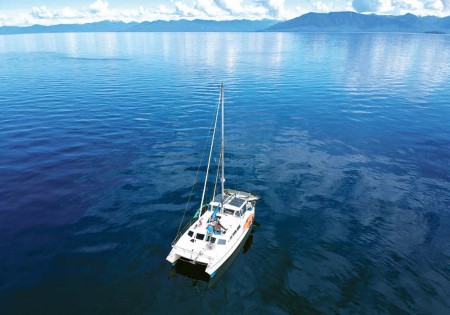
Affordable and innovative, these five boats were multihull game-changers.
Issue 129: Nov/Dec 2019
Anyone who’s read this magazine for a while can appreciate how deep and broad the roots of monohull sailboat history go. I certainly do. But I’m not just a Good Old Boat reader and contributor, I’m a confirmed multihull sailor. In fact, I’ve owned four good old multihulls, all launched before this magazine. I’ve enjoyed blasting along on a spinnaker-equipped beach catamaran, cruising aboard a well-found family catamaran, and, more recently, sporting about on my folding F-24 trimaran. And while my heart is close to everything we celebrate in this magazine — fixing stuff, tweaking more stuff, and enjoying local waters on a tight budget — I appreciate the function and beauty of doing it all on more than one hull. And for the past 50 years, so have a lot of sailors.
The oldest multihull I’ve owned was built in 1979, not long after the dawn of production multihull boatbuilding. Indeed, multihull roots don’t run so deep. Significant experimentation in catamarans didn’t start until the mid-1950s, and the first serious production launch was probably the Hobie 14 in 1968. It took many early failures of racing machines and homemade plywood projects before the engineering of these very different vessels could be worked out. But once the problems were solved, it didn’t take long for solid designs of proven reliability to emerge. And along the way, a population of multihull sailors was born.
Curiously, there was a lull in multihull popularity between the 1970s beach-cat craze and the surge in cruising catamarans we’re seeing today. Although people bought tens of thousands of Hobies, perhaps it just took time for the Hobie generation to get old enough to demand cruising boats. As was largely the case for cruising monohulls, charter companies eventually kicked the door open when they saw how customers loved multihulls’ wide-open decks and floor plans.
And although it took charter company demand to accelerate things, development and delivery of cruising multihulls has been ongoing. Early entries, like the Gemini 3000, evolved into better-rounded boats like the Gemini 105 MC. The Farrier Folding System was a breakthrough, bringing real cruising legs to trailerable boats. Prout, PDQ, and other manufacturers proved that cruising catamarans could be durable and bluewater capable, circling the globe many times over.
Design innovation continues. The charter market demands boats as roomy as condos, optimized for fun at anchor. Racing trickle-down has inspired performance cruising cats that can really fly, though at a dear price. Beach catamarans have improved by leaps and bounds from the pitch-pole-prone Hobie 16 into the sizzling-fast Formula 18 Olympic speedster. Folding trimarans have developed into real cruising boats and even more agile day boats.
The multihull world has something for everyone. But some boats stand out for their innovation and staying power. Following is my personal take — mini-reviews if you will — of five such boats that influenced multihull development in a critical way and are still affordable and available in good numbers.
Prout Snowgoose, Prout and Sons
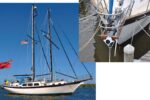
The Prout family began experimenting with catamarans in the early 1950s, quickly moving to the forefront with the Shearwater III, a highly successful 16-foot precursor to the Hobies of the ’70s and ’80s. Cruising models included the 27-foot Ranger (1962) and 31-foot Quest (1974). But it was the 37-foot Snowgoose in 1977 that cemented the reputation of catamarans as safe machines for serious cruising.
It doesn’t look like an ocean- crossing catamaran by today’s standard. The 15-foot 3-inch beam is too skinny on paper and the cockpit seems small, but the boat weighs 12,000 pounds and has the deliberateness of a bluewater cruising boat. More than 500 were built, and combined with the related Quest and Advent lines, they have been an enduring design, crossing and re-crossing the world’s oceans. On the down side, they are slow and go to windward like a loaf of bread.
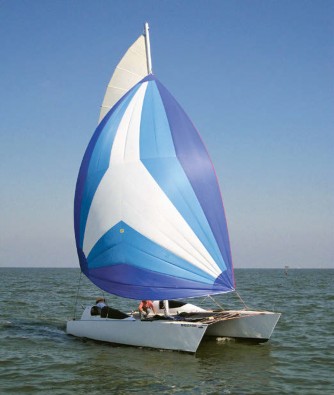
Stiletto 27, Force Engineering
Molded from pre-preg Kevlar honey- comb — the same materials used to make overhead luggage doors on jet liners of that time — the hulls were light, stiff, and virtually immune to deterioration if kept painted. They wouldn’t delaminate or blister, no matter how sloppily the fittings were sealed. The rig was an up-sized beach cat arrangement making for fast, easy sailing. Powered by an outboard and with only the most basic electrical and plumbing systems, they were dead simple to maintain or rebuild. As a result, they still survive in good numbers. There is simply no reason for them to end up in the dumpster.
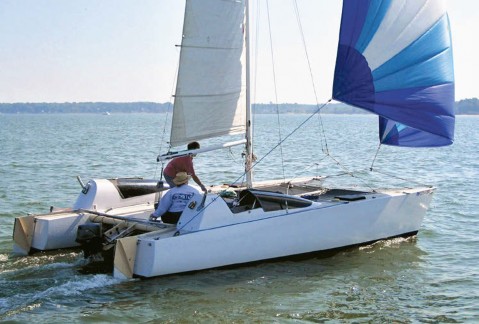
The downside is that accommodations are primitive. A pair of pipe bunks, a few lights, and painted walls make them camping comfortable at best. If the wind blows over 15 knots you need to bring your A-game; she’ll fly a hull in 12 knots with everything trimmed in tight. On the other hand, double-digit speeds are easy, and some have glimpsed 20 knots on a broad reach. It was the first production boat fast enough to satisfy ex-Hobie sailors.
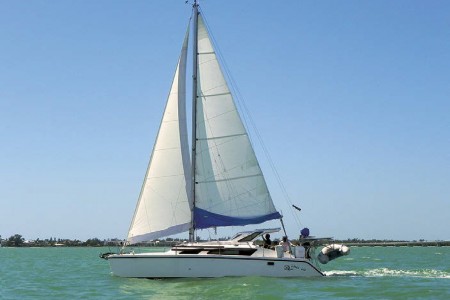
Gemini 105 MC, Performance Multihulls
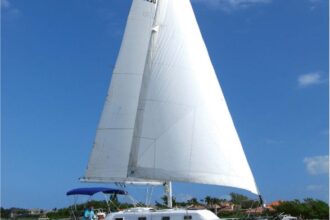
This design provides absolutely the most livability you will find in 34 feet. The line started with the Gemini 3000, first built in 1981, evolving through the 3200 and 3400, until reaching its final evolution in the 105 MC, starting in 2003. The narrow beam (14 feet) that allows it to use standard slips restricts the sail power a bit, but the rig is relatively low aspect, keeping it safe if reefed responsibly. Innovative features include asymmetrical centerboards and kick-up rudders that can actually steer when raised halfway. The Gemini improved upon the speed and accommodations of the Snowgoose without giving up too much seaworthiness, brought the price down, and improved windward performance enough to attract a few racers. Over 1,000 were built.
When the company was sold to Hunter in 2009, the design philosophy changed to better fit the charter market. The Gemini faithful and multihull enthusiasts in general don’t see this as a positive, but the new Gemini Legacy is comfortable and polished. The original designer, Tony Smith, has moved on and is now playing with a very different articulating wing sail concept, hoping to introduce something revolutionary. Always worth watching.
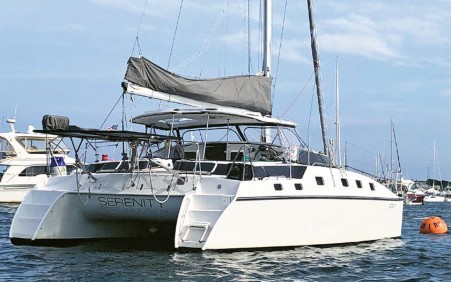
PDQ 36, PDQ Catamarans
A true ocean-going boat, the PDQ 36 combined quality construction, cruising amenities, and well-rounded performance. One of the first truly modern catamarans, they are built solidly, like the Prouts, but with a modern hull form that is fast, tacks through 100 degrees, and doesn’t slam under the bridge deck. They added 3 feet more beam, increasing room and stability, and saved 4,000 pounds through smart use of materials and vacuum-bagging.
I cruised her smaller brother, the PDQ 32, for 12 years. She was reliable, rugged, seaworthy, and she’d chase down most monohulls up to 10 feet longer on any point of sail, all while lugging a dinghy on davits, heat, air conditioning, and a full galley.
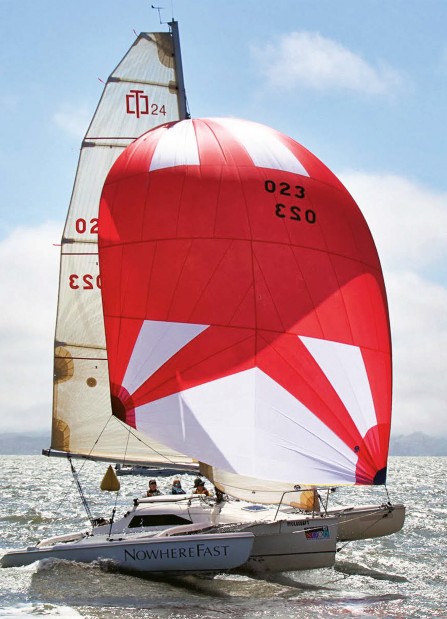
Corsair F-27, Corsair Marine
Designed by Ian Farrier, the F-27’s unique folding mechanism made trailer- able cruising multihulls practical for the first time. Between 1985 and 1997, 453 of these speedsters were built. Unlike the Stiletto 27, the F-27 was built with breezy conditions in mind, making them quite at home in the San Francisco Bay area, where they and their descendents are extremely popular among racers.
I recently downsized from a PDQ 32 to this boat’s smaller cousin, the F-24 Mk I, because I felt I was finished with cruising. I wanted something sporty, safe, and fun, and I haven’t been disappointed. A 4-foot centerboard and good sails make her as weatherly as most monohulls, she tacks on a dime, and off the wind, double-digit speeds are commonplace and relaxing, with fingertip control on the tiller. Of course, the slim center hull results in a cabin that is claustrophobic compared to the typical 24-foot monohull, but there is some storage, an alcohol stove, an adequate V-berth, and a convertible twin in the center. Short cruises with two are glamping-comfortable, certainly better than the Stiletto 27.
Interestingly, Corsair is one of the few brands that has resisted the pull towards bigger is better. Although a 37-foot version was produced with more livable accommodations, the Farrier F-22 (Daedalus Yachts) and the Pulse 600 (Corsair Marine) form the bulk of production and keep the designs in touch with their roots. The 760 (24 feet) has become the most popular model, a close cousin to the original F-24. (The corporate history of Farrier designs is complicated, with numerous comings and goings. Corsair Marine produces the Corsair models, and with Farrier’s death in 2017, Daedalus Yachts bought Farrier Designs and is producing the F-22, with more designs planned for the future).
Comparison to Monohulls
Broad comparisons are fraught with peril, and all boats are compromises. But, in general, multihulls have a quicker motion, the result of less weight in proportion to the waterline. If the hull bottoms are flat they can pound upwind, and if the bridge deck clearance is too low (it should be at least 10% of beam) they can slam. On a beam reach in waves there can be a nasty snap-roll, and a flying bridge helm location only amplifies this. A mono- hull, on the other hand, will heel considerably up wind, forcing you to either ease up or live on your ear. They can yaw and roll in a sickening manner off the wind, worse if the designer gave them wide aft sections to increase space and stiffness.
Multihulls most often have shoal- draft, low-aspect keels, allowing them access to every cove and even to haul up safely, if the conditions allow. Combined with broad bridge-deck salons, high freeboard, and undersized rigs intended to keep charter customers out of trouble, many can barely point to windward. That said, there are exceptions. The Gemini 105 MC and Corsair trimarans use daggerboards or center- boards and can fly to weather, pointing only a few degrees lower than similar monohulls, but sailing knots faster. I lengthened my PDQ 32 to 34 feet, added a genoa and inside tracks, and modified the keel to improve balance and match the expanded sail plan; as a result, she would tack through 95 degrees while sailing at 8 to 9 knots in choppy water.
So it depends. Of course, the motion could be a bit sharp in waves, unavoidable at only 9,000 pounds. The “feel” in cruising cats is greatly reduced. There is no heel to speak of and the helm is dull, the result of two small rudders (shallow draft, remember?) and the extra linkages required to connect them. Until the wind gets up and boat speed tickles 8 knots or more, they’re just dull to sail and the autopilot gets a lot of use. Above that the sailing can be quite fun, and they can eat up the miles.
Sport Boats
The Corsair F-24 and the Melges 24 were designed about the same time with the same goals; spirited racing and some cruising if you liked roughing it. They are both weatherly and just plain fast on a reach if you are willing to push it. They can be slowed down to the point of relaxing by reefing, but they are never smooth upwind and best fit a sailor that likes to go for it. Neither performs well if loaded down with cruising stuff. The Melges can be knocked down, but it will come back up (unless someone forgot the hatch boards), and the F-24 can be capsized (they aren’t hard to right with assistance), but both boats can easily avoid trouble by reefing down and accepting more normal speeds. Neither has any business far offshore. Both can be wet if sailed hard.
Cruising Boats
The ride is different and the sailing is different, but the most conspicuous differences are in the price, the cabin, and the deck. Claims abound that catamarans are faster and roomier but are too expensive. To an extent, this is true, but if we compare them to monohulls that are 5 to 10 feet longer, the gaps narrow. Cruising speeds become similar; although the cats are faster in a breeze, in light winds it’s close, and to weather most cats lose, sometimes big. Multihulls are expensive because the construction is more complex, but if we adjust for similar cabin size, not so much. And evaluating cabin size is not so simple; the layout is different, but perhaps similar in volume. Cats allow many separate cabins, but fitting the galley and standing headroom in the salon is a real challenge in the smaller sizes. Catamarans will have smaller sails for similar performance and accommodation space.
At anchor catamarans win. The typical hard top gives wonderful protection from sun and weather. The decks are huge, providing lounging space and room for toys like windsurfers and kayaks. Having the salon and cockpit on one level is far more sociable, and the swim platforms make access to water toys quick and easy.
Perhaps one of these good old multihulls will add up for you. Slender hulls and stability through form look right to me. I’m used to the quick motion and I’m addicted to high speed and shallow-draft exploration.
One thing is clear: multihulls are growing in popularity, and as the years tick by and more enter the used market, they’re joining the ranks of good old boats. Sailed by good old multihull sailors. Like me.
Drew Frye draws on his training as a chemical engineer and pastimes of climbing and sailing to solve boat problems. He cruises Chesapeake Bay and the mid-Atlantic coast in his Corsair F-24 trimaran, Fast and Furry-ous, using its shoal draft to venture into less-explored waters. He is most recently author of Rigging Modern Anchors (2018, Seaworthy Publications).
Thank you to Sailrite Enterprises, Inc., for providing free access to back issues of Good Old Boat through intellectual property rights. Sailrite.com