Stay safe and sane when sailing singlehanded
Issue 71 : Mar/Apr 2010
My friend Dorothy’s brother was visiting from Ohio. She said he was a fellow sailor and invited me over for dinner. Her brother turned out to be Robert Manry, who’d just crossed the Atlantic in his now legendary Tinkerbelle — at 13 1/2 feet, the smallest boat to have done so at that time, which was 1965.
As he described the crossing, I began to think differently about my little home-built 18-footer. Suddenly she was bigger than I’d thought and capable of great adventure. It was a good evening all around. I was left with the notion that true adventure on a small boat requires, at least in part, sailing alone.
Robert Manry sailed by preference with his family but also found single-handing an essential part of his love of sailing. Singlehander Bill Howell put it another way. He wrote, “If you love adventure, whatever you do is much more adventurous if you do it alone.”
Accounts of singlehanded ocean crossings are among the most exciting and inspiring in the literature of the sea. It is well to read and re-read the voyages of Francis Chichester, John Guzzwell, Kenichi Horie, Ellen MacArthur, and so many others. From Joshua Slocum’s epic Sailing Alone Around the World to Robert Manry’s Tinkerbelle, the great singlehanders never fail to inspire.
But the difference between reading about sailing alone and actually doing it is like the difference between reading about making love and actually doing it. Setting off in a small boat without anyone else on board is an inherently dangerous act whether the aim is to cross an ocean or spend a week or two seeking night-time anchorages closer to home. Neither should be undertaken lightly.
Stay connected
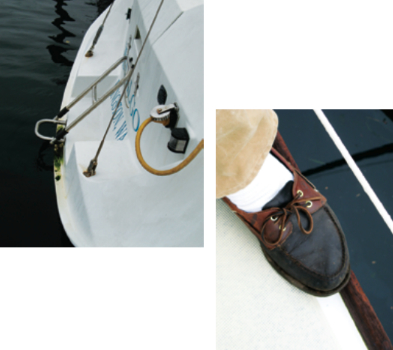
The main thing for the singlehander is to stay on board. Stay in the cockpit unless it’s absolutely necessary to go forward. Substantial toerails are important safety features, as are stout lifelines. Jacklines should be rigged as close to the centerline of the boat as possible and used with short tethers made fast to D-rings in a harness type PFD so, if you fall, there’s a better chance you’ll land on deck. The jacklines on my Ericson Cuising 31 are made from rigging wire with swaged thimbles at the ends that connect to well-backed eyebolts. The forward ends are shackled and the cockpit ends are lashed so they can be cut loose in an emergency with others on board. If all else fails and you suddenly find yourself staring at the boot stripe, there should be a ladder or other means of getting back on board.
“Non-skid” decks can be notoriously slippery, especially as they get wet. Replace your deck shoes when they lose their grip or become hardened with age. Thinner and more supple soles allow for a better feel of the deck. Look where you’re going and think about every step you take. Move about very carefully with “one hand for yourself and one hand for the boat.” If you must move quickly, remember festina lente — make haste slowly.
Be aware
It’s important to know where your boat is and where it’s likely to be in the next few minutes. If you sail with a GPS, be sure you know how to use it without taking your eyes off the shore any more than necessary. Make sure you can back it up with conventional piloting methods in the case of battery or other equipment failure. Develop a good sense of how close you are to things — including the bottom — by sight alone. Learn to judge distances and heights. Keep paper charts in the cockpit along with your instruments, hand-bearing compass, cruising guides, tide tables, and log book. Organize other necessities such as sunblock and glasses where they’re handy to the helm.
Be alert
Keep a good and constant lookout, especially in limited visibility. When you have your hands full tacking, dealing with backed jibs, and clearing lash ups of one kind or another, your eyes can easily be diverted. Make sure your boat and its equipment present as few obstacles to good visibility as possible. Many potential hazards can lurk behind Lifeslings and horseshoe buoys, barbecues, outboard motors, inflatables hauled up against the transom rail, fenders, and opaque sections of a dodger. Rain on plastic windows and side curtains can obscure crab-trap buoys, deadheads, kelp beds, and a host of hazards. While keeping tabs on immediate dangers, also remember to keep a 360-degree watch on such things as speeding powerboats hard on their GPS tracks and supertankers that come up out of nowhere.
An autopilot is something of a mixed blessing to the singlehanded sailor sailing close to shore. It can be a good extra hand, especially toward the end of a difficult day spent tacking through rambunctious water, but overuse can encourage spending too much time away from the helm. Keeping your hands on the wheel or tiller focuses your attention, keeping you in better touch with the boat, where she’s going, and how she feels.
Have proven methods
Devise a good method of making sail and stick to it. Some singlehanders swear by lazy-jacks. Whether you do or not, make sure that all is clear aloft and that you know what’s happening at the other end of the line you’re hauling. There’s no one else to spot an open snapshackle or a halyard about to foul a spreader.
Consider leaving a mooring under power with the main halyard attached and all but one sail tie cast off. Getting the main up with as little fuss as possible means you can get your eyes back on the water quickly.
Plan and practice a simple and foolproof way of getting two reefs in the main. When you get the first inkling that it might be well to reef, do so. Don’t wait, getting more and more anxious, rationalizing away those dark scudding clouds and whitecaps off to windward in the hope that things will get better. If the morning breeze is building, consider tying in a reef before leaving that snug anchorage.
The roller-furling jib or genoa is a boon to many singlehanders. You can reduce sail quickly with just a few turns, and furling from the cockpit is a safe and convenient way to clear the foredeck prior to anchoring. A headsail with a high-cut foot, well off the deck, can provide an uninterrupted view of the horizon and will not go amiss. If you plan to use a spinnaker, make sure your skills and energy are up to the care and feeding of it. Think of everything that can go wrong with a full crew. Now multiply it by four if you’re on your own.
Be prepared
Keep a sharp boat knife with marlin-spike and shackle key on a lanyard in your pocket at all times. Some solo sailors also keep a knife in its sheath lashed or duct-taped to the binnacle or tiller for emergency use.
Be equipped
In addition to the electrical bilge pump, mount a good manual pump near the helm where it can be operated with one hand while steering.
Keep a good non-collapsible boat-hook within reach and have it weighted so it floats in an upright position and high enough to be grabbed from the deck or cockpit. Devise a good way of picking up buoys by yourself and practice in all conditions.
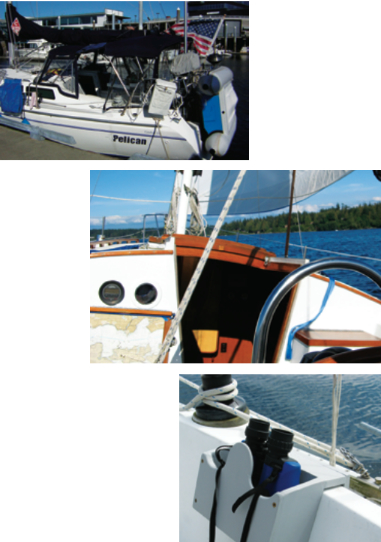
Keep a pair of binoculars handy. They should be light, feel good, and be easy to use with one hand. Sailing close to shore, I use binoculars for bringing up points and bays on a distant shoreline, identifying aids to navigation, and looking for ripples around the bases of buoys for indications of current speed and direction. I look for glassy patches and signs of wind signaled by cat’s-paws, the heel of other boats, the drift of chimney smoke, and movement in the tops of tall firs.
Binoculars also get a workout when I spot a bird I don’t know, seals, porpoises, or whale spouts. Sailing alone is aided and abetted by a general curiosity about the water and the creatures who live in and on it.
Be neat
Whether you run halyards and other running rigging back to the cockpit or keep them secured up forward (there are advantages and disadvantages both ways), try to keep the deck and cockpit well organized. Avoid a jumble of lines. Coil halyards and secure them after each use.
The solo sailor also has to consider what happens when crossing a turbulent pass in 20-knot winds that blow counter to a strong current or when approached by a large, fast-moving powerboat. These events can cause turmoil down below. Nothing in the cabin should be affected by anything less than a knockdown. The last thing you want is to slip and slide in spilled olive oil or Simple Green at the foot of the companionway ladder.
Be warm, fed, and watered
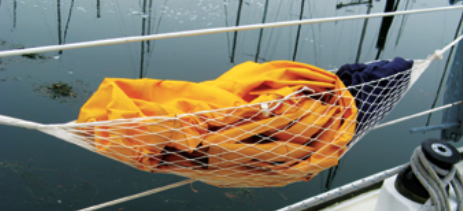
To cut down on trips to the cabin, I keep an assortment of sweaters and jackets, hats and gloves, foul weather gear, and such in a small hammock rigged between stanchions. As well as carrying a carton of water bottles in a cockpit locker, I also like to keep a thermos of hot tea or coffee in an insulated bag with sandwiches, fruit, and other snacks hung over the binnacle.
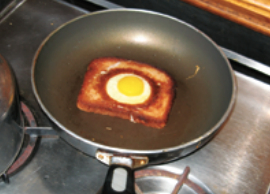
Meals are apt to be simple affairs when you’re on your own. Some of my solo-sailing friends seek restaurants at the end of a long day on the water. One friend, a former climber who frequently sails alone, takes freeze-dried foods on his cruises and boils up soups in bags. There are evenings when I’m not up to much more than dropping an egg in the punched-out hole of a piece of fried bread. But I’ve also spent wet and happy days at anchor making Irish soda bread in a pressure cooker and getting together a gourmet meal inspired by my dog-eared shipboard copy of Joy of Cooking.
Occupy the mind
Loneliness stalks the singlehanded sailor and must be dealt with before the adventure can truly begin. It’s important to occupy yourself with interesting pursuits when you’re on your own and there’s no one else to help take the edge off your splendid isolation. Sailing a small boat is its own reward, but the safe and exciting enjoyment of cruising singlehanded close to shore is an acquired art. The trick is to busy yourself with things you enjoy doing.
Keeping the cell phone turned off for a few days is a good start. I try not to call home until the cruise takes over and solitary contentment begins to replace loneliness . . . about three days and three nights.
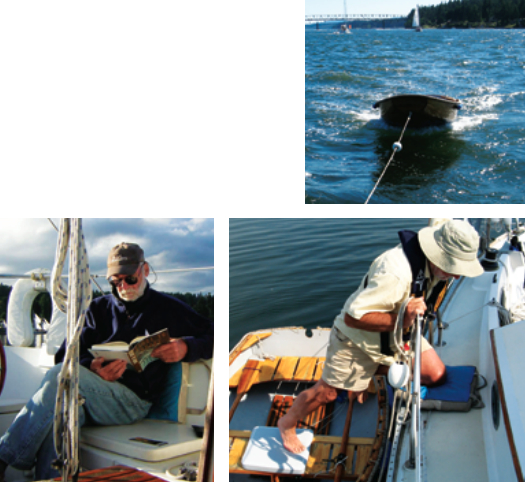
Reading a good book is the lone sailor’s traditional way of avoiding the dreaded ennui. You’ll have access to the radio, DVDs, BlackBerries, cyber gaming, and all the rest, but try to avoid replicating the comfortable world you’ve just left.
A good rowing dinghy is essential to my good humor when singlehanding. I like to start the day by rowing along the shore. My newfound enjoyment of bird watching comes almost entirely from cruising singlehanded, watching crows mobbing a lone eagle, and following a great blue heron along the water’s edge, admiring its short takeoffs and smooth landings as it squawks the squawk of the ancient pterodactyl.
I throw in a couple of boat cushions before casting off in the dinghy and use one for kneeling as I climb back on board. Boarding and landing from the dinghy are among the more hazardous activities for the solo sailor. Do them with great care and respect and always wear a PFD that gives you freedom of movement to row and moor in comfort and safety.
I tow the dinghy except when crossing wide straits, when I expect heavy weather, or when undertaking a particularly long or arduous passage.
It’s difficult for many would-be singlehanders to enjoy the solitary nature of sailing without a crew. But after a couple of days, if you discover the knack, a sense of independence and self-reliance begins to assert itself and the world is set to rights. You’ve moved your boat more or less where you wanted, had an unexpected adventure or two, and suffered your own company to no bad effect.
Richard Smith is a contributing editor with Good Old Boat. He has built a wide variety of boats and sailed them in waters near Detroit, Seattle, and Liverpool, England, for about 40 years. These days, when not messing about with his fleet of five dinghies, he sails an Ericson Cruising 31 with his wife, Beth, in Puget Sound. But when Beth can’t make it and the wind and waves beckon, Richard often sails alone.
Thank you to Sailrite Enterprises, Inc., for providing free access to back issues of Good Old Boat through intellectual property rights. Sailrite.com