Classic varnish solves boater’s problem
Issue 47 : Mar/Apr 2006
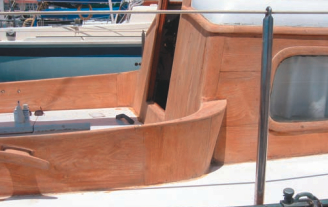
Any owner of a good old boat will, at some time or another, be confronted with the sight of brightwork that no longer lives up to the name. I was faced with this problem when the two-part “system” applied by my boat’s previous owner started to fail. It had begun to cloud and crack even before Herald Bird came into my life. After a year it was certain there would be no simple fix: small sheets of the coating could be lifted off with a dull snap.
The only option was to remove it and start over. I won’t go into the details of removal, except to say it isn’t as hard a task as it might seem at first. Using a heat gun and scraper, keeping focused and resisting impatience are the keys (see Tom Young’s article in the May 2005 issue). When down to bare wood I was faced with The Dilemma of Decision or, more exactly, The Dilemma of Indecision. With so many wood finishes, coatings, systems, and treatments out there, which is best for my boat? I found the answer in Good Old Boat, and it was a total surprise.
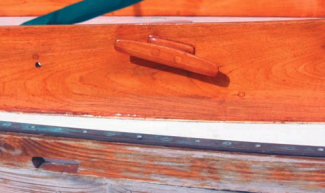
After reading much of the available advice about which varnish to use and how to apply it, I was more confused than ever. What I wanted was a brilliant brightwork finish without the angst of dealing with a temperamental product that had to be applied under exacting environmental variables by a journeyman alchemist to get acceptable results.
The more I read, the more inadequate I felt. Then I found Le Tonkinois (luh-tonk-een-WAH), a classic French varnish that’s been around since 1906. It’s celebrating a 100th anniversary this year, but is virtually unknown in this country.
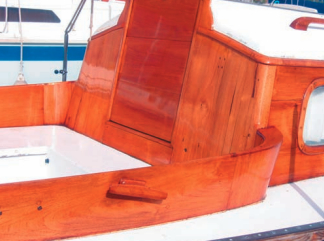
Natural product
In contrast to all other varnishes I considered, Le Tonkinois seemed the most environmentally friendly as it is a natural product without additives. The claims for UV- and abrasion-resistance, ease of application (no thinning, wide humidity and temperature tolerance), and low maintenance all proved true in practice. My experience has been 100 percent positive with this product.
Here are the highlights: teak is an oily wood, so after a final sanding with 220-grit sandpaper and a thorough wiping with a tack cloth, I wiped again with a clean rag dampened with acetone. I used an ox-hair brush to apply all coats. Le Tonkinois goes on easily. Work quickly and deliberately, keeping it even and maintaining a wet edge. Don’t try to pick out little bugs or rework runs and sags. Allow 24 hours between coats.
Although it is not necessary to sand between coats, I recommend you do so after the first coat and before the last, at a minimum. The stuff is so clear it is hard to see where you have put on wet varnish if you don’t lightly wet-sand between coats, and you’ll get a flatter and deeper finish if you do. Apply eight to 10 coats. My maintenance schedule is to put on three coats once a year. When finished, relax and be the envy of the marina. (I generated a bit of a buzz around my dock with that “Frog oil in a square can,” as one colorful salt likes to call it.)
I’ve used Le Tonkinois now for three years, and it’s everything I hoped for. It makes my wood look spectacular and keeps me sailing in style. Belowdecks I used only four coats and haven’t retouched it . . . yet. Bill Rickman, the U.S. distributor is friendly, knowledgeable, and professional. Contact his company, American Rope & Tar, at http://www.tarsmell.com.
Thank you to Sailrite Enterprises, Inc., for providing free access to back issues of Good Old Boat through intellectual property rights. Sailrite.com