An automatic cycle counter for next-to-nothing
Issue 47 : Mar/Apr 2006
Living in Colorado, with my Pearson 424 tied up in New Bern, North Carolina, I sometimes awaken in a cold sweat, wondering if my bilge is full of water and if the pumps will last until I return to Regina Oceani. Yet, when I finally step aboard, I find only cobwebs in the bilge. If there had been a leak while I was away, though, how would I have known? Something else to keep me awake.
Under way in heavy seas, though, is another story. Some water always gets into the bilge by and by. The key to happy sailing is to know how much and how often. Too much, too often, requires investigating. But how do you know when to check the bilge? A buzzer wired to the bilge pump is not appreciated by the off-watch crew on passages.
The solution is a bilge-pump cycle counter, checked and reset periodically. A boatowner quickly learns the difference between a normal amount of pump cycles and a problem.
Bilge-pump cycle counters sell for around $70 from popular sources. The buzzer costs less than $5. Hmmm . . . there had to be a cheaper, quiet solution.
While I was outfitting my boat last summer in Florida, one of the hamburger chains was giving away pedometers with their salads, an image-changing effort, no doubt. The pedometer seemingly offered little utility aboard a sailboat. But, surprisingly, this nifty little digital counter, combined with a 12-volt reed relay from Radio Shack (P/N 275- 233) for less than $3, is easily transformed into a bilgepump cycle counter.
By the time I got to my workbench, I had misplaced the free pedometer, but found one at my local Wal-Mart for less than $4.
Spring-loaded pendulum
The pedometer registers one’s steps by means of a connection made by a spring-loaded pendulum. Each time the round weight at the end of the pendulum strikes the copper wire coil a scant current is conducted and a step is registered. Removing this mechanical part from the pedometer and replacing it with a tiny relay creates the counter.
I removed the circuit board from the case, keeping track of the rubber push buttons and tiny screws, to discover two points where 24-gauge wires could easily be soldered to substitute for the pendulum. Conveniently, removing the pendulum assembly provided a hole through which the wires could be passed.
I drilled two very small holes in the back of the pedometer case to allow the relay’s switch leads to pass into the case. After quickly soldering slightly larger wires to the coil side of the relay (don’t overheat the relay and melt the fine wires of the coil), I used hot glue to attach the relay to the case and secured these wires.
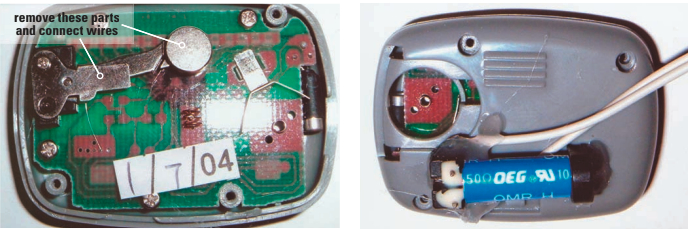
Inside the case, I soldered the surrogate pendulum wires to the relay switch leads. I trimmed these and insulated them with a dab of hot glue.
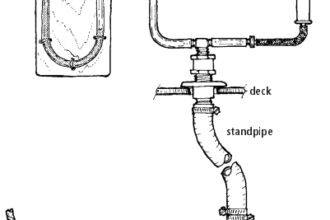
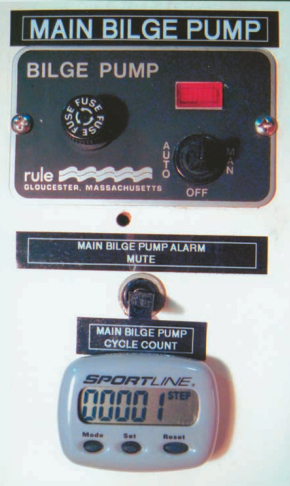
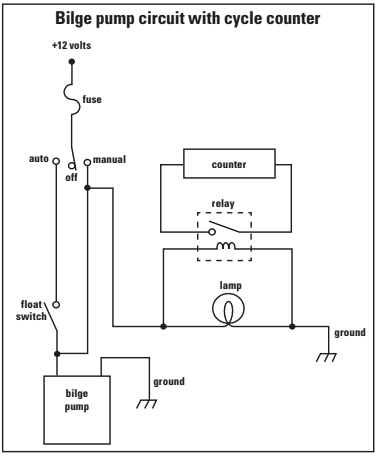
I mounted the unit on a bulkhead with Velcro to allow for easy battery changing every few years. I cut a slot in the bulkhead to accommodate the relay and the unit mounted nicely. As shown in the schematic, the two relay coil leads connect in parallel to the light on the bilge pump control switch panel or, lacking a light, to the manual pole of the switch and ground (polarity does not matter).
Now when I return to my boat I can see immediately if the bilge pump has cycled at all while I was away. And the counter cost less than a bottle of Sominex.
Thank you to Sailrite Enterprises, Inc., for providing free access to back issues of Good Old Boat through intellectual property rights. Sailrite.com