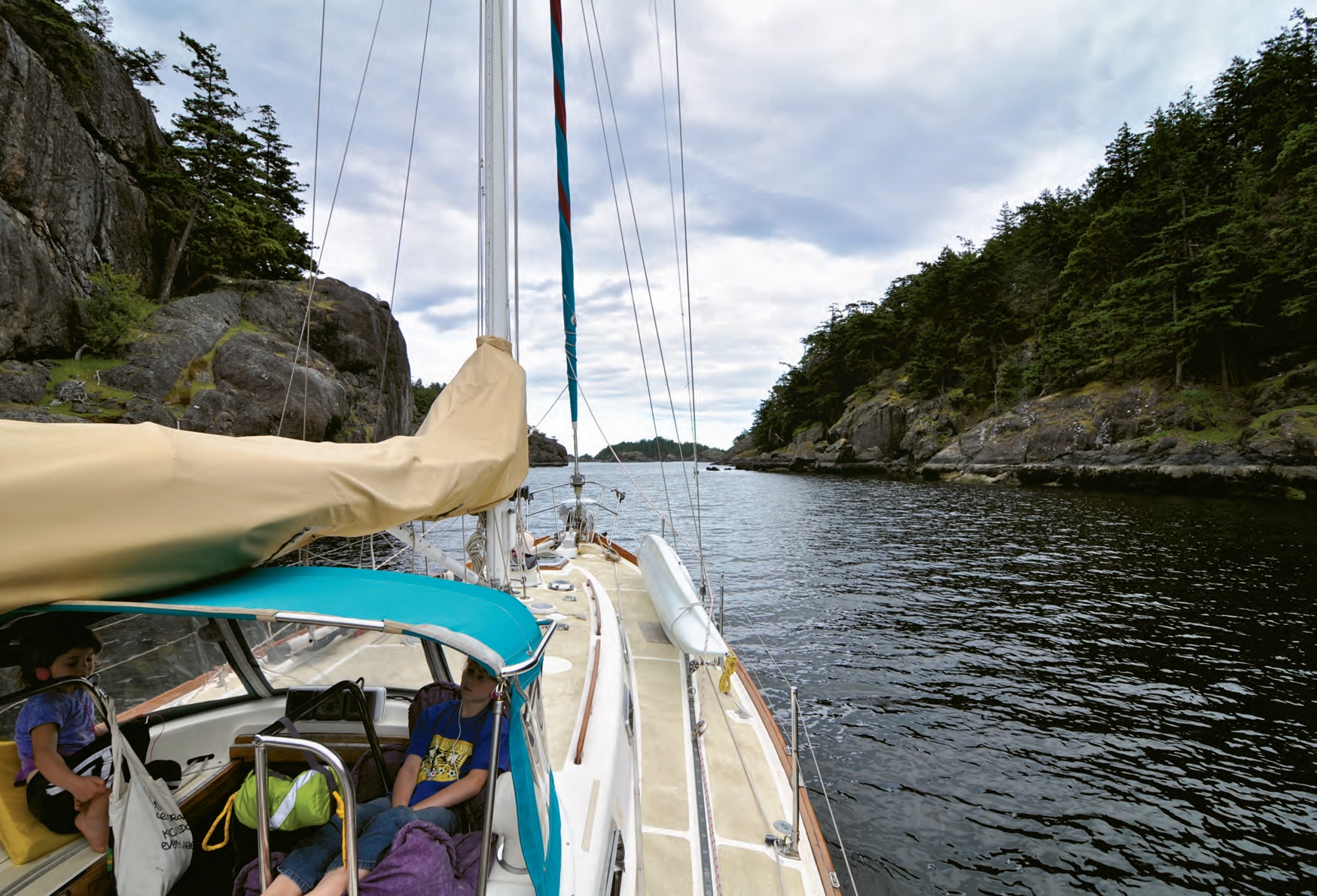
Off the grid and off most sailors’ itineraries, Lasqueti Island is a community unto itself.
Issue 132: May/June 2020
“You should stop here,” said our new friend, Kevin, tapping his finger on our route planning chart taped to the main bulkhead in our cabin. “Lasqueti Island is not like the rest of the Gulf Islands.”
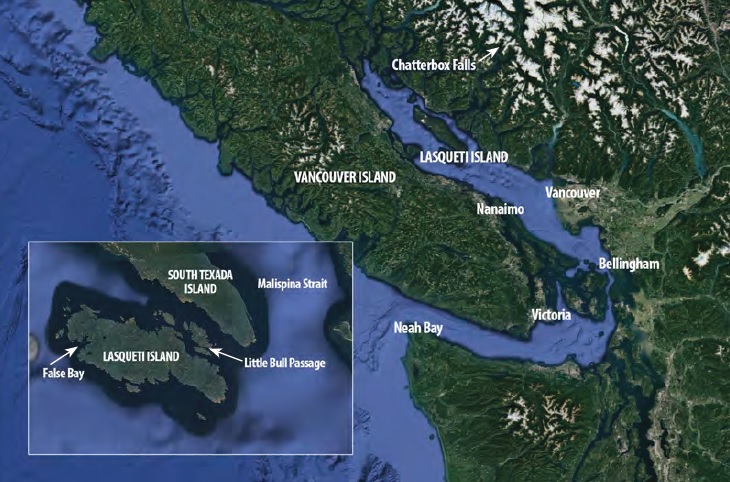
I leaned in for a better look. This was not part of the plan. We’d already mapped out our Salish Sea sailing trip, winding through Canada’s Gulf Islands and bouncing between ports on Vancouver Island and mainland British Columbia. From Ganges we were headed to up the coast to Nanaimo, the second-largest population center on Vancouver Island, then due north across the Strait of Georgia and up the Malaspina Strait on our way to Chatterbox Falls, at the end of the Princess Louisa Inlet, about 40 miles inland from the British Columbia coastline. A visit to Lasqueti would mean a detour up the southwest side of giant Texada Island.
“There’s a community there, totally off the grid.,” he added. “I’ve heard they make their own money.”
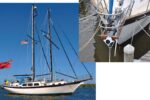
Their own money? We learned long ago to give great weight to locals’ recommendations. A week later, from Nanaimo, we pointed our bow northwest and headed for False Bay, on the northwestern end of Lasqueti Island.
According to the Waggoner Guide, Lasqueti Island is, “often overlooked by pleasure craft.” This isn’t surprising. The island is away from the route usually taken by northbound boats on the way to Jervis Inlet or Desolation Sound. The resorts, farmer’s markets, and artist communities that appear regularly in the top 10 lists of glossy travel magazines are a world away in the Southern Gulf Islands. The big ferries don’t call here.
We rounded Prowse Point into False Bay late in the afternoon. To starboard, a pier extended from the shore in front of the blue-roofed Hotel Lasqueti. We motored about, looking for a spot to drop the hook that wouldn’t impede ferry or seaplane traffic in and out of the small bay. In the end, we followed the lead of half-dozen boats anchored around the corner in Mud Bay, in about 35 feet. Here, the holding and the protection from southeasterlies is excellent.
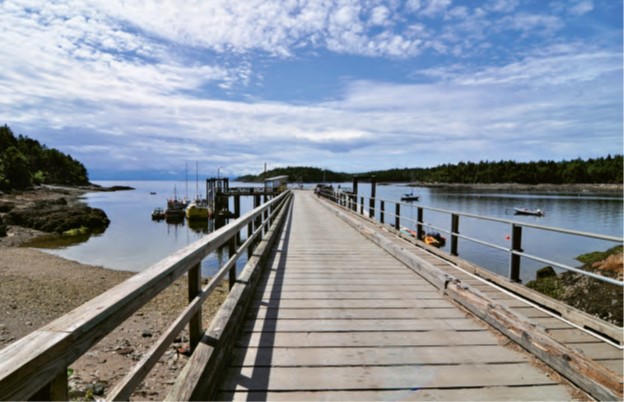
The morning broke clear, warm, and sunny and we hopped in the dink. We found a small dock on the north side of the pier and tied up.
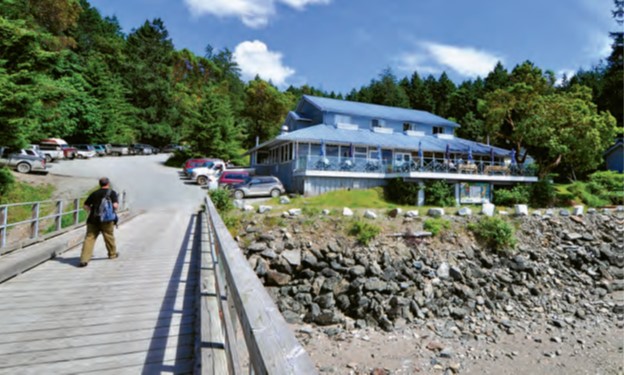
In terms of a population center on Lasqueti, False Bay is it. It’s where the 60-passenger, walk-on ferry berths. The post office, school, a tiny grocery store, and the hotel are all here. This is where the 400-plus residents of this Manhattan-sized island gather for their farmer’s market and community events.
It wasn’t always so.
The island was home to the Pentlatch people when it was visited by Spanish sailing ships in 1791 (Juan Maria Lasqueti was a prominent officer on one of these ships). By the time sheep farmers arrived on Lasqueti in 1860, only a few Pentlatch survived, a First Nations people destroyed by smallpox and northern tribes.
Subsequent settlements on Lasqueti were centered around Tucker Bay, on the northeast side of the island, facing the Sabine Channel. Steamships landed here, and the post office, school, and store were all within a short walk. But in 1916, a salmon cannery opened in False Bay, and the population and infrastructure followed and remained.
During the first half of the 20th century, Lasqueti was home to loggers who nearly stripped the island of its red cedar trees and ranchers who tried to make a go of large beef cattle operations. But in the 1960s, commercial ventures having been exhausted, Lasqueti was discovered by a new group of people.
“It offered wild coastlines, abundant harvests of salmon and shellfish, and beautiful forests. The climate was benign, the soil rich, and the population sparse. With no intervention from government or police, it was a hippie’s dream,” wrote Charlie Walters in his book, Island Dreams. And it was more than a dream. They came, they staked their claims, and they formed what is today the predominant culture of Lasqueti.
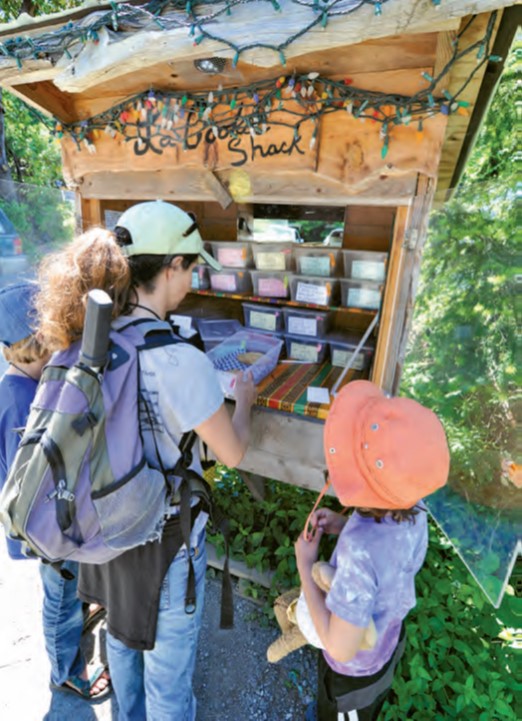
At the top of the pier, we walked up the steep road, continuing past the Hotel Lasqueti, the largest establishment on the island, its restaurant/pub balcony perched over the shore and crowded with tables and umbrellas. A sign outside advertised public showers, but my daughters ran ahead to La Cookie Shack, a self-serve stand along the road displaying more than a dozen different kinds of cookies, muffins, and quick breads for sale. We each picked a treat and put our loonies in the cash box.
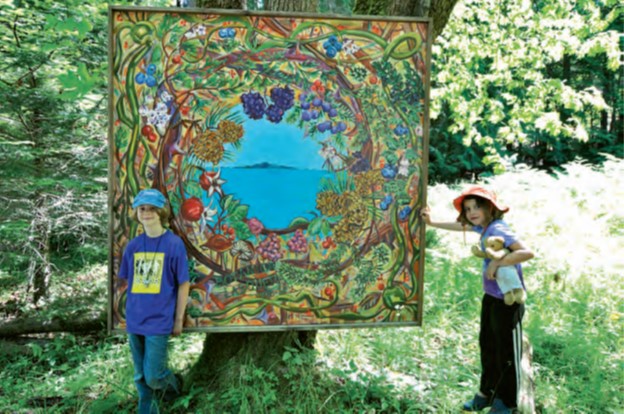
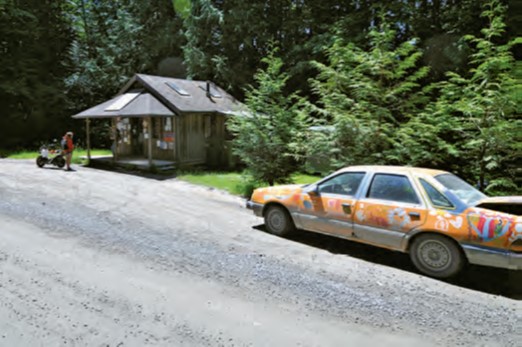
For a kilometer, the dirt and gravel road wound up and down through forest, past a few homes and occasional displays of public art. Outside the wood-framed post office, we stopped to read the handwritten notices tacked to the outside, nearly all of them from residents offering services to other residents. Some were specialized, others simply offered any form of unskilled labor.
In an April 2012 episode of Global News 16×9, Lasqueti islander Gerry Chicalo estimated that fewer than 40 percent of new residents are successful. “People come, get all excited, maybe even buy land. A couple years later, it’s just all too much, they don’t have the skills, and they leave.”
Though BC Hydro has made several offers over the years to connect the island to its power grid, Lasqueti residents have repeatedly turned down the offer, preferring to live independently and relying instead on solar, wind, micro-hydro, and gas or diesel generators. Today, Lasqueti remains the only large, inhabited Gulf Island that is off the grid.
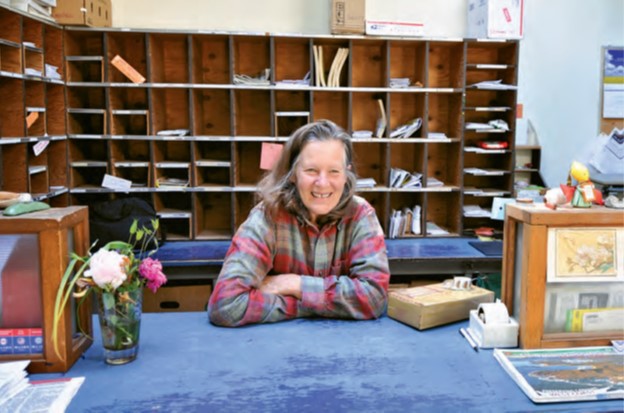
Inside the post office, Dee Dee stood behind the small counter, next to the wood stove used to heat the space in the winter. Light came from skylights overhead. Residents’ mail was bundled and sorted alphabetically into wall boxes behind her.
A young woman with a backpack pulled up on a 50cc dirt bike, excited to collect the parcel of books she’d reserved from the BC library system. She told us that she and her husband and two young children moved to Lasqueti a year earlier, that they committed to the life after just a single visit on the ferry. She could have been a spokesperson for the back-to-the-land movement, her eyes bright as she praised the simplicity of the lives they’d built here. She turned before leaving, “Have you been to the Free Store? It’s just a bit further down the road, past the school and the firehouse.”
The Free Store was a small house with a wraparound covered porch filled with used clothing, books, movies, games, kitchenware, and odds and ends. Residents drop off what they no longer need, and volunteers organize everything. My youngest daughter, Frances, clutched a children’s book she found by Maria Coffey, a Lasqueti Island resident.
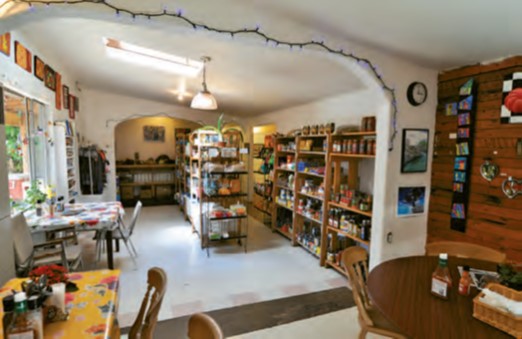
Back at the head of the pier, we stopped in at Mary Jane’s, a combination deli/grocery store, for lunch. The soups are made from island-grown ingredients and the fresh bread is made in-store.
But a visit to Lasqueti isn’t about the food or shopping and services. It’s about the special kind of peace and tranquility that can be found in a place where people celebrate simplicity, embracing the hardship and independence they know is required for self-sufficiency. Away from False Bay, Lasqueti is about the ease with which you can find solitude. It’s about how much more numerous the night stars appear when away from city lights. It’s about the dozen natural bays available to kayakers and beachcombers and photographers.
We walked miles of roads, gazing dreamily at owner-built cabins, some quite elaborate and comfortable looking. As sailors, the quirks of self-sufficiency, like solar panels and cisterns, were familiar to us. Absent chain link and other institutional characteristics, the public school on Lasqueti looked warm and inviting, the kind of place we’d like to send our girls if we weren’t
transients. We saw a few cars on Lasqueti, but bicycles seemed to be the common form of transport. Art displays were around every corner.
Both Lasqueti’s north- and south-facing shorelines are dotted with small anchorages. On the south shore, Richardson Cove is adjacent to the 200-hectare Lasqueti Island Ecological Reserve, established in 1971. The reserve protects a shoreline forest of one of the largest populations of seaside junipers in British Columbia, and at least 15 plants considered rare in the province occur here.
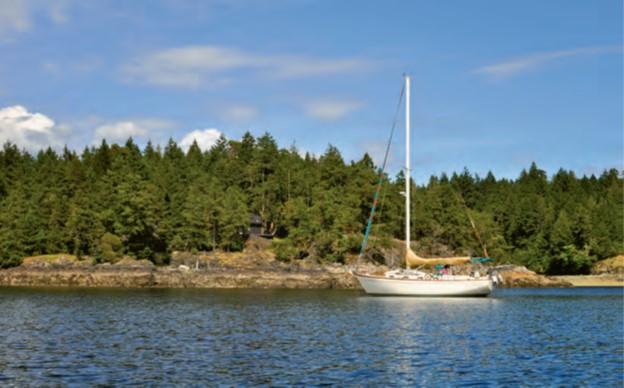
North shore anchorages are more protected, abutting a small archipelago just off the coast and in the narrow Sabine Channel that separates Lasqueti and Texana islands. This archipelago includes small Jedediah Island, an unpopulated marine park and a destination to include with any visit to Lasqueti. Jedediah is rugged and crisscrossed with trails accessible from the island’s anchorages.
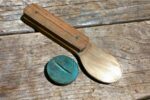
As we left Lasqueti behind, threading our way through the narrows of Little Bull Passage, I thought back on our visit, realizing I never heard or saw any reference to a unique Lasqueti currency. “Do you think he was pulling our leg about the money?” I asked my wife, Windy. But I later looked it up on the island community’s own website. Along with a list of eclectic artists and artisans providing goods and services in the community, there it was: Lasqueti Mint. Apparently, “the mint was conceived when a goldsmith and a numismatist became excited over the potential for a 19th-century drop-hammer coin mint.” The pair enlisted a Lasqueti artist, and in 1997, “locals reached into their drawers and pulled out saved bullion to convert into Lasqueti commemorative coins.” There have been several mintings since, the most recent in 2008. The dream is still alive that these Lasqueti coins will someday circulate widely, throughout the islands.
“Kevin was right,” I said to Windy, “Lasqueti Island is different, I’m glad we made the detour.”
Before he was editor of Good Old Boat magazine, Michael Robertson and his family lived aboard and sailed around on their 1978 Fuji 40. For over a year they explored the Pacific Northwest, from Washington’s Puget Sound to Alaska’s Glacier Bay
Thank you to Sailrite Enterprises, Inc., for providing free access to back issues of Good Old Boat through intellectual property rights. Sailrite.com