A famous designer tells how yachts have changed
Issue 61: July/Aug 2008

In honor of Good Old Boat’s 10th anniversary, I thought it would be interesting to look back over the changes in small-boat design in the 50-some years that have passed since I was discharged from military service in May 1957. That’s when I got into the boating business, beginning as a yacht broker at George Cuthbertson’s Canadian Northern Company, later to become famous as C&C Yachts.
My father served with the Canadian Navy so I learned to sail on 27-foot navy whalers and 14-foot dinghies when I was a teenager, but I knew literally nothing about the sailing yachts of the late 1950s and I was keen to learn. Thanks to George and his partner, Peter Davidson, I found a berth aboard Vision, a 48-foot Eight Meter sloop, sailing out of Toronto’s Royal Canadian Yacht Club. There was an active fleet of Eights in Toronto, with races twice weekly plus weekend regattas at various ports around Lake Ontario. It was a great start to my career, as it gave me the opportunity to see and race against all types of yachts, from 25-foot Folkboats and 27-foot Tumlarens to large 50- to 60-foot cruiser/racers.
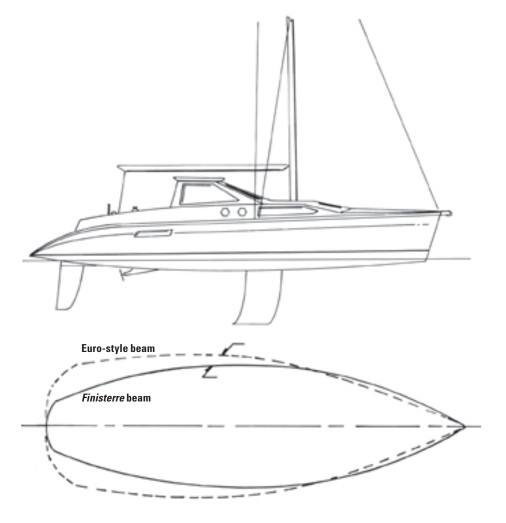
At the time, George Cuthbertson was designing a new 54-foot keel/centerboard (keel/cb) yawl; construction had already started at Cliff Richardson’s yard in Meaford, Ontario. The keel/cb type was popular in those days, as the Cruising Club of America (CCA) handicap rule favored long overhangs, short waterlines, husky displacement, shoal draft, good beam, and yawl rigs. Olin Stephen’s 1954 design of Finisterre, the keel/cb yawl (pictured on this page), combined these features, with a length overall of 38 feet 6 inches on only a 27-foot 6-inch waterline, 11-foot 3-inch beam, a board-up draft of only 3 feet 11 inches, and, at 18,640 pounds of displacement, a very husky 400 D/L ratio. In the late ’50s and early ’60s, Finisterre was winning major coastal and offshore races, including several Bermuda Races, and cleaning up the competition. As a result, other designers started drawing up their own versions of the type, producing keel/cb cruiser/racers ranging from Bill Shaw’s exquisite little 24-foot yawl, Trina, to George’s handsome 54-foot Inishfree.
Of course, there were plenty of CCA-type deep-keel yachts sailing and racing as well, many of them built in the 1930s, along with many newer ones designed and built post-war from the boards of Olin Stephens, Bill Luders, Phil Rhodes, Ray Hunt, John Alden, Laurent Giles, and other talented designers in North America and abroad. Fiberglass construction was in its infancy in the late 1950s, so these boats were custom-built, usually of wood, and designed primarily as cruising yachts with racing potential as a plus, but only if they were successful at bringing home the silver.
No large facilities
Even the smaller yachts were custom-built, as there were no large production facilities turning out great numbers of boats and, for that matter, no demand for great numbers of boats either. Bill Luders was building the 26-foot Luders 16s of hot-molded wood construction, but the quantity turned out was very small by modern standards. The 25-foot Folkboats that we imported, used, from Denmark were built by the score in Scandinavia, but each shapely lapstrake hull was individually built to order in small boatyards.
I sold several Folkboats while working for George and greatly envied their lucky owners. The boats cost about $2,500 delivered to Toronto but, compared to a modern 25-footer, they were very stark indeed. There was no engine and only sitting headroom in the cabin. The primitive galley had no running water, sink, or icebox. The stove, if there was one, was usually a single-burner kerosene Primus that would flare like a volcano when fired up.
The cabin featured only two settee berths with an exposed toilet or a bucket up forward. A few of the boats had two children’s berths in the forepeak. But these models were the exception, as you can only put so much into 19 feet of waterline. The cockpit was deep and comfortable but not self-bailing and that, in itself, would frighten off many of today’s sailors. Yet the Folkboats raced in all weather, won their share of heavy-weather events, and sailed all over the Great Lakes and coastal waters with their happy crews. Indeed, several modified Folkboats sailed and raced across the Atlantic.
Larger yachts were not much better off in their accommodations. It was generally considered that no boat less than 30 feet in length overall could have standing headroom. Even 30- to 40-footers (and larger) lacked pressure water systems. Galley sinks were supplied by hand pump. The boats had no water heater, no electric refrigeration, and little decent lighting, as you could only do so much with the puny 6-volt batteries that were the standard in those days. Indeed, kerosene navigation and anchor lights were quite common; otherwise, you could run down the weak little car battery overnight and awaken to find that you owned a true 100-percent sailboat.
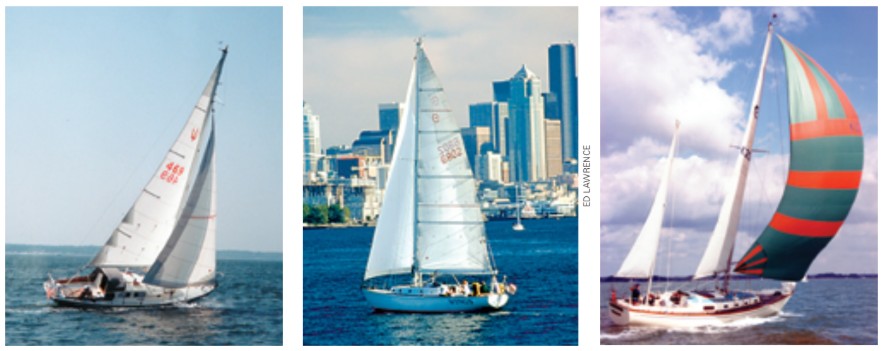
Hand-crank starting
The gasoline engines of that era were low-compression types, and many small engines had the luxury of a hand crank to start them when the battery died, as it so often did. Diesel engines were unheard of except in larger yachts and, even then, of low power by today’s standards. As I recall, the heavy-displacement, 54-foot Inishfree had only a four-cylinder Mercedes diesel of about 40 horsepower. She managed quite well with it, but many owners of 40-footers would consider that to be inadequate power today.
The necessity for custom building in wood kept the price of a new yacht on the high side and the numbers built relatively small. Yachting definitely was a gentleman’s sport, a wealthy gentleman’s sport by today’s standards. Then, in the late 1950s, things began to change, with the introduction of fiberglass-reinforced plastic (FRP) construction. The U.S. Navy experimented quite successfully with FRP personnel boats in the late 1940s, but the first large FRP yachts were not produced until 1956, when Fred Coleman introduced the handsome Phil Rhodes-designed Bounty II, a keel sloop [no centerboard –Eds.].
Other large production yachts soon followed and, in 1957, Bill Tripp designed a keel/cb yawl that was first produced by a Dutch yard as the Vitesse class. Later the molds were shipped to the U.S. and built as the Block Island 40. Bill followed this up in 1959 with the Bermuda 40, another successful CCA keel/cb yawl, for the Henry R. Hinckley Company, which until then had been building wooden yachts.
The Carl Alberg-designed 22-foot 6-inch Sea Sprite, introduced in 1958, was primarily a daysailer with weekend aspirations. The big surprise at the 1959 New York Boat Show was another Alberg design, the first true production small cruising yacht, the Pearson Triton. With her standing headroom and an introductory price of $9,700, the little Triton was such a success that Pearson built 750 of them before production stopped in 1966.
With the Triton’s success, Carl Alberg became one of the major cruising yacht designers of the 1960s, specializing in full-keel sloops with long ends, narrow beam, good draft, husky displacement, a high ballast ratio, and a flattish sheerline. Alberg designs were popular and built by Pearson, Whitby, Cape Dory, Ryder, and others for many years. The last Alberg 30 rolled out of the Whitby plant in 1987, some 25 years after the launch of the first one!
In 1963, the beginning of the end came for the CCA full-keel and keel/cb cruiser/racers, when the first of the Bill Lapworth-designed Cal 40s was built by Jensen Marine in California. The next winter a Cal 40 won the prestigious Southern Ocean Racing Conference (SORC), but the real clincher came in 1966 when Thunderbird won the Bermuda Race and five of her Cal 40 sister ships finished in the top 20 in the fleet. Bill Lapworth’s breakthrough design combined light displacement (D/L ratio 248), a long 30-foot 4-inch waterline, generous 11-foot beam, and a sail area/displacement ratio of 18 with a fin keel and spade rudder to reduce wetted surface. On top of that, Lapworth set the chainplates inboard to reduce the sheeting angle and also gave the hull flat bilges to enable the boat to get up and surf in favorable conditions, helping her win the Transpac Races in 1965, 1966, and 1967.
Keel discussions
For the next few years there was considerable discussion about the merits of fin-hull designs, and many designers stuck to full-keel types, particularly for cruising yachts. Indeed, my first production design after leaving Luders in 1967 was a full-keel cruiser, the Douglas 31, a standard CCA-type hull with the long ends and other general features of that rating rule. Other designers were experimenting with fin hulls, particularly if the boats were cruiser/racers, and the fins grew increasing smaller fore-and-aft as time passed. Practical Sailor summed it up by noting that the Cal 40’s fin was small compared to a full-keel hull of its day but, when compared to a contemporary fin, it hardly justified the name. Such is progress.
In lateral shape, designers experimented with rakishly raked fins and fins that looked as if they had been modeled after a shark. They certainly appeared to be fast, but over the years the fin’s leading edge has become less raked and the trailing edge almost vertical. Still, many boats were very CCA-ish in the late 1960s, with long ends, short waterlines, and husky displacement . . . even if they did sport a fin. Despite the Cal 40’s success, it appeared that few designers took Lapworth’s other innovations seriously for racing under the CCA rule or, across the pond, under the Royal Ocean Racing Club rule.
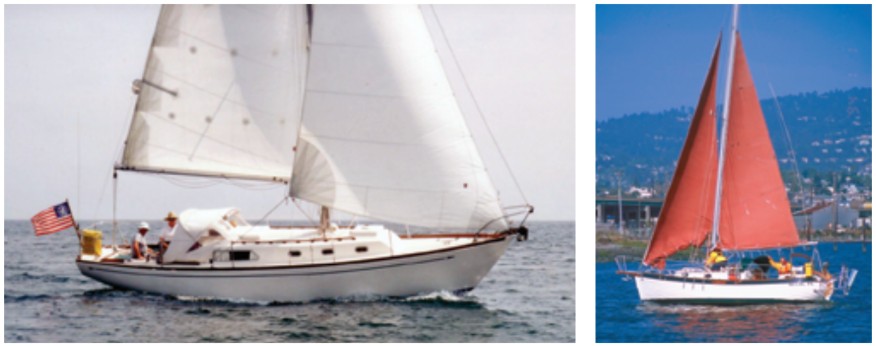
This began to change in 1969 when the International Offshore Rule (IOR) was developed. This rule measured displacement not, as the CCA had, by designer’s certification or, later, by actually weighing the boat, but rather by measurements taken from the hull. Naturally, it did not take designers very many years to figure out how to beat the rule with distorted bulges and even chines in the hull to increase the “displacement factor.” Ends became very pinched to exploit the rule, and the boats came out with V-shaped transoms and diamond-shaped deck plans. The rule eventually produced unseaworthy yachts in the quest for low ratings. This resulted in many boats being abandoned and lost — and 15 sailors died — in the 1979 Fastnet Race when the fleet was hit by an unusual freak storm.
Sensible, seaworthy designs
Even before this tragedy, cruising yachtsmen had grown away from the extreme IOR boats, and many fine, seaworthy fin-keel and full-keel yachts were developed to meet a demand for a sensible and seaworthy auxiliary cruiser with good performance. In any case, I was never keen on the IOR rule and was not interested in producing such freak boats. My own favorite design is a custom one-off cruiser, Black Velvet II. She was a 43-foot fin-hull, skeg-rudder cutter with a 35-foot 4-inch waterline and a D/L ratio of 251 that I designed in 1971. BV II, as I call her, was later put into production in Hong Kong as the Cape North 43, and the latter won a few notable ocean races. Still, the true raison d’être for the design was to provide her Montreal owner with a weatherly yacht to tackle the annoying headwinds of Lake Champlain, while being capable of voyages to Bermuda, the Caribbean, or even transatlantic when time permitted.
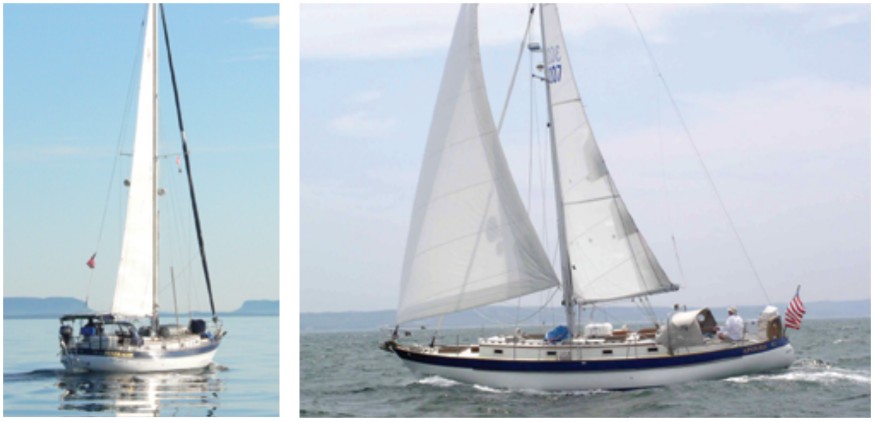
Many other designers also created fine non-IOR cruising yachts, both full-keel and fin-hull but, in 1974, Bob Perry’s Valiant 40 fired the cruising sailor’s imagination. The Valiant is a fin-hull, skeg-rudder cutter, 39 feet 11 inches overall on a 34-foot waterline with a D/L ratio of 256. Its double-ended hull with a full deckline and a Scandinavian-shaped stern was apparently based on the marketing success of the very, very full-keel Westsail 32. Bob felt that a truly well-performing double-ender would attract sailors, and he was right. The Valiant 40 was a great success from the start but, when one sailed by Francis Stokes in the 1980 OSTAR singlehanded transatlantic race won its class and was the first American monohull to finish, the boat became legend.
By this time the serious ocean-racing sailor and the cruising/racing sailor were parting ways. The IOR rule gave way to the International Measurement System (IMS), but it has also created problems. The Royal Ocean Racing Club finally came out with its own rule that was approved for international competition in 2004. Now different areas of the world sail under different rules, and racing appears to be fragmented. I have not followed handicap rule development in the last few years as it simply does not interest me anymore. When racing yachts started to sport advertising slogans and well-paid professional crews, I quit paying ocean racing any attention whatsoever.
Plenty of amateurs
Of course, there have always been, and always will be, thousands of true amateur sailors, who enjoy taking part in club racing and overnight events in boats that are fast cruisers or vintage racers but are not necessarily the ultimate in new rule-beating racing design with the latest equipment. Fortunately for these folks, the popular Performance Handicap Racing Fleet (PHRF) rule allows them to compete fairly with a wide variety of boats.
There are also many sailors who never race and who swear by the steadiness of full-keel designs, such as Bruce Bingham’s little Flicka, Lyle Hess’ Nor’Sea designs, the chunky and able Island Packets, the very husky Hans Christians, and similar craft of even older vintage. However, the mainstream design of cruising yachts has changed significantly over the years, as owners demand more accommodations, greater amenities, and improved performance. Fin hulls with spade or skeg rudders are widely accepted for inshore and bluewater cruising, while the boats have grown in waterline length and beam and, at the same time, lost heaviness. The great majority of designers and builders turn out able, good-performing cruisers, but some contemporary yachts are so beamy and of such light displacement that I would hesitate to take them very far offshore, regardless of their size. That includes some craft as large as 60 feet.
In addition, imports from Europe in the last two decades have given many newer sailors a very different idea of what a boat should look like compared to the yachts of 30 years ago. Today, Euro-design in boats is all the rage, featuring a flat sheer, high freeboard, reverse transom (preferably with sugar scoop), super-wide stern, super-light displacement, and deep, narrow fin. The trunk cabin is streamlined like a Buck Rogers rocketship but, to me, such radical streamlining seems unnecessary on a vehicle that will rarely travel faster than a man can run.
Such boats would have L. Francis Herreshoff rolling in his grave and, frankly, they do nothing for me either. That is to be expected after the years I’ve spent admiring and studying the work of so many of the truly great yacht designers both in North America and Europe. Indeed, I still long for the days of the old CCA rule and the handsome and able yachts that were produced: a little short on accommodations and all modern conveniences, perhaps, but long on beauty and seakindliness.
Fortunately, there are designers alive today — men like Bill Crealock, Mark Ellis, German Frers, Rod Johnstone, Chuck Paine, Bob Perry, and others — who can still draw a sweet sheerline, balanced ends, and a generally handsome, well-performing, cruising-yacht design, no matter whether it is of traditional or contemporary styling or of wood, fiberglass, or metal construction. Fortunately, too, there are still owners who appreciate such fine, well-thought-out, and beautiful yachts and the craftsmen who can build them.
Ted Brewer is a contributing editor with Good Old Boat and one of North America’s best-known yacht designers. He also is the man who designed scores of good old boats . . . the ones still sailing after all these years.
Thank you to Sailrite Enterprises, Inc., for providing free access to back issues of Good Old Boat through intellectual property rights. Sailrite.com