Old-fashioned, cocky, seakindly
Issue 23 : Mar/Apr 2002
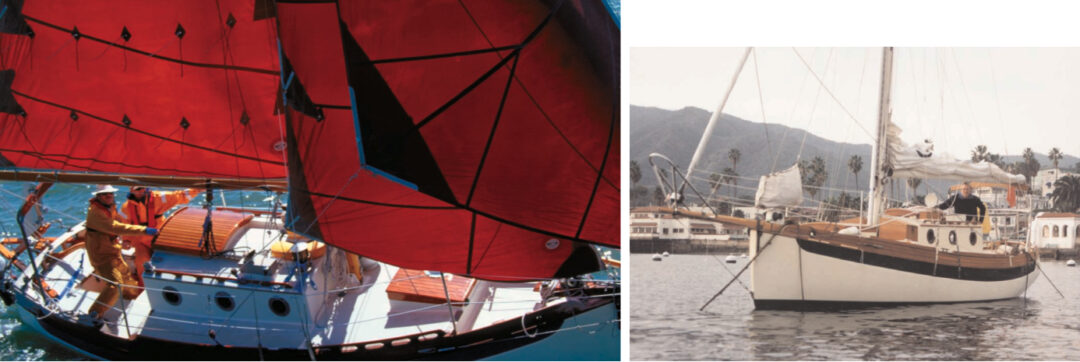
The British coastline is rugged and convoluted around Falmouth, Cornwall. The tides run fast, and the wind blows stormily from the southwest. A boat under sail needs to be strong, buoyant, agile, and weatherly to survive those conditions. Just like the Falmouth Cutter 22, in fact.
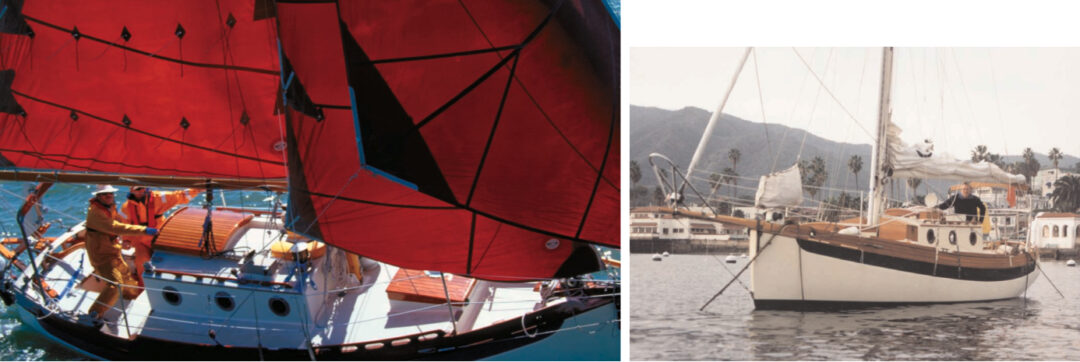
At first glance, you wouldn’t connect Lyle Hess’s feisty little cutter with that coastline. She looks too small, too vulnerable — and perhaps too darned cocky for her own good. But, in fact, in every respect except size, she shares the properties that earned the renowned Falmouth cutters their reputation for safety and seaworthiness.
She’s old-fashioned, deliberately oldfashioned, as if she’s delighting in carrying on an ancient tradition of full keels and simple fittings in an era when fin keels and electronic gimmicks rule the roost.
Lyle Hess designed this cutter with no regard for racing rules or modern fads. His aim was to create a pocket cruiser that could cross oceans, and his foremost concern was safety. You’ll notice her resemblance to her bigger sister, the 28-foot Bristol Channel Cutter. In fact, only minor changes were dictated by her smaller size.
Although it wasn’t a design priority, the Falmouth 22, with her 8-foot beam, turned out to be trailerable. She is not the sort of trailersailer you tow behind the family car and launch into the nearest lake for a Saturday afternoon jaunt, however. In the first place, she weighs 7,400 pounds, and you’ll need at least a Suburban or a full-size pickup with which to tow her. In the second place, it would take you most of the afternoon to get her mast and rigging set up properly.
But the fact that she’s trailerable and fully capable of ocean passages makes her very unusual and quite attractive to gentleman sailors who prefer not to sail to windward. For example, it’s a nice downhill passage from Seattle to the Sea of Cortez, but it’s a dreadful, endless slog against wind and current on the way back. With a Falmouth Cutter you can sail down in comfort and then tow her home against the prevailing wind at 50 miles an hour up Interstate 5.
Her shallow draft of 3 feet 6 inches gives her some wonderful advantages, too. She can sneak into pretty little coves and anchorages in the Florida Keys, or the Bahamas, that are denied to other ocean-going yachts with deep keels.
And there’s another thing about a small boat that is often overlooked. Many people actually feel safer and more confident on a smaller boat because they feel more in control at all times. The sails are smaller and easier to manage. The engine is smaller. You can probably start it by hand. The tiller never becomes unwieldy. You can paint the bottom in a couple of hours with a gallon of antifouling. Everything is more human-sized and manageable. You never have to worry about your refrigeration going wrong because you don’t have room for a freezer in the first place.
Basic design
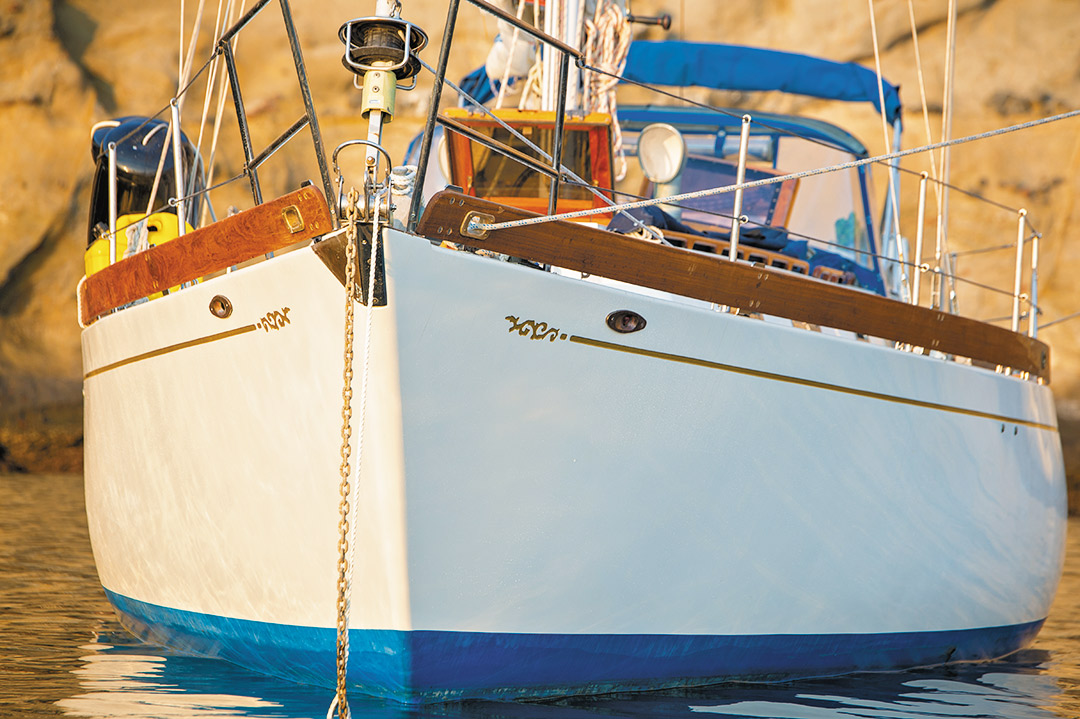
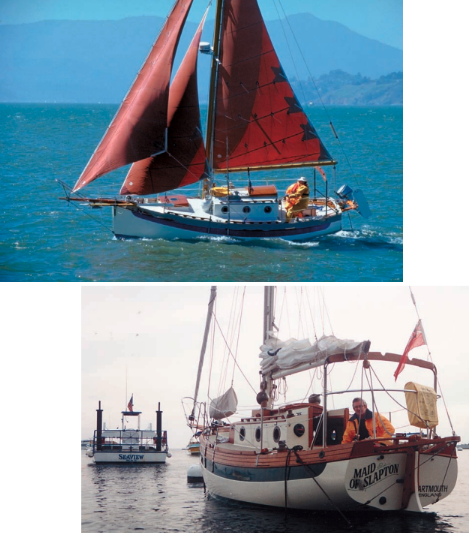
The Falmouth Cutter 22 looks as if she should be built from wood. She has all those things that wooden boats have: bulwarks, a bowsprit, a boomkin, a tiller, a saucy sheerline, an outboard rudder, and a full keel. But she’s made of fiberglass all right, and it’s a solid, hand layup, not cored, so that the finished hull weighs about 1,100 pounds.
The Sam L. Morse Company, which builds the cutter in Costa Mesa, California, says the thickness of the hull varies from 5⁄16 inch at the sheer to 15⁄16 inch near the bottom of the hull. According to the company’s sales brochure, “The actual thickness at the bottom of the keel is greater than 1 inch because we overlap layers at this location.”
The lead ballast, a 2,500-pound block, is pre-cast and then placed inside the hull cavity. It’s fixed in place by poured resin and covered with three layers of glass mat and roving.
Unlike the hull, the 22’s fiberglass deck does have a core. It’s not the usual edge-grain balsa, however, but 1⁄2-inch marine plywood encapsulated in glass mat and 24-ounce roving. This makes a very strong, stiff deck on which you can mount hardware of your own without worrying about compressing the deck when you tighten the fasteners. Extra layers of plywood are used where the mast and mooring bitts penetrate the deck.
The sidedecks are reasonably wide and unobstructed by shrouds, which are taken outboard to their fullest extent for more efficient mast support, and you can do your work at the base of the mast in greater security because of the flat deck space between the coachroof and that cute little scuttle hatch a couple of feet forward of it.
Like her big sister, the Falmouth Cutter 22 has a plumb bow that sweeps around fairly sharply beneath the waterline and then takes an almost straight line aft to the deepest part of the keel under the cockpit. This is not exactly a high-lift airfoil fin, but it’s alleged to be more efficient than it looks. Although it’s long and shallow, Lyle Hess seems to have found a way to make this keel perform to windward. The sales brochure claims it gives the boat “as much or more windward ability and speed as other, now more common, cruising keels with skeg or spade rudders.” In the absence of proof to the contrary, and making due allowance for the breathless prose of the sales staff, we have to give the brochure the benefit of the doubt.
Her outboard rudder is attached directly to the keel and the transom, which lines up with the end of the keel. This is undoubtedly the simplest and strongest way to attach a rudder and, if anything should go wrong, it’s the most accessible for repair.
The self-draining cockpit is small and shippy, safe at sea when you have to leave the boat to look after herself. The tiller sweeps over a good deal of it, but no bluewater sailor is going to complain about that. And in port you can remove the tiller completely and lock it down below for security reasons when you leave the ship. Nothing deters a boat thief more than not being able to steer what he’s stolen.
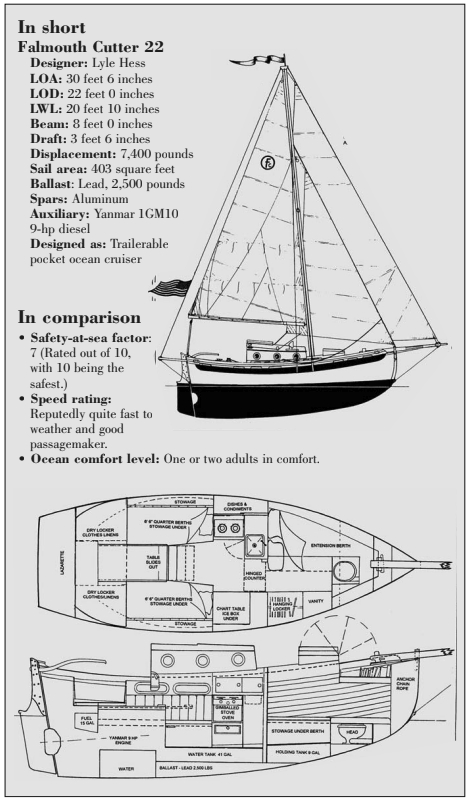
Most people will want the inboard engine with this boat, but depending on the kind of sailing you do most, it might also make a lot of sense to choose the outboard option. The inboard engine sits quite deep in the cutter’s capacious nether regions; so much so that the propeller shaft runs almost horizontally. The standard power plant is the Yanmar 1GM10, a single-cylinder, 9-hp diesel that drives a two-bladed, 14×10-inch prop. The 15-gallon fuel tank is situated under the cockpit, high enough in comparison with the engine to obviate any fuel lift problems. With this amount of fuel and using about half a gallon an hour at full power, she’ll have a range under power of about 180 miles at a little over 6 knots. Throttled back to a gentle cruise, she should do 250 miles or so at 4 1⁄2 to 5 knots in calm weather.
Accommodations
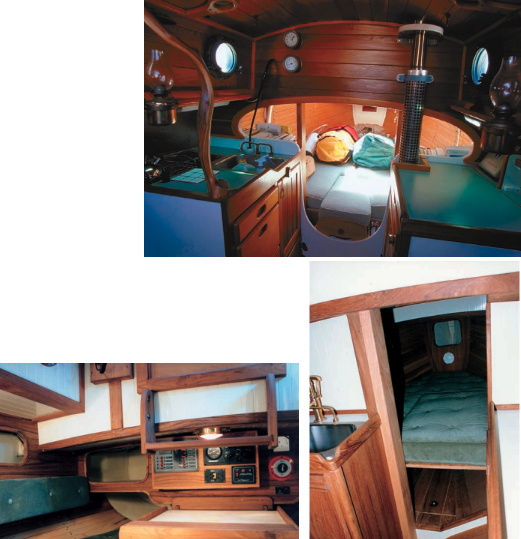
One of the first things you notice about the Falmouth Cutter 22 is that she’s all wood down below. The Morse company does not use plastic hull liners or molds for the furniture. It’s all done by hand from scratch. One big advantage here is that if you have any special requirements for the interior that differ from the standard layout, the company can build it exactly the way you want it, and it may not even cost you any extra.
Practically speaking, the lack of liners means you can get to any part of the hull in a hurry, so when you have to stuff a blanket in a hole in the chine, you won’t have to waste precious time chopping away acres of plastic.
There’s headroom down below for all normal-sized people, at least under the cabintop and for a square foot or two under the hatch in the fo’c’s’le, although you’ll have to duck as you pass from one area to the other.
That forward cabin contains the head, a hanging locker, a vanity dresser, and a double berth to port. Alternatively, according to Roger Olson, former president of the Sam L. Morse Co., you can have a double berth aft that runs athwartships, or even — if you opt for an outboard engine instead of an inboard — an enormous wall-to-wall bunk. Some owners do opt for the outboard version, not necessarily for the pleasures of the oversized bed, but because of the large amount of stowage space it opens up.
Aft of the forward cabin, the galley lies to port, consisting of a large stainless-steel sink and a gimbaled twin-burner cooker with oven, with stowage outboard for dishes, cutlery, and condiments. Propane for the cooker is stored in aluminum tanks concealed in two mahogany deck boxes on either side of the mast. Across the gangway, to starboard, there’s a big icebox with a top cover that doubles as a chart table.
Aft of the cooking/navigation area there are two settees that tuck in under the cockpit seats to become quarter-berths. A table slides out from beneath the cockpit for use in the seating area.
The rig
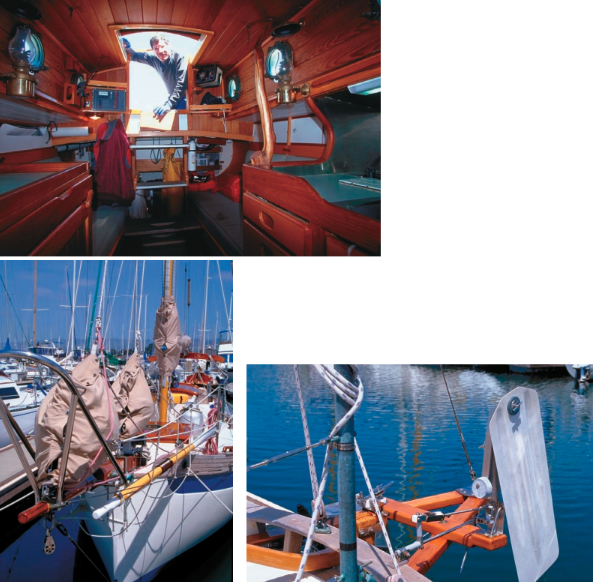
As her name implies, she has a simple, single-spreader, masthead rig of Bermudian mainsail and two headsails, a forestaysail and a jib.
The 107-square-foot Yankee jib is flown from a bowsprit with just the right amount of steeve (the angle of the bowsprit) to create the illusion of a much larger boat, and the 98-square-foot staysail tacks down to the stemhead. The mainsail (171 square feet) is narrower and taller than you might expect on this type of boat, but its increased efficiency obviously contributes to good windward ability.
The boom runs the full length from the mast to the transom, which makes for easy positioning of the mainsheet but tends to complicate the backstay arrangement. As a consequence, the backstay is led clear of the boom and the mainsail leech by a bumpkin that you could almost describe as petite if it weren’t so determinedly rugged (see photo on Page 6).
Performance
When we talk of performance, we really mean two things: speed, especially to windward, and seakindliness. You have to be realistic about the speed of any boat that is less than 21 feet on the waterline and displaces more than 7,400 pounds. Then, having reined in your expectations, you can prepare to be pleasantly surprised. The Falmouth Cutter 22 is not going to sizzle around an Olympic course as would a club racer like a J-22, or even a Santana 22, but she will not disgrace herself in the company of other cruisers.
And when it comes to seakindliness and seaworthiness, she wins hands-down against the racers. She will keep going to weather in seas rough enough to knock the light-weight club racers back to the shelter of the yacht club bar. In the trade winds she’ll have that slow easy motion that makes a heavy displacement vessel so popular for long voyages, and she’ll display her ability to track down the face of large swells without the need for constant sawing at the helm and the constant wearying threat of broaching to.
Known weaknesses
There must be some known weaknesses, apart from the “nuisance” weaknesses such as the bowsprit and bumpkin, but they are nowhere particularly evident.
The cockpit might be a little exposed in rough weather, perhaps, but we can hardly hold that against her. And by the time things are shaping up for a bad storm, you might want to shut yourself down below and let her look after herself, in any case.
Given that a good big boat is safer than a good small boat, the Falmouth Cutter 22’s size is theoretically a weakness. She is so conservatively designed, however, and so ruggedly built, that you eventually are forced to the paradoxical conclusion that she suffers only from the best and strongest kind of weakness.
Owners’ opinions
People who own Falmouth Cutters are unreliable arbiters of her desirability. The kind of sailor who buys this boat is biased from the start, a hopeless romantic who knows from the beginning that only a boat with charm, character, craggy good looks, and the highest standards of seakindliness will satisfy him. Or her, as it happens. Several women have crossed oceans in them.
Mary White, owner of Sapo, sailed singlehanded. After the 31-day crossing from Mexico to the Marquesas, she said she gave thanks to Lyle Hess and the Sam. L. Morse company every day. And when she got farther west she added: “People keep asking to buy my boat, I even have an offer here in Tonga.”
Some restless people truck their Falmouth Cutters all over the place. Gary Felton sailed his boat, Angelsea, directly from San Diego to Cabo San Lucas, Mexico. After seven months in the Sea of Cortez, he borrowed a trailer and took her back to San Diego. Then he trucked her to Fort Lauderdale, Florida, and made a 21-day trip to the Virgin Islands.
Mitch Kilgore ran into heavy weather with his Hopscotch en route to the Bahamas. “As soon as it got dark, the wind freshened to 25 knots, and the seas built to 8 to 10 feet.” The cutter kept beating hard to windward with plenty of spray and great motion, yet Mitch felt quite safe. “Hopscotch was in her element,” he said. “The crossing was somewhat scary for my family, but they got over it fast, being preoccupied with the Bahamas. I bet if more gentlemen owned Sam L. Morse boats, they’d sail to weather more often.”
Conclusion
This is a very modern old-fashioned boat, one that retains the best characteristics of traditional design and blends them with the latest boatbuilding technology. If it’s true that the best things come in small packages, then the Falmouth Cutter 22 proves the rule.
It also proves the rule that small things are not necessarily inexpensive things. The basic price of a new boat from the factory is $116,000 (semi-complete for $83,650 and hull and deck only for $27,200. Ron Walton says the best deals are used boats, of course, and he knows of at least one that has never been launched –Ed.). But, considering what you get for the money, it’s good value. And used boats are a lot cheaper, although you rarely come across one on the open market because they’re snapped up so quickly and quietly. It’s the Falmouth Cutter cult at work, you know. They look after their own.
John is a professional journalist. The author of The Practical Mariner’s Book of Knowledge, The Sailor’s Assistant, and The Seaworthy Offshore Sailboat, he has worked for major newspapers around the world and is a frequent contributor to leading sailing magazines. He has sailed for more than 40 years in boats 11 to 40 feet in length and logged some 15,000 miles of ocean voyaging. In 1987 he and his wife, June, and their 17-year-old-son sailed their 31-foot sloop from South Africa to the U.S. This series of boat reviews is based on articles from John’s book: Twenty Small Sailboats to Take You Anywhere, which is available from The Good Old Bookshelf (see Page 65 for more information).
Thank you to Sailrite Enterprises, Inc., for providing free access to back issues of Good Old Boat through intellectual property rights. Sailrite.com